Majority of journalists in Kenya are under 35 but most of them work as freelancers, MCK survey reveals
Data indicates a clear disparity in contractual security: 75 per cent of journalists employed by media houses operate under written contracts, whereas 80 per cent of freelance journalists work without any formal contractual agreements with media outlets

A survey conducted by the Media Council of Kenya (MCK) shows that 65 per cent of freelancers and 62 per cent of employed professional journalists in Kenya are under the age of 35.
The findings, which are contained in the Assessment of Media Environment in Kenya 2025 report, point to a predominantly young workforce, particularly in freelance roles, adding that the trend may reflect either a preference for flexible work among younger professionals or a lack of sufficient formal employment opportunities in the media sector.
The survey further indicates a clear disparity in contractual security: 75 per cent of journalists employed by
media houses operate under written contracts, whereas 80 per cent of freelance journalists work without any
formal contractual agreements with media outlets. This highlights a significant vulnerability among
freelance journalists, underscoring the need for stronger labour protection and standardised contracting
practices in the media industry.
“The data indicates that 86 per cent of journalists are holding contracts for one year or more. However, a
minority (14 per cent) are on short-term contracts for three to six months, suggesting some instability within
a portion of the workforce. The survey reveals a significant reliance on temporary contracts within the journalism sector, with 71 per cent of contracted journalists lacking permanent employment. This indicates limited job stability for the workforce.
According to the report, the findings indicate that just over half (53 per cent) of the contracted journalists who responded to the survey receive a paid leave allowance, while a significant proportion (47 per cent) do not.
“This suggests a notable disparity in employment benefits among contracted journalists, highlighting potential
inconsistencies in contract terms or enforcement of labor standards across employers.”
Safety of journalists
Also highlighted in the report is the safety of journalists, which remains a critical concern across counties, with both physical threats and systemic challenges posing serious risks to their work.
“The prevalence of incidents such as denial of access, physical attacks, legal intimidation and psychological harassment highlights a hostile environment that undermines press freedom and the ability of journalists to operate safely and independently. Ongoing safety concerns are significantly limiting press freedom, as journalists face various threats and challenges that hinder their ability to report freely and without fear. This situation compromises the ability of the media to function as a watchdog and provide accurate, unbiased information. Most respondents indicated that their media outlets exhibit moderate commitment to journalist safety, suggesting that while some efforts are made, there is room for improvement in ensuring comprehensive protection for journalists on duty,” the report concludes.
Financial constraints are also a substantial challenge for journalists, with over 60 per cent of respondents acknowledging that their ability to adhere to the journalistic code of conduct is compromised to some degree due to limited resources.
“This suggests that financial insecurity within the industry may negatively impact journalistic integrity and ethical practices, as seen in rushed or unethical practices, such as the failure to blur children’s faces on April 10, 2025 and coverage of the Butere Girls Play during the national drama festival by some media stations.”
It adds that the financial instability within media outlets, marked by inconsistent or inadequate payments to
journalists, undermines the industry’s ability to retain skilled professionals and maintain ethical standards. The dependency on advertising revenue further exacerbates these issues, creating a cycle of financial uncertainty that affects both journalists and media organisations.
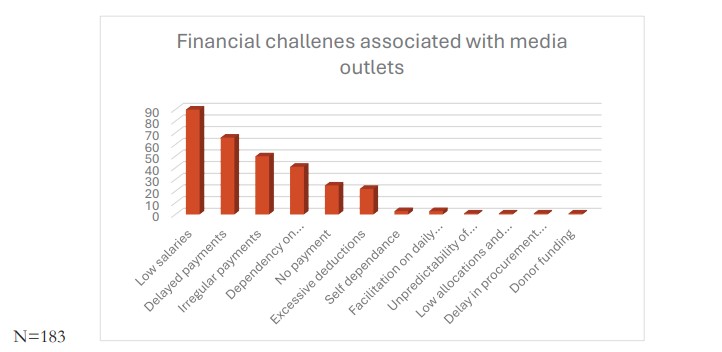
“Media outlets are primarily confronted with challenges related to the payment of journalists. These challenges include low salaries, delayed or irregular payments, non-payment and excessive deductions. Additionally, a heavy reliance on advertising revenues has emerged as a significant challenge, contributing to low income for many media outlets,” the report says.
“These findings reveal interconnected challenges, such as risky employment, financial instability, and safety risks, that erode journalistic professionalism and press freedom, resonating with the World Press Freedom Day 2025 theme on Artificial Intelligence (AI). The prevalence of temporary contracts and inadequate benefits like medical cover drives high turnover, weakening the industry’s capacity to adopt AI tools for enhanced reporting, such as automated fact-checking or data analysis, which could strengthen professional standards,” it adds.
According to the MCK survey, financial limitations, cited by 62 per cent of respondents as impeding ethical compliance, restrict investments in AI training and ethical AI frameworks, increasing the risk of misuse that could worsen ethical breaches.
Safety concerns, including digital threats like phone tapping, highlight the need for AI-powered cybersecurity solutions, but the moderate commitment of media outlets to journalist safety hampers their adoption.
Consequently, it adds, MCK in partnership with the Kenya Editors Guild (KEG), Kenya Union of Journalists (KUJ), and other stakeholders, must leverage these findings to push for policy reforms, mandate AI-focused training, and promote sustainable funding models. By tackling these challenges, the MCK can utilise AI to bolster press freedom, enhance journalist safety and elevate professional standards across Kenya’s 47 counties, fostering a
resilient media landscape in the digital era.
According to the report, out of a sample of 395 journalists, 242 consented and participated in the survey, yielding a response rate of 61 per cent. Among the respondents, 24 per cent were female and 76 per cent were male. In terms of age distribution, 63 per cent were aged 35 years or younger, while 37 per cent were older than 35 years.
Among the journalists who participated in the survey, 23 per cent identified as freelance journalists, while the remaining 77 per cent were employed by various media outlets. Of the freelance journalists, 65 per cent were
under the age of 35, and 35 per cent were over 35 years. Similarly, among those employed by media outlets, 62 per cent were under 35 years of age, while 38 per cent were over 35.
Lack of written agreements
The majority (75 per cent) of journalists working in media houses have written contracts whereas 80 per cent of
journalists lack written agreements with any media outlets.
Journalists with contracts reported varying durations: approximately 45 per cent hold one-year contracts, 41 per cent have contracts extending beyond two years, while short-term contracts of three and six months each account for 7 per cent.
Among journalists with contracts, the majority (71 per cent) are employed on a temporary basis, while only 29 per cent hold permanent positions.
The report also shows that more than half (52 per cent) of journalists do not have medical cover with 48 per cent have medical cover.
“Out of the 152 contracted journalists, 143 responded to the question regarding leave allowance. Of these, 53 per cent reported receiving a paid leave allowance, while the remaining 47 per cent indicated that they did not receive this benefit,” the report says.