How Kenya’s oil imports turned into a political and billion-shilling battle

Details have emerged regarding how top Kenya government officials bulldozed the award of a highly lucrative tender for the importation of oil to a well-connected energy company, locking out key players in the sector.
Former Attorney General Justin Muturi on Wednesday, April 15, 2026 lifted the lid on the scandal, detailing how top government functionality including a Cabinet Secretary and a top presidential advisor approached him for consent over the deal.
According to Muturi, the deal entailed using his office to rubberstamp a deal which ultimately saw a local firm, Gulf Energy, secure the lucrative tender to import oil under the Government-to-Government arrangement.
Muturi recounted how then Energy Cabinet Secretary Davis Chirchir and President William Ruto’s head of the Economic Council David Ndii and his colleague on the council, a Mohammed Hassan approached him with the proposal, which he flatly rejected.
The trio allegedly suggested to Muturi that due to pressure from multinational oil companies which were demanding huge amounts of money for oil importation to the pressure on the Kenya shilling, a new approach, preferably a Government-to-Government one, be considered.
According to the three government functionaries, the three foreign firms identified by the Kenya government under this arrangement would pick a local company to transact the business with.
It is at this point that Muturi questioned why the three foreign firms would not simply deal with the establishment government entities namely the National Oil Corporation (Nock) or the Kenya Pipeline Company (KPC).
“My simply question to them was, why not use the established government agencies, the National Oil Corporation or the Kenya Pipeline Company if it was G-to-G but they insisted that the three foreign firms pick a local company to work with, that is how Gulf Energy came into the picture, a company in which President William Ruto owns majority shares, he became the G in the matter,” said Muturi while addressing a press conference in the wake of the national crisis occasioned by the sharp increase in fuel pump prices blamed on the ongoing war in the Middle East.
On Tuesday, the Energy and Petroleum Regulatory Authority (EPRA) in it monthly pump price adjustments a sharp rise if between Sh40 and Sh28 for diesel and super petrol respectively, effective April 15 2026 to May 14, 2026 before further revising the prices downward by Sh10 for diesel retail at a increased cost of Sh30.

The increase thrust the pump prices for petrol and diesel at about Sh196, while the pump price for kerosene remained unaffected.
The adjustments immediately led to the increase of fares by public transport vehicles across the country, prompting opposition leaders to threaten a countrywide protests if the government did not intervene to cushion Kenyans against the increase in the cost of living as a result.
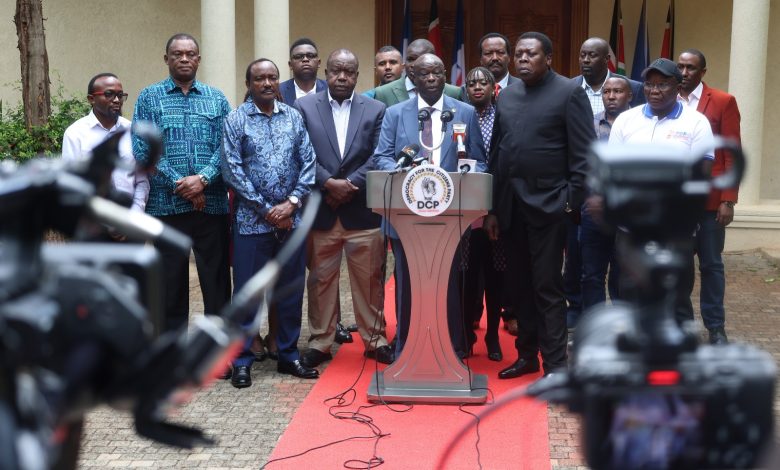
The opposition leaders, led by former Deputy President Rigathi Gachagua pointed fingers at President Ruto as the direct beneficiary of the increased prices, claiming he held stakes in the companies importing the fuel.
The leaders, who included Jubilee party Deputy leader Dr Fred Matiang’i, Wiper leader Kalonzo Musyoka and DAP-Kenya’s Eugene Wamalwa as well as Linda Mwananchi’s James Orengo and Babu Owino also demanded the resignation of Energy Cabinet Secretary Opiyo Wandayi.

But a defiant President Ruto maintained that the government was doing everything possible to cushion the local Mwananchi from the adverse effects of the oil crisis, which he blamed on the crisis in the Middle East.
“My government has set aside Kshs6.5 billion from our reserves to cushion the ordinary Kenyan from these adverse effects, those opposition leaders calling for maandamano, will maandamano bring down the fuel prices,” President Ruto hit out while addressing a series of public meetings in Kisii county.
But with the rise in pump prices threatening to trigger a national crisis, the government on Wednesday released a gazette notice, reducing the Value Added Tax rate from 13% to 8%.
This, in turn, forced EPRA to revise the new pump prices on Wednesday night.
In its statement released late Wednesday, EPRA stated; “Pursuant to Legal Notice No.70 dated 15th April 2026, the Cabinet Secretary for National Treasury has revised the Value Added Tax (VAT) rate from 13% to 8%. Accordingly, we have recalculated the maximum total pump prices that will be in force from the 16th April 2026 to 14th May 2026 taking into account the revised VAT taxes.”
“As a result, the pump price per litre in Nairobi of super petrol and diesel decreases by Sh9.37/litre and Sh10.21/litre respectively while that of kerosene remains unchanged,” the statement further read.
“Consequently, the level of subsidy on kerosene reduces from the current Kshs108.10/litre to Kshs96.56/litre. In Nairobi, super petrol, diesel and kerosene now retail at Ksh197.60, Kshs196.63 and Kshs152.78,” it concluded.
But despite the belated move by the executive, public transport operators appeared reluctant to make any adjustments to the new fares, saying they needed to time to consult on the matter.
Matatu Owners Association (MOA) President Albert Karakacha stated that operators require more time before implementing any fare changes, citing the need for internal consultations before effecting such changes.
The shananigans in the energy sector have now put the taxpayer in a Kshs3.2 billion financial hole resulting from the cancellation of a controversial fuel import deal involving an oil tanker that had already been procured for delivery to the country.
The loss stems from the abrupt reversal of a procurement agreement that had been awarded to a shipping company before the vessel docked at the Port of Mombasa, raising questions over due process and accountability in the energy sector.
A Senate Committee on Energy has since launched investigations into the circumstances surrounding the cancellation, as well as claims of irregular fuel procurement outside the G-to-G framework.
The tanker, reportedly carrying 96 tonnes of fuel, had been scheduled to arrive in Kenya before the deal was called off, triggering a compensation claim against the government by the affected oil importer.
Appearing before the committee, company manager Angeline Maangi revealed that the firm entered into the agreement following instructions from the Ministry of Energy, and is now seeking to recover losses amounting to Sh3.2 billion.
“The damages we incurred are upwards of 25 million dollars, that is Sh3.2 billion, in the form of demurrage, premiums, and other related costs. Our pricing simply reflected the global market at the time, where supply disruptions forced us to compete with Asian buyers at any cost,” Maangi noted.