Goons menace: Is the state complicit or failed in its mandate?

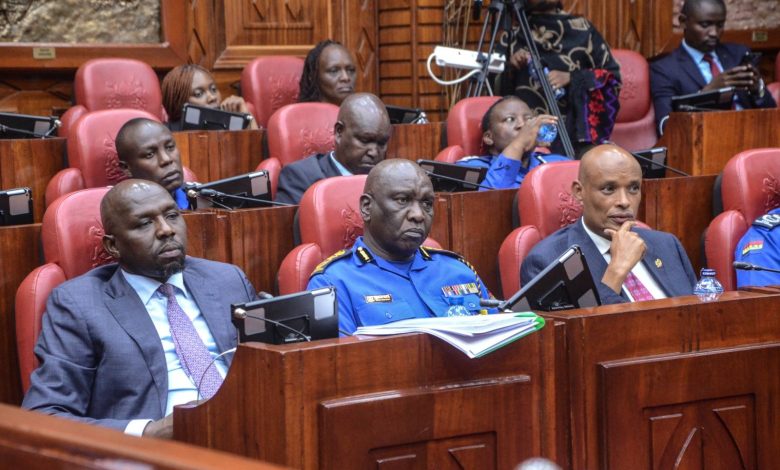
Interior Cabinet Secretary Kipchumba Murkomen has come under the spotlight over failure to act against politically-motivated goons even as the country heads to next year’s General Election, which is expected to be a hotly contested affair raising more questions than answers on whether state operatives and security agencies are complicit of the hooliganism mess in the country or they have flatly failed in their mandate.
Murkomen admitted Kenya is home to 104 active gangs increasingly used as political ‘goon squads” revealing that most are used by governors to execute their agenda while vowing that the government will not allow cities to be turned into gangland hostages.
The latest incident involves violent attack targeting Vihiga Senator Godfrey Osotsi in Kisumu and deployment of gangs to disrupt DCP rally in Kikuyu.
Murkomen said 14 suspects who attack the Senator, who appeared to have been trailed and his real-time location notified to the attackers have since fled the country.
According to Murkomen, the Directorate of Criminal Investigations (DCI) is now working with foreign agencies to trace and arrest them.
Murkomen was responding to Suba South MP Caroli Omondi, who told the National Assembly that while 17 “goons” were said to have attacked the senator, only three had presented themselves to police, and questioned why the rest had not been arrested.
The three have since raised over Sh1million cash bail and secured their freedom further raising question the source of money and whether ordinary rascals would have the financial muscle to immediately bail themselves out.
“We have seen that almost every politician has a form of goons disguised as bouncers escorting them around. In some counties, there are chief officers in charge of goons who accompany governors to functions. They can’t go anywhere without them,” he told the National Assembly’s Departmental Committee on Administration and Internal Security.
“To some leaders, their own claim to leadership in making it impossible for opponents to operate,” Murkomen added.
The hooliganis menace, some operating with precision and extraordinary capacity characterised by common rascal and outlaws traits, has raised fears the groups could be enjoying backing of government and political elements.
“Unemployment fuels goonism, and it is disheartening to see politicians exploit it CS Murkomen must build a watertight case and deal with the goons swiftly. Investigations should be thorough, and they must be brought to book once and for all,” Nairobi Woman Rep Esther Passaris told a local TV station.
Political leaders, church leaders and the civil society have pointed an accusing finger to government functionaries.
“Murkomen understands what is happening. They are shielding these goons,” Vocal Africa Director Hussein Khalid told Spice FM on Thursday, April 23, 2026.
Separately, the CS linked local political rivalries to the coordination and execution of the attack by goons on former Deputy President Rigathi Gachagua at Witima ACK St. Peters Church in Nyeri.
On the events of January 25, 2026, the CS, who appeared before the Senate plenary on Wednesday, April 21, 2026 stated that unknown individuals lobbed teargas canisters into the church during a service attended by the former Deputy President and his entourage, disrupting the proceedings.
He was responding to a question by Kisumu Senator Prof. Tom Ojienda regarding the circumstances surrounding the attack.
The inquiry sought clarification on the deployment of police officers to the church, the identities of those who authorized and commanded the operation, and the measures being taken to ensure that police conduct aligns with constitutional provisions and the standards of the National Police Service.
Responding to the matter, Murkomen informed the Senate that investigations into the incident remain active, with the Inspector General of the National Police Service (NPS) Douglas Kanja having directed the Internal Affairs Unit to take over the case in order to ensure an independent and impartial inquiry, particularly in light of allegations suggesting possible involvement of police officers.
He told the House that a preliminary report has since been submitted, while investigations continue.
Murkomen noted that preliminary findings indicate that the church leadership did not provide prior notification of the visit to the police or other government authorities, and that the Officer Commanding Police Station (OCS), Witima, was not aware that a high-profile guest would be in attendance.
He further explained that no formal request for police security had been made in respect of the service, and therefore no sanctioned deployment had been arranged in advance.
The CS added that police officers who responded to the incident did so after it had already been reported, in line with their statutory duty to maintain law and order, but encountered resistance from members of the public who blocked their access and accused them of complicity.
On the legal framework governing police deployment, the CS explained that the Public Order Act requires any person or organisation intending to convene a public meeting or event that may require security arrangements to notify the nearest police station at least three days, and not more than fourteen days, prior to the event.
Murkomen told the Senate that, notwithstanding the requirement for prior notification, police commanders have been directed to enhance situational awareness within their jurisdictions by proactively monitoring social and religious gatherings, including those that may not ordinarily trigger formal notification requirements.
The CS stated that the directive is intended to enable timely risk assessments and the implementation of appropriate preventive security measures, particularly where high-profile individuals may be present.