Press Freedom under siege as journalists silenced globally

By Patrick Wachira
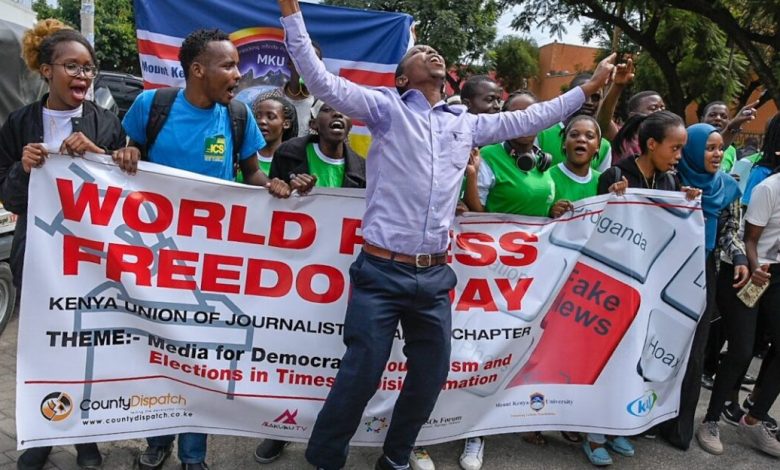
The World Press Freedom Day was marked today, on May 3 against the backdrop of an inhospitable media environment globally, with the Committee to Protect Journalists (CPJ) reporting a surge in fatalities.
According to the global body, for the fifth consecutive year, more than 300 journalists were imprisoned worldwide by the end of 2025.
The emerging picture is grim indeed.
Granted, most of the reported fatalities (47 as at the end of 2025) occurred in the Israeli Gaza conflict.
But 330 scribes behind bars globally, mostly on anti-state charges, including terrorism and foreign funding claims, is unfathomable. The gravity of the situation is understated.
The deadliest and most deliberate effort to kill and silence reporters was by Israel, the report says.
In Africa, journalists face an increased risk of digital surveillance, which hampers their work. Notably, crackdowns are major threats in Kenya and Nigeria.
Women journalists, in spite of traditional hurdles, face online smear campaigns and harassment designed to drive them from public discourse, much to the disadvantage of the societies in which they operate.
These rather grave statistics paint a sorry picture of the situation, yet what is mentioned here does not even scratch the surface of what media corps go through daily.
That governments are increasingly using advanced techniques and equipment to spy on journalists is another area of concern that threatens the independence and latitude of journalism work.
Thousands of scribes have found themselves in the streets, retrenched and becoming jobseekers overnight. Some media houses exacerbate the situation by not paying them gratuity or terminal benefits.
For those in employment in many parts of Africa, underpayment is still a thorny issue, as labour laws are flouted with impunity, to the detriment of those caught in the cross-hairs.
Of course, there exists the perpetual threat of politicians and governments targeting journalists for informal working arrangements which eventually embed the latter to a level objectivity suffers.
Indeed, in such scenarios, the line between truth and propaganda gets slippery indeed, which further erodes the independence of journalists.
Poor pay also poses an existential threat to journalists in many parts of Africa and Latin America, creating a gap that unscrupulous individuals use to mask corruption, the very evil that journalists aspire to fight.
In Kenya, journalists face the increasingly slippery terrain of being targeted by politicians unhappy with the coming out of the truth under the mighty pen.
As witnessed last year during street protests, accredited media personnel found themselves the target of physical violence, with police tear-gassing them for no reason other than practising the very craft they are trained for. Incidents occurred in Nakuru, Nairobi and Homa Bay.
Threats are frequently used to ensure stories that paint the powers that be in less than flattering light are either played down or do not see the light of day. The truth is the ultimate casualty as graft continues to fester unabated.
At times, the physical assault of scribes is aimed at ensuring excesses and lack of accountability by the political class are not investigated and documented. Again, the truth gets a mighty kick, mostly fatal.
When governments unleash an atmosphere of fear and apprehension against journalists and eventually the populace, stability, trade, commerce, productivity and economic progress are the eventual casualties.
When the truth suffers, the very life blood of the citizenry is also gravely affected, with livelihoods endangered and posterity facing the risk of a future that is stillborn.
This is unacceptable and untenable.
Journalists must be allowed access to information without let or hindrance, under the fundamental premise that they not only mirror society but also ask probing questions on behalf of the people.
That sacrosanct premise must not be sacrificed at the altar of political expediency, as politicians come and go but society remains.
Above all, journalists hold the mirror to society, and the hand that holds the mirror should not shake, or the image gets blurred beyond recognition.
That is as it should be.
Mr. Patrick Wachira is a seasoned media professional and respected commentator on current affairs.