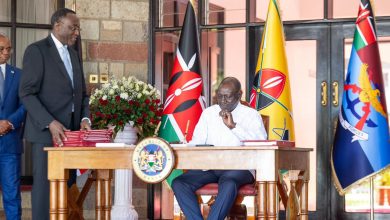
Return to the old order? Chiefs to get police officers as new unit set to be launched
New unit, known as NGAPU, will operate like the old Administration Police, helping chiefs when they are conducting raids to eliminate illicit brews and other operations.


The ministry of Interior will this unveil a new special police unit tasked with supporting National Government Administration Officers (NGAOs) in enforcing the law across the country.
The move, albeit in changed constitutional and political circumstances, will see the country revert to a system almost similar to the one that obtained before the coming into force of the 2010 Constitution when the now defunct provincial administration had control over the Administration Police officers.
Sources at Harambee House told The Informer that the mandate of the new unit, which will be known as the National Government Administration Police Unit (NGAPU), is to provide security and support NGAOs in the wake of the threats they have been encountering in the course of their work with some getting killed or their property destroyed.
“It will basically operate like the old Administration Police, helping chiefs when they are conducting raids to eliminate illicit brews, for instance, and other operations. This is because as we speak, they are exposed and some have even been killed, maimed or have lost their property,” a source familiar with the thinking behind the formation of the new unit said.
It is set to be unveiled in Kwale this morning by Interior Cabinet Secretary Kipchumba Murkomen. This comes almost a year after his predecessor, Kithure Kindiki, now Deputy President, proposed that the Administration Police Service (APS) should return to its old role of supporting then then Provincial Administration.
He pointed out heightened security threats and sluggish responses to criminal activities after the merger of AP and the Kenya Police into one National Police Service.
In the last four years, several chiefs, their assistants and police reservists, who usually accompany them, have been killed in areas such as Laikipia, Baringo, Samburu, Marsabit, and Turkana by bandits.
Some have seen their family members and property, such as cattle, targeted in revenge attacks.
In the latest incident, irate residents razed down an assistant chief’s houses on fire following the killing of two people suspected to be cattle rustlers, but whom the local say were genuine livestock traders.
However, even as the government moves to unveil the new unit, it is likely to face resistance from within the ranks as many officers, especially those from the APS, who might see it as returning them to the old order where they were at the beck and call of provincial administrators.
In the immediate aftermath of the promulgation of the 2010 Constitution, many AP officers who were still stationed at chiefs’ camps and divisional (now sub-county) headquarters, openly refused to to take instructions from their hitherto superiors as they celebrated their new-found independence.
Many NGAOs still complain they face difficulties working with the police , especially in enforcing security directives with their collaboration often entirely depending on the relationship an administrator has with the respective police bosses in their areas of operation.
This is despite the merger of the APS and the Kenya Police Service officers into General Duty Officers under the Command of the Inspector General of Police about five years ago, which saw 23,000 chiefs’ camps converted into modern police posts after the APs were ordered to vacate.
At the same time, human rights activists are also likely to be alarmed given the history of the Administration Police (in the pre-2010 era) when it was used, alongside the now defunct provincial administration, to suppress those opposed to government policies and programmes.
In the old days, the provincial administration, now remodelled as NGAOs, served as the “eyes and ears” of the president on the ground.
In doing so, they operated under an upward accountability mechanism that saw them implement orders coming from Nairobi without question even when they were detrimental to public interest, according to experts, thus personifying repression, dictatorship, impunity and authoritarianism.
While the 2010 Constitution upended how both the police and the executive operate and granted extensive rights to citizens, there have been cases where the security agencies have been used to suppress their expression, including in previous election cycles and recently, the Gen Z revolt.
However, Javas Bigambo, a lawyer and governance expert, says the launch of the new unit is welcome given the security challenges the country has been facing.
“If you look at the security challenges the country is facing, you must appreciate that the government needs to expend all resources to tackle them. I think it is a good thing, because if you go to Europe or the US, if something happens in a county, it takes the shortest time to investigate and take action,” said Bigambo.
“But here, something happens and it takes too long to respond or investigate and many of them remain unresolved. So, if NGAPU will enhance the security of every citizen, make everyone down to the village level feel safer, then I think it is a good idea,” he added.
On whether, there is a possibility of the new police unit being used to execute political missions, Bigambo said that since security is a function of the executive – the president chairs the National Security Council – there is nothing like absolute independence, adding that what is important is to ensure that the officers are well resourced with vehicles and other equipment to undertake their duties.