ODM implodes as Sifuna fights ouster, Ruto’s shadow looms large

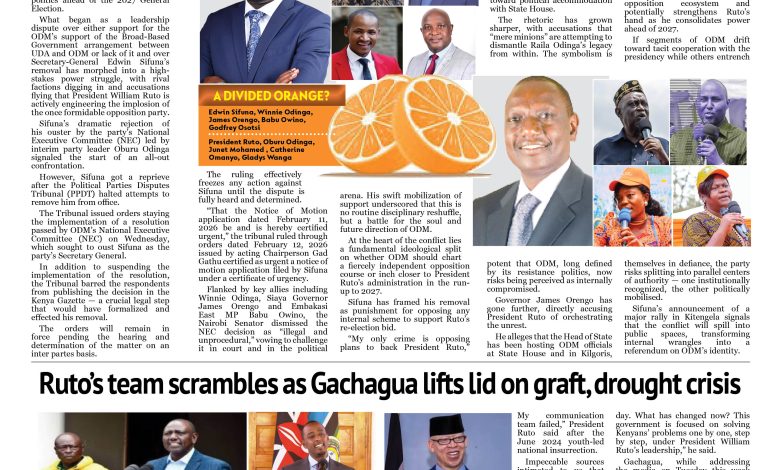
The simmering wrangles within the Orange Democratic Movement (ODM) have now exploded into an open political war, exposing deep fractures that could redefine Kenya’s opposition politics ahead of the 2027 General Election.
What began as a leadership dispute over either support for the ODM’s support of the Broad-Based Government arrangement between UDA and ODM or lack of it and over Secretary-General Edwin Sifuna’s removal has morphed into a high-stakes power struggle, with rival factions digging in and accusations flying that President William Ruto is actively engineering the implosion of the once formidable opposition party.
Sifuna’s dramatic rejection of his ouster by the party’s National Executive Committee (NEC) led by interim party leader Oburu Odinga signaled the start of an all-out confrontation.
However, Sifuna got a reprieve after the Political Parties Disputes Tribunal (PPDT) halted attempts to remove him from office.
The Tribunal issued orders staying the implementation of a resolution passed by ODM’s National Executive Committee (NEC) on Wednesday, which sought to oust Sifuna as the party’s Secretary General.
In addition to suspending the implementation of the resolution, the Tribunal barred the respondents from publishing the decision in the Kenya Gazette — a crucial legal step that would have formalized and effected his removal.
The orders will remain in force pending the hearing and determination of the matter on an inter partes basis.
The ruling effectively freezes any action against Sifuna until the dispute is fully heard and determined.
“That the Notice of Motion application dated February 11, 2026 be and is hereby certified urgent,” the tribunal ruled through orders dated February 12, 2026 issued by acting Chairperson Gad Gathu certified as urgent a notice of motion application filed by Sifuna under a certificate of urgency.
Flanked by key allies including Winnie Odinga, Siaya Governor James Orengo and Embakasi East MP Babu Owino, the Nairobi Senator dismissed the NEC decision as “illegal and unprocedural,” vowing to challenge it in court and in the political arena. His swift mobilization of support underscored that this is no routine disciplinary reshuffle, but a battle for the soul and future direction of ODM.
At the heart of the conflict lies a fundamental ideological split on whether ODM should chart a fiercely independent opposition course or inch closer to President Ruto’s administration in the run-up to 2027.
Sifuna has framed his removal as punishment for opposing any internal scheme to support Ruto’s re-election bid.
“My only crime is opposing plans to back President Ruto,” he declared, a statement that has galvanized a section of the party’s base wary of perceived rapprochement with the ruling Kenya Kwanza coalition.
Deputy Party Leader Godfrey Osotsi and Babu Owino amplified claims that an Oburu Odinga-led faction is steering the party toward political accommodation with State House.
The rhetoric has grown sharper, with accusations that “mere minions” are attempting to dismantle Raila Odinga’s legacy from within. The symbolism is potent that ODM, long defined by its resistance politics, now risks being perceived as internally compromised.
Governor James Orengo has gone further, directly accusing President Ruto of orchestrating the unrest.
He alleges that the Head of State has been hosting ODM officials at State House and in Kilgoris, effectively “taking possession” of the party following Raila Odinga’s death in October 2025.
Orengo’s explosive claim that Raila’s death remains “a mystery” adds an emotional and conspiratorial layer to an already volatile contest, energizing hardline loyalists while deepening mistrust between factions.
The NEC, however, insists its decision was rooted in concerns over discipline and leadership conduct, appointing Deputy Secretary-General Catherine Omanyo as acting SG pending the election of a substantive office holder.
Pundits hold that a fractured ODM weakens the broader opposition ecosystem and potentially strengthens Ruto’s hand as he consolidates power ahead of 2027.
If segments of ODM drift toward tacit cooperation with the presidency while others entrench themselves in defiance, the party risks splitting into parallel centers of authority — one institutionally recognized, the other politically mobilised.
Sifuna’s announcement of a major rally in Kitengela signals that the conflict will spill into public spaces, transforming internal wrangles into a referendum on ODM’s identity.