Man moves to court seeking removal of ‘satanic’ carvings from the National Assembly
He claims the display of symbols that suggest idolatry or occult practices infringes on the religious freedoms guaranteed under Article 32

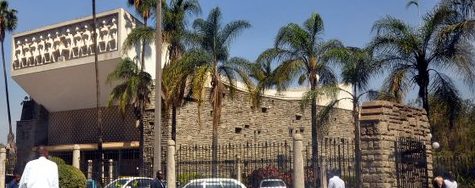
A man has filed a petition in the High Court to challenge the presence of symbolic carvings located at the entrance of the National Assembly and on the Speaker’s seats, saying they allegedly violate principles of religious freedom, national values, and cultural heritage as enshrined in Articles 10, 11, and 32 of the Constitution.
In his petition filed at the Milimani High Court’s Constitutional and Human Rights Division, John Mweha Kariuki, a resident of Ndenderu Ward, Kiambaa Constituency, avers that the symbols are perceived by many Kenyans as
promoting idolatrous or occult beliefs, which contradict the constitutional principle of religious pluralism and public trust.
“The display of symbols that suggest idolatry or occult practices infringes on the religious freedoms guaranteed under Article 32. Members of parliament, visitors, staff, and members of the public who adhere to different faiths are compelled to interact with these symbols, which may be offensive to their religious convictions, especially among Christian, Muslim, and other religious communities in Kenya,” Kariuki says.
He has sued the speakers of the National Assembly and Senate, the Parliamentary Service Commission and the Attorney General.
Kariuki adds that as upheld by a significant portion of the Kenyan population, the Christian faith explicitly prohibits idol worship as outlined in Exodus 20:3-5, which states, “You shall have no other gods before me” and forbids the creation of graven images for worship.
“These carvings, interpreted by many as forms of idolatry, directly contradict these biblical teachings, making their removal necessary to respect the convictions of a large portion of the Kenyan population. The carvings, being perceived as representations of idols or false gods, contravene the Preamble of the Constitution of Kenya, which affirms the supremacy of the Almighty God. Their presence undermines the foundational recognition of God’s sovereignty as a guiding principle for the nation, as outlined in the Constitution’s Preamble,” the petition says.
Kariuki adds that Kenya’s cultural heritage is deeply rooted in religious and moral integrity and that the carvings appear inconsistent with Kenya’s cultural values, which do not promote occult or idolatrous symbols.
He claims that the presence of these symbols within Parliament, Kenya’s highest legislative institution, has led to widespread public suspicion, creating an environment of mistrust.
“This perception has the potential to erode public confidence in Parliament and may be seen as a sign of moral and spiritual degradation in governance.”
Kariuki adds that the installation of the carvings occurred without adequate public consultation, as mandated by
Article 10(2)(a), which requires public participation in governance.
“The public was not engaged in discussions regarding the symbolic meaning of the carvings, violating the people’s right to be involved in decisions that affect their cultural and religious environment,” he says.
Also, the petitioner says that the display of the carvings at the National Assembly and the Senate allegedly violates Section 181 of the Penal Code, which prohibits obscene exhibitions in public spaces.
“These carvings are perceived as offensive by the public, as they are seen to promote ideas that are contrary to established moral and cultural values. As such, their continued display necessitates removal to uphold public decency and protect societal standards of morality.”
He wants the court to issue an interim order for the immediate removal of the carvings from the entrance of the
National Assembly and the Speaker’s seats, pending the hearing and determination of this petition.
Kariuki is also seeking a declaration that the carvings at the entrance of the National Assembly and on the
Speaker’s seats violate Articles 10, 11, and 32 of the Constitution of Kenya, 2010.
Further, he wants the court to issue orders compelling the Parliamentary Service Commission to provide an explanation regarding the installation and symbolic meaning of the carvings; directing the immediate removal of the carvings from the National Assembly and the Senate as well as an order compelling the Parliamentary Service Commission to ensure that the present and the future designs in and within the Parliament resonates with the national values and Kenya’s cultural heritage.
He is also seeking an order directing the Attorney General to undertake a review of all symbols displayed in
public institutions to ensure compliance with constitutional values.
Kariuki had last year also petitioned National Assembly Speaker Moses Wetang’ula, who chairs the PSC, to have the carvings removed.