Long list of unsolved murders in Kenya’s history
One thing remains common in all the high-profile murders: many questions remain unanswered, with the reasons behind the killings remaining a mystery

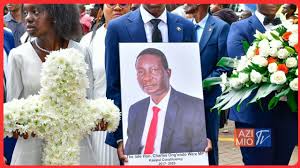
The assassination of Kasipul Member of Parliament Charles Ong’ondo Were joined a long list of mysterious high profile murder cases that started long ago in the 1960s.
For decades, Kenyans have been left to speculate why some prominent people were killed or who wanted them dead, and why some of whom were prominent people in the society.
Ideally, the National Police Service (NPS) has several arms meant to investigate such deaths and bring the killers to book.
They include the Crime Research and Intelligence Bureau, Homicide Investigations and the National Forensic Laboratory, which are all based at Directorate of Criminal Investigations (DCI) headquarters at Mazingira House.
However, over the years, they have either appeared to be unable or unwilling to do just that in some of these cases while in some cases, some people appear framed to carry other people’s burden.
In some cases, investigations are still underway even though the murders happened years ago.
In Were’s case, the DCI has moved with unusual efficiency arresting more than 10 suspects, including Homa Bay politician and businessman Philip Aroko and the late MP’s driver and bodyguard.
Others are the suspects who allegedly trailed him from Parliament to the City Mortuary roundabout where one of them who alighted from a motor cycle, pulled the trigger and shot the MP five times. However, they are yet to uncover the motive or whether there was a mastermind behind the murder as some claim.
Also recovered was the suspected murder weapon and money believed to have been paid to the killers for the hit job.
According to the police, Aroko was the one who planned and financed the murder and was in communication with the suspects as were the MP’s driver and bodyguard.
However, politicians, including ODM Leader Raila Odinga, are demanding that the police do more to bring the chief architect of the killing to book.
“We have to have an end to this kind of act. The people who killed Ong’ondo are known and should be brought to book immediately. We know this is a political assassination which has been ignored in this region. We’ve seen people who have been assassinated. We knew Tom Mboya was assassinated. He was shot by Nahashon Njenga. But Njenga asked “what about the big man?” He was never arrested. There is Odhiambo Mbai, who was shot in cold blood in front of his family, and nothing happened,” Raila said during Were’s burial on Friday.
Were knew he was a marked man and was even using his son’s car to avoid being trailed by his killers, who, on the contrary, appeared to have been one step ahead of him.
A few days before his death, the Kasipul lawmaker had shared with the police and the public that his life was in danger.
He accused outsiders of fueling violence in Kasipul and said that even funerals were no longer safe for him to attend.
The MP’s fear of violence seemed rooted in escalating political tension within his constituency.
While he continued to serve his people, there had been claims linking him to incidents of violence in the area.
Cases of assaults, disappearances, and deaths had been reported over the years, and some residents had previously accused him of fueling political unrest.
Among other high-profile killings that remain unsolved are those of Foreign Affairs minister Robert Ouko, Nyandarua North MP J.M. Kariuki, Kisumu Town MP Robert Ouko, Kilome MP Tony Ndilinge, Makueni Senator Mutula Kilonzo, businessman Jacob Juma, university lecturer Chrispine Mbai, IEBC ICT Manager Chris Msando, Bishop Alexander Mugo, and Catholic priest Fr Anthony Kaiser, among others.
One chilling reminder of past killings is that Nairobi Hospital Finance Director 40-year-old Eric Onchari Maigo, who was found dead with 25 knife stabs.
His body was discovered at his home in Woodley Estate of Nairobi, with the main suspect, Anne Adhiambo Ouma Alias Nut, who was a minor, being arrested days later.
It emerged that Adhiambo had previously been committed to Dagoretti Girls Rehabilitation School in 2017 after being convicted for the offence of stealing.
Though she was presented before Justice Diana Kavedza where she initially pleaded guilty before changing her plea, there is no record of how her case progressed and whether the DCI closed the file or sought to know whether she acted alone especially in light of the wrangles that continue to grip the management of the premier facility.
37-year-old Pio Gama Pinto was the first Member of Parliament to be assassinated in 1965.
He was shot while driving out of his home in Parklands on February 24 in the company of his daughter.
The late legislator, who was a lawyer, gained prominence when he rendered legal representation to the Kapenguria Six during their detention.
He was also actively involved in the sourcing of weapons for the Mau Mau.
The man accused of killing Pinto, Kisilu Mutua, died in prison after 36 years, though he maintained that he did not kill him.
Mboya, the Economic Planning and Development minister was shot dead by Nahashon Njenga, while leaving a Chemist a long now Moi Avenue (Government Road) on July 5, 1969.
At the time of his killing, he was the MP for Nairobi Central (now Starehe).
The assassin was hanged in November 1969 after he was sentenced to death.
In January 2008, Embakasi East MP Mugabe Were was shot outside his home at Woodley Estate.
Three suspects, James Omondi alias Castro, Wycliffe Simiyu alias Zimbo, and Paul Otieno alias Baba, were sentenced to death seven years later in 2015.
George Muchai, who was serving as the Member of Parliament for Kabete, was fatally injured along Kenyatta Avenue as his car was approaching the roundabout while slowing down.
His driver and two of his bodyguards also died in the shooting.
Ten years later, those involved in the heinous act have not been jailed as the case is still ongoing.
The prosecution’s witness recently told the court that the main suspect in the killing of the four rammed into the car carrying Muchai before he stepped out and shot all four occupants.
Currently, seven suspects are being robbery with violence and murder over the same.
Almost 15 years after being found dead along Waiyaki Way, the killers of Mercy Keino have never been charged.
The then University Student had attended a party in Kiambu with a high-profile politician before being found dead later.
In 20016, Jacob Juma, who had several fraud cases against him in court and had rubbed shoulders with several high-level politicians in the country, was sprayed with bullets along Ngong Road.
Before changing and becoming a crusader against corruption, Juma was in a spot for various failed projects he had secured contracts to work for the government.
Meshack Yebei, a witness in the 2007/08 post-election violence at the International Criminal Court (ICC) cases, was found missing from his Eldoret home in 2014 before his body parts being found later at Tsavo National Park.
His death remains unresolved to date.
The most recent cases are the nearly 100 victims of femicide recorded last year. In response, the government established a taskforce chaired by for Deputy Chief Justice Nancy Barasa to find solutions. The culprits, however, remain at large.
One thing remains common in all the high-profile murders: many questions remain unanswered, with the reasons behind the killings remaining a mystery.