Infotrak poll: A united opposition can beat Ruto with a landslide

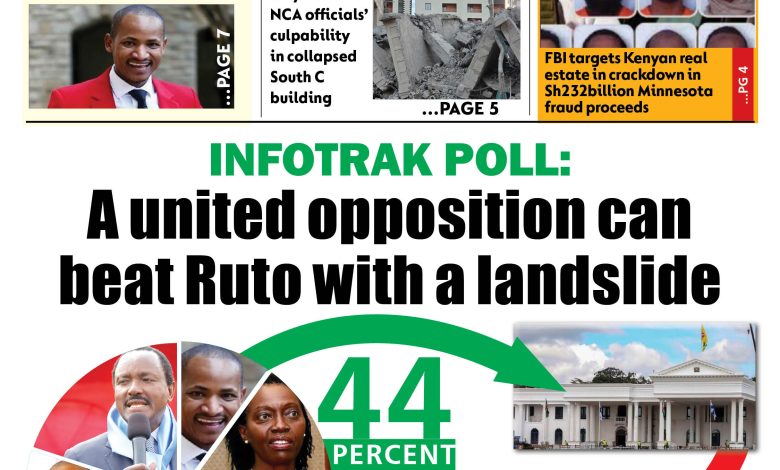
The end-year polls released by Infotrak Research on December 28, 2025, present a snapshot of the political reality in Kenya as the country gears up for the 2027 general elections.
According to the poll, while President William Ruto commands 28 per cent of the presidential vote if elections were held today, a combined opposition coalition could beat him by securing 44 per cent of the vote.
This disparity underscores the growing influence of the opposition as Kenya approaches the next presidential election, but also highlights the uncertainty surrounding political re-alignments, with a significant proportion of 31 per cent of Kenyans still undecided.
With the proposed united opposition yet to settle on a torchbearer and 31 per cent of voters still undecided, Ruto’s defeat in 2027 is not just possible, it could be overwhelming.
While President Ruto’s support stands at 28 per cent, a solid but not dominant figure, Fred Matiang’i from Jubilee party comes in second at 13 per cent. Other potential opposition candidates like Kalonzo Musyoka (12 per cent), Babu Owino (7 per cent), Rigathi Gachagua (5 per cent), and Martha Karua (2 per cent) follow, while former Chief Justice David Maraga also garners two percent.
The most striking element of these numbers is the 31 per cent of Kenyans who remain undecided, a considerable pool of voters that will likely determine the outcome of the 2027 elections.
The poll also revealed a significant level of voter indecision. About 25 per cent of respondents said they were undecided, while 4 per cent preferred not to disclose their preferred candidate.
The survey was conducted on December 19 and 20, 2025, across all 47 counties, using a nationally representative sample of 1,000 adult Kenyans aged 18 years and above.
Data collection employed Computer Assisted Telephone Interviews (CATI), with a 99 per cent response rate.
The combined support of the opposition is significant, at 44 per cent, which would outstrip Ruto’s 28 percent if elections were held today. However, these numbers could be misleading in their current form.
The Infotrak opinion poll also reveals one major reality, the opposition must unite or perish together.
The poll shows a deeply fragmented opposition field with multiple figures vying for leadership, including Matiang’i, Kalonzo, Babu, Karua, Maraga among others.
This scenario raises critical questions about the opposition’s ability to coalesce into a unified front before the 2027 elections.
However, political pundits content that with President Ruto being a master of the political chess-game, he will seek to disintegrate the opposition or risk having them send him back home to Sugoi as the first one-term president since the introduction of multi-party democracy in the country.
That is the one-million dollars question the proposed United Opposition should continue asking themselves as they prepare to name their torchbearer.
The poll also reveals interesting regional divides in support. It shows Ruto’s Kenya Kwanza alliance has strong support in the Rift Valley, Mount Kenya, and parts of the North Eastern region.
While the reality is that Ruto is still strong in Rift Valley and North Eastern, the scenario in Mt Kenya has diametrically changed.
Ruto’s support in Mt Kenya has been drastically eroded since the impeachment of his then deputy Rigathi Gachagua who is currently the undisputed kingpin of Central Kenya.
On the other hand the Infotrak poll shows that the opposition coalition appears to command significant backing in the Nyanza, Western, and Eastern regions.
While it is true that the opposition is strong in Eastern and Western, that cannot be said of Lions Nyanza that its leaders are divided between supporting Ruto’s re-election in 2027 and supporting the opposition.
Notably, the newly formed Kenya Moja Alliance, led by figures like Babu, Edwin Sifuna, and Gathoni Wamuchomba, has managed to attract 17 percent of voter support, indicating that a new, dynamic opposition formation could pose a serious challenge to Ruto’s dominance.
The poll highlights a drop in the percentage of undecided voters from 43 percent to 31 percent, reflecting some degree of political clarity among the electorate.
However, the 31 per cent undecided figure, coupled with the four percent of voters who declined to disclose their preferences, suggests a high level of volatility in the electorate.
The regions most affected by this uncertainty are Mount Kenya (36 per cent undecided) and Western Kenya (35 percent undecided), regions that have historically been decisive in past presidential elections.
The poll also provides insights into the internal dynamics of the opposition, particularly the Orange Democratic Movement (ODM).
A significant portion of respondents (33 percent) expressed support for Babu as the next political leader of the Luo community, a position traditionally held by the late Raila Odinga.
This shift indicates a possible change in the political arena, with Babu emerging as a popular figure among the youth and an alternative to the old guard. His leadership could galvanise opposition support in Luo Nyanza and other regions, positioning him as a key player in the 2027 race.
Kenya’s political history is marked by intense competition between the ruling party and opposition coalitions.
The 2022 election, which saw Ruto narrowly defeat Raila in a hotly contested race, offers important insights.
Opinion polls in the lead-up to the 2022 election were similarly volatile, with both Ruto and Raila frequently changing positions in terms of voter support.
However, despite Ruto’s relatively low approval ratings during the 2022 polls (often in the mid-40s), he managed to secure victory, aided by strategic alliances and a robust campaign that resonated with Kenyans in the Rift Valley and Mount Kenya regions.
The 2022 elections also illustrated the role of the opposition in Kenyan politics. Raila’s long-standing influence was evident, but the division between his allies and the lack of unity within the opposition coalition weakened their chances.
Ruto capitalised on these divisions, ultimately securing a narrow win. The lesson from 2022 is clear: a divided opposition is often less effective against a well-coordinated ruling coalition.
Looking ahead to 2027, the key question for Kenya’s political dynamics is whether the opposition can unite behind a single candidate. If the opposition splinters into multiple factions, it is unlikely they will be able to overcome Ruto’s well-organized, state-supported and financially superior campaign.
While the combined opposition could command 44 percent of the vote, the fragmentation of this support could make it easier for Ruto to maintain his grip on power.
Ruto, therefore, will likely focus on ensuring the opposition remains divided. A fragmented opposition would make it much harder for any single candidate to build a broad-based coalition capable of challenging Ruto in 2027.
By encouraging splits within the opposition, Ruto can avoid the electoral head-to-head contest that would likely pose a real threat to his re-election.
Given the current fragmentation within the opposition, Ruto will likely invest in creating further splits or exacerbating existing tensions.
This could include capitalising on regional differences, negative ethnicity and promoting narratives that undermine the opposition’s unity, or courting undecided voters who might otherwise swing towards a unified opposition.
Additionally, Ruto will need to appeal to the undecided 31 percent of voters, a critical group that could tilt the scales in his favour majority of whom are in Mt.Kenya and Western regions.
Infotrak’s end-year poll paints a complex picture of the 2027 presidential race. While President Ruto currently enjoys significant support, his 28 percent approval rating is far from secure, especially with the combined opposition commanding more than 44 percent.
However, the divisions within the opposition poses a risk to their chances, with the possibility of several candidates vying for the same voter base. A unified opposition could present a serious challenge to Ruto, but without this unity, Ruto is likely to continue exploiting the divisions to maintain an electoral edge.
For the opposition to mount a serious challenge to Ruto in 2027, they must overcome their fragmentation in this New Year and coalesce around a single candidate.
The coming months will likely be marked by intense negotiations and alliances, with the future of Kenya’s politics hanging in the balance.