How Raila’s death complicates Ruto’s 2027 re-election arithmetic
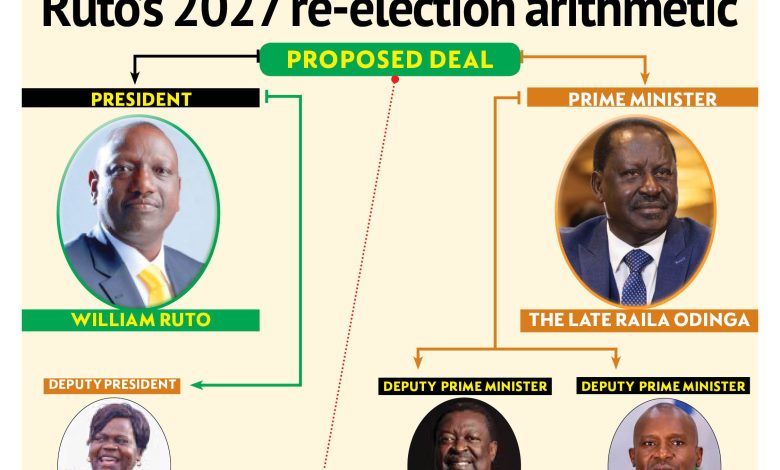
According to impeccable sources, under the proposed arrangement, President Ruto was poised to retain the presidential flagbearer post to secure with his second and final term while Raila would take up the PM post

The death of former Prime Minister and then Orange Democratic Movement (ODM) party boss Raila Odinga has plunged Kenya into political uncertainty dismantling decades of predictable rivalries and leaving President William Ruto to navigate an unexpectedly volatile landscape ahead of the 2027 General Election.
The Informer Media Group has established that President William Ruto’s Kenya Kwanza kitchen cabinet had proposed what would have been a potentially first round one winning formula with the merger of UDA and ODM and a proposed referendum alongside the 2027 polls for constitutional amendment to entrench the seat of the Prime Minister idea on the table.
According to impeccable sources, under the proposed arrangement, President Ruto was poised to retain the presidential flagbearer post to secure with his second and final term while Raila would take up the PM post.
ODM would then produce the Deputy President, where Homa Bay governor Gladys Wanga’s name was suggested as a likely candidate while Deputy President Kithure Kindiki was to be relegated to the Deputy Prime Minister’s post, in an apparent demotion move alongside Musalia Mudavadi to deputise Raila.
“This would have been an assured round one win,” our source intimated.
Although UDA has since castigated a Bill seeking to extend the terms of the President and all elected leaders from five to seven years sponsored by Nandi Senator Samson Cherargei, leaders, leaders allied to President Ruto’s United Democratic Alliance (UDA) have been pushing a referendum to be held on the same date as the 2027 General Election to save costs and ensure maximum participation.
The UDA leaders argue that after 15 years under the 2010 Constitution, Kenya must confront structural weaknesses that continue to frustrate governance and development.
During a church service in Kapsabet in August this year, Nandi Hills MP Bernard Kitur pressed for immediate action.
“Let us start the process of changing the Constitution as soon as now. If there are bad issues, let us start working on them right away,” Kitur said.
He suggested consolidating proposed amendments into one referendum question, to cut costs and ensure maximum turnout by merging the exercise with the general election.
Nandi Governor Stephen Sang echoed the push, saying that a decade and a half of experience with the current framework provides a solid basis for review.
“We must evaluate what has worked and what has not. The law should help us move forward, not hold us back,” he argued.
Through the Constitution of Kenya (Amendment) Bill, 2024 Cherargei seeks to have a law passed that increases the term of service for the President, MPs, MCAs and governors to seven years.
“The Bill proposes to amend Article 136 of the Constitution, which provides for election of the President, to increase the term of President from five years to seven years,” the Bill states.
Further, the Bill amends Articles 101, 177 and 180 of the Constitution to extend the terms of MPs, senators, MCAs and governors to seven years.
With Raila’s demise, analysts now contend that what seemed a manageable political equation has transformed into a high-stakes reconfiguration that could either fragment the opposition or spark a new, populist backlash strong enough to threaten Ruto’s re-election.
ODM is now torn between factions with those supporting continued participation in Ruto’s “broad-based government” and those urging a full return to opposition politics.
The ideological confusion has paralysed the party’s operations and created room for internal rebellions in counties that had long been ODM bastions.
Without Raila anchoring Nyanza, Western, and Coastal regions, Ruto faces a mosaic of volatile actors regional power brokers, ambitious governors, and restless youth movements whose loyalties could shift overnight.
At the same time, the United Opposition bringing together Wiper leader Kalonzo Musyoka, Martha Karua (People’s Liberation Party (PLP), impeached former Deputy President Rigathi Gachagua (DCP), DAP-Kenya’s Eugene Wamalwa and George Natembeya, Fred Matiang’i (Jubilee) and DP leader Justin Muturi has vowed to field a single joint candidate to face President Ruto at the ballot.
The United Opposition has since appointed Mukhisa Khituyi as head of secretariat and spokesperson.
Currently, President Ruto is now under pressure to ensure full implementation of the 10-point agenda contained in the Memorandum of Understanding (MoU) he signed with the late ODM leader after the party resolved to stay in the broad-based government until 2027.
Analysts say implementation of the MoU to an extent that satisfies the ODM rank and file will determine whether its relationship with Ruto’s UDA will continue beyond 2027 or it will seek new alliances or field its own candidate.
There are those who say the massive loss of Raila on October 15 leaves the deal with UDA as the only ideal option for the party to remain in government as it continues to search for a viable successor.
On Tuesday, November 4, Chief of Staff and Head of Public Service Felix Koskei met with the committee the two principals had formed to find ways of ensuring implementation of the MoU’s commitments, which include full implementation of the National Dialogue Committee (NADCO) Report; inclusivity in public life; protection and strengthening of devolution; safeguarding youth livelihoods; and promoting leadership and integrity.
Others are ensuring the right to peaceful assembly; addressing the national debt; fighting corruption; preventing wastage of public resources; and protecting and promoting sovereignty of the people, rule of law, and constitutionalism.
Some of the specific issues covered in the 10-point agenda include economic investment in the youth; right to peaceful assembly and compensation for victims and a stop to abductions.
While President Ruto and Raila also formed a committee on compensation for victims of demonstrations, which is chaired by his Senior Advisor on Constitutional Affairs and Human Rights Prof Makau Mutua, its work was stopped by the courts leading to the resignation of its vice chair, Law Society of Kenya President Faith Odhiambo on October 7.
The committee on implementation of the 10-point agenda, which is chaired by former ODM Nominated Senator Gladys Zani, was supposed to make periodic progress reports to the two principals but with Raila’s death, the onus is now on Ruto to ensure the pact is actualised.
The team, which has Fatuma Ibrahim, Kevin Kiarie, Gabriel Oguda, and Javas Bigambo as members, was tasked to undertake inclusive and extensive consultations with members of the public and all relevant stakeholders and deliver its final report by March 7 next year, the first anniversary of the MoU.
It is fully funded and facilitated by ODM and UDA with Secretaries General Edwin Sifuna and Hassan Omar heading a joint secretariat formed to support its activities.
Critics, however, argue that the fact that the committee’s work has so far not been felt could mean Ruto is buying time before reneging on his promise while ensuring ODM has little time to reorganise itself.
However, speaking on Wednesday, November 5, 2025 during a memorial service held at Raila Odinga Stadium in Homa Bay, ODM interim party leader Oburu Oginga expressed optimism that the MoU will be fully implemented.
“We are happy that a committee is in place for the implementation of the 10-point agenda. This will help the people of this country,” he said.
Oburu has already hinted that ODM could negotiate with Ruto for a pre-election pact but stated that the party will not accept anything less than Deputy President, an asserting that has caused jitters among allies of the current holder of the position, Prof Kithure Kindiki.
On Wednesday this week, ODM national chairperson and Homa Bay Governor Gladys Wanga reiterated: “We are in broad-based to stay because that is where Raila Odinga left us. In 2027, we are either the government or in the coalition that forms the government.”
It is for this reason that implementing the NADCO Report, which, among others, recommended the establishment and entrenchment of an Office of the Prime Minister in the Constitution as a means of coordination of functions of the Executive arm of government.
While this could impact on Prime Cabinet Secretary Musalia Mudavadi, who currently plays that role, it could serve as a juicy offer to extend to ODM to secure its backing for Ruto’s re-election bid.
Since Raila’s death, ODM’s central committee has splintered over its role in government. Former ODM Party chairman and National Treasury Cabinet Secretary John Mbadi and several national legislators advocate staying within the “broad-based” coalition, arguing that it guarantees access to state resources and political stability. Younger leaders, however, including a new generation from Nyanza and Coast, accuse them of betraying ODM’s legacy.
Should that happen, Ruto’s re-election campaign would face a reinvigorated populist bloc capable of mobilising the same voter anger that once powered Raila’s rallies.
For decades, Raila was not merely an opposition leader, he was the gravitational centre of Kenya’s political orbit. His passing in October 15, 2025 left the Orange Democratic Movement (ODM) without a universally accepted successor.