High Court halts prosecution of ex-Nairobi Planning Chief, two others over Manzil Towers collapse
In orders issued by Justice Dr. Nabil Mokaya Orina, the court stayed the decision by the Director of Public Prosecutions (DPP) to charge Analo, David Kibui Kigathi and Fredrick Ochanda, effectively barring their arrest, arraignment, prosecution or any further criminal proceedings until their judicial review application is heard and determined.

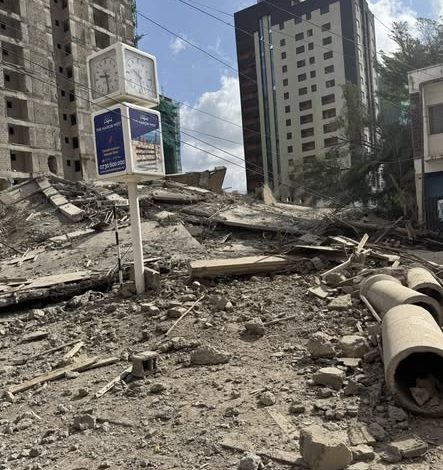
The High Court has temporarily suspended the prosecution of former Nairobi County Executive Committee Member (CECM) for Urban Planning Patrick Analo Akivaga and two other county officials over the collapse of Manzil Towers in South C, Nairobi.

In orders issued by Justice Dr. Nabil Mokaya Orina, the court stayed the decision by the Director of Public Prosecutions (DPP) to charge Analo, David Kibui Kigathi and Fredrick Ochanda, effectively barring their arrest, arraignment, prosecution or any further criminal proceedings until their judicial review application is heard and determined.
“Leave herein granted does operate as a stay of the decision of the 1st Respondent contained in the charge sheet dated 14th July 2026, and of any arrest, arraignment, charging, prosecution or further criminal proceedings against the applicants pending the hearing and determination of the substantive judicial review application,” Justice Orina ruled.
The three officials had moved to court seeking permission to challenge the DPP’s decision to prosecute them over the building collapse, arguing that the charges are unlawful, irrational and unsupported by evidence.
The judge granted them leave to institute judicial review proceedings to quash the decision to charge them. Analo and Kigathi are facing charges of abuse of office contrary to Sections 101(1) and 102A of the Penal Code, while the third applicant is challenging charges of neglect of official duty under Section 128 as read with Section 36 of the Penal Code.
Justice Orina also granted leave for the applicants to seek orders prohibiting the DPP, the Directorate of Criminal Investigations (DCI) and any other persons acting under their authority from arresting, charging or prosecuting them over the matter pending the determination of the case.
The dispute stems from the approval and subsequent collapse of Manzil Towers C in South C, a case that has sparked investigations into Nairobi County’s development approval process.
In court documents, the applicants state that Abyan Consulting Limited, through its architect Gideon Chege Mwangi, applied on October 18, 2023, for approval to construct an 80-unit, 12-storey apartment block in South C.
They argue that the application was first considered by the Urban Planning Technical Committee (UPTC), whose role was limited to reviewing the proposal before forwarding its recommendations to the County Executive Committee Member for Lands, Physical Planning, Housing and Urban Development.
According to the applicants, the CECM approved the development on December 19, 2023.
They contend that under the law, the UPTC has no statutory authority to approve development applications, as that power rests exclusively with the CECM. Consequently, they argue that the DPP’s decision wrongly attributes criminal liability to officials whose statutory responsibilities differed.
The applicants further maintain that the prosecution is irrational, unreasonable and procedurally unfair because it failed to evaluate each officer’s individual legal mandate and instead imposed collective criminal responsibility.
They argue that the DPP failed to satisfy the evidential threshold required under the Office of the Director of Public Prosecutions’ 2019 Guidelines on the Decision to Charge, insisting there is no realistic prospect of securing convictions against them.
Kigathi, who served in the Planning Compliance and Enforcement Department, separately argues that the charges against him are unconstitutional and unsupported by evidence.
He told the court that his department operated independently of both the UPTC and the CECM and that he discharged his statutory duties by taking enforcement action against the developer.
According to his application, the county carried out inspections, issued enforcement notices and prosecuted the developer’s on-site officers, demonstrating that it acted within its legal mandate.
The applicants also argue that the DPP overlooked evidence showing that no enforcement instructions existed on December 19, 2023, when development approval was granted, and on February 13, 2025, because the approvals had only recently been issued by the CECM.
They further state that the UPTC was still considering aspects of the development during a meeting held on November 6, 2025, underscoring what they describe as an incomplete assessment of the facts by investigators.
In addition, they contend that the prosecution improperly seeks to hold public officers criminally liable for actions attributable to private developers, architects, engineers and contractors, contrary to the Constitution, public policy and established legal principles.
The applicants argue that the DPP disregarded relevant evidence, failed to meet both the evidential and public interest tests required under the 2019 charging guidelines, and acted contrary to Article 157(11) of the Constitution by criminalising lawful administrative decisions made in good faith.
Justice Orina directed the applicants to file and serve their substantive judicial review application within seven days. The respondents have been given 21 days to file their responses, after which the applicants may file supplementary affidavits within seven days if necessary.
The matter will be mentioned on September 16, 2026, for compliance and further directions, with the court’s stay orders remaining in force until the judicial review application is heard and determined.