Five weeks of agony: Patients pay the price as nurses’ strike deepens health crisis
For five weeks, public hospitals have struggled to provide essential services after nurses withdrew their labour, leaving patients stranded, maternity units under pressure and families scrambling to find private facilities they cannot afford.

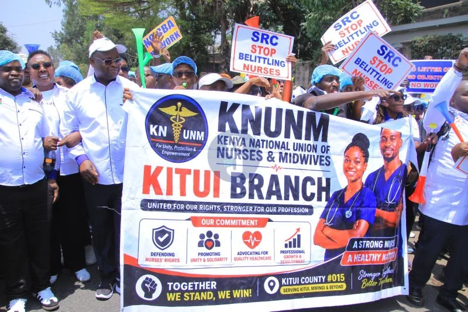
For thousands of Kenyans, the nurses’ strike is no longer a dispute over salaries, allowances or a Collective Bargaining Agreement. It is a question of survival.
For five weeks, public hospitals have struggled to provide essential services after nurses withdrew their labour, leaving patients stranded, maternity units under pressure and families scrambling to find private facilities they cannot afford.
The most devastating warning has come from health professionals who say maternal and newborn deaths are mounting as the industrial action enters its 37th day.
At least 83 maternal deaths and 513 perinatal deaths have been recorded during the strike period, according to figures cited by health professional associations. Between Monday and Wednesday alone, eight maternal, 16 neonatal and 55 perinatal deaths were reported nationally.
While the figures do not prove that the strike directly caused each death, they provide a grim measure of the pressure facing a health system already struggling with shortages and delayed care.
In Muhoroni, 28-year-old Lavender Otieno died while in active labour, leaving her husband, Joshua Abuor, mourning the wife with whom he had expected to welcome their first child. The family reportedly struggled to secure assistance at a public health facility.
For other patients, the crisis has meant being turned away from hospitals that would ordinarily provide treatment.
In Mombasa, Cecilia Wandete rushed her injured son, Omar, to Coast General Teaching and Referral Hospital after he fractured his leg. He needed a metal plate inserted, but the family was told the hospital’s five theatres were closed.
“We took him to Tudor Clinic for first aid, and we were referred here. But we only had the leg dressed and nothing further. Now we are looking for somewhere to take him, but I don’t know how much it will cost us,” she said.
At the same facility, patients waited for hours without meaningful assistance.
The crisis is being compounded by another industrial dispute. Clinical officers have been on strike since June 20, demanding implementation of career guidelines, better risk allowances and permanent employment for eligible Universal Health Coverage workers.
The result is a widening gap between those who can afford private treatment and the millions who depend almost entirely on county hospitals.
In Nyanza, some families have been forced to provide care for their relatives themselves.
“We are suffering because most of us cannot afford to take our patients to private hospitals. We have no alternative, so we have had to stay with our children and take care of them ourselves,” said Mary Ochieng, a patient’s relative.
Across the North Rift, county facilities have been severely disrupted, pushing more patients towards Moi Teaching and Referral Hospital.
MTRH chief executive Dr Phillip Kirwa said the hospital had experienced an unusually high number of referrals because county facilities were not functioning normally.
Government and nurses dig in
At the centre of the standoff is the 2017 Collective Bargaining Agreement, which the Kenya National Union of Nurses and Midwives wants implemented.
KNUNM Secretary-General Seth Panyako says progress has been made on some grievances, including the absorption of UHC workers into permanent and pensionable employment and plans for a joint committee on career guidelines.
But the CBA remains the union’s red line.
“The main elephant in the house is the issue of the collective bargaining agreement,” Panyako said, insisting that the union has no deal with the Government. “Unless we have an agreeable agreement, we will press on with our strike.”
The union estimates that implementing the CBA would require about Sh5.9 billion, while also demanding risk and uniform allowances.
The Council of Governors, however, maintains that the agreement presents a major financial burden for counties and has questioned its sustainability.
CoG chairman Ahmed Abdullahi said governors had attempted to negotiate with nurses and urged them to return to work as talks continued.
“We want to ask nurses to go back to work as we negotiate this matter,” he said.
The governors have also argued that the 2017 CBA was signed under difficult circumstances and was not financially sustainable.
Nurses have rejected that argument, saying the agreement was negotiated and signed by government representatives and cannot simply be discarded.
SRC becomes new battleground
The dispute has now drawn the Salaries and Remuneration Commission deeper into the confrontation.
Nurses recently demonstrated at the SRC offices, demanding a letter of no objection that they believe could help unlock the stalemate.
Seth Panyako said the union had for years been caught in a “push and pull” between SRC and the Council of Governors over implementation of the agreement.

The protests have underscored the growing frustration among health workers as neither side appears ready to surrender its position.
Deputy President Kithure Kindiki has urged the Ministry of Health, governors and SRC to intensify negotiations, warning that the prolonged strike is disrupting essential services and hurting Kenyans.
The Kenya Medical Association has similarly called for dialogue to end the standoff, as professional bodies warn of the long-term consequences of disrupted care.
A health system under siege
For now, the consequences are being absorbed inside hospitals and homes.
Some counties have resorted to temporary or locum workers to keep facilities operating, but these measures have not restored normal capacity.
At Mbagathi Hospital, management has relied on qualified locum nurses as a stopgap measure, while acknowledging that the facility is not fully operational.
Referral hospitals are absorbing patients from counties where services have effectively collapsed, creating another layer of pressure.
Pregnant women, newborns, patients requiring surgery and those needing regular specialised treatment are among the most vulnerable.