Farmers upbeat as they await court decision in landmark battle for seed sovereignty
They expressed hope of regaining their rights to store, share and sell indigenous seeds

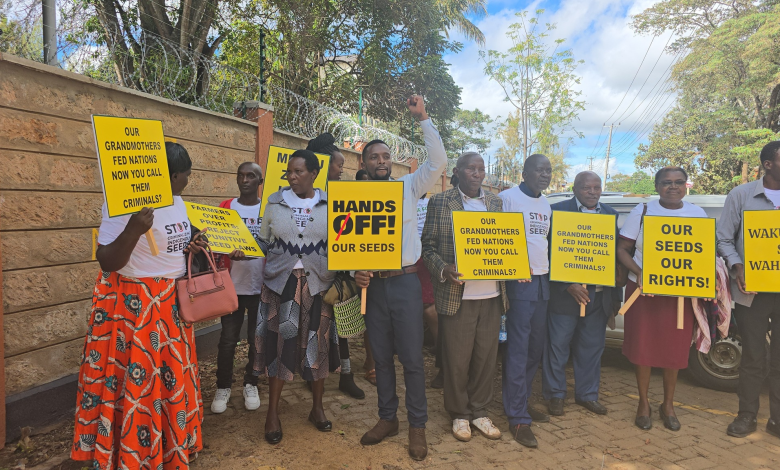
Small-scale farmers have expressed optimism about winning in the case against the criminalisation of saving, sharing, and selling of indigenous seeds as the court is set to give its ruling in November this year.
Speaking after the final hearing of the case today at the Machakos Law Courts, Alvin Muhanji, an advocate for the 15 farmers under the Seed Savers Network and Greenpeace Africa, said as petitioners, they are confident of their submissions as they hoped the ruling would be made in their favour.
“Without preempting what the court will decide, we are confident in the judge and our submissions that a just judgment shall be fair and in favour of the farmers for them to enjoy their rights,” Muhanji stated.
The optimism was also shared by the farmers who filed the petition as they stated that even though a lot of time has passed since 2022, when they filed it, they have hope of regaining their rights to store, share and sell indigenous seeds.
“The case has taken too long, but we shall still wait as we have given our submissions. We have hope that we will win the case because no one should own seeds or say they are theirs, preventing others from using them. We are sure that we shall win the case on behalf of all the smallholder farmers,” Francis Ngiri, who is among the 15 farmers, stated.
The farmers maintain that they are the custodians of the seeds and have a right to fully protect them.
“As farmers, we have hopes of winning because we are the custodians of the seeds, and we have the right to protect them because they are indigenous,” Beatrice Wangui, a group leader of a farmers’ group in Gilgil, Nakuru County, present during the hearing in Machakos, stated.
According to Justus Mwololo, the Chairman of the Small Scale Farmers Forum, the submissions by the farmers have proved that they are rightful seed owners. He added that the farmers hope their rights will be upheld in the November ruling.
“As far as the case is concerned, our submissions are very powerful, as we have given conclusive evidence that our seed rights are being violated. We expect that our rights are upheld and the seeds remain with us and not the multinational companies that want to take over. We are hopeful that the Court will give us the freedom that we are looking for,” Mwololo stated.
Explaining what the farmers term as punitive law, lawyer Wambugu Wanjohi, representing the Law Society of Kenya, which was enjoined in the case last year, said the Seed and Plant Varieties Act (SPVA) 2012 discriminates against smallholder farmers, which is against the Constitution.
Wanjohi added that they have persuaded the court and hope the farmers’ rights will be restored in the long run.
He explained that the registration as stipulated in SPVA 2012, is expensive as a farmer requires Ksh 80,000 at first and Ksh 10,000 yearly to maintain it.
“Our submission was that the Seed and Plant Varieties Act of 2012, under the seed regulations of 2016, discriminates small smallholder farmers as it bars them from sharing their seeds and saving them for the next planting season, and it requires that they register their seeds, which is very expensive,” he said.
“We need the provisions declared unconstitutional and to stop empowering seed inspectors to arbitrarily detain farmers’ seeds. We have persuaded the court in the best way we can, and hope that it will come to one conclusion that the Seed and Plant Varieties Act is unconstitutional, null and void,” Wambugu added.
Peninah Ngau, also a farmer in Gilgil, advised that the government needs to empower the indigenous small-scale farmers, who she says can produce seeds to be used in the country.
She adds that that can be the only solution to tame the ‘chorus’ by the government every planting season that there are no seeds.
“The case is in the right direction, and Small-scale farmers are about to get the freedom and sovereignty in food and seeds, because even the government is lamenting that there are no seeds in Kenya. Why can’t they empower small-scale farmers to be able to multiply the indigenous seeds and release them to the farming community?” Ngau emphasised.
Muhanji dismissed the argument by the government that the farmers had taken much time to file the petition as he reiterated that there are no time limits on matters that violate the Constitution.
“We have submitted our arguments, and the government says we took so much time before raising the petition. There is no limitation in terms of time on matters that violate the Constitution. No law prohibits raising concerns when a right in the Constitution is violated or infringed. You can take 50 years,” he explained.
Today’s hearing came after the February postponement to allow Lady Justice Rhoda Rutto who took over the case hearing to familiarise herself with it after the initial judge was transferred.
The farmers argue that SPVA criminalises traditional seed-saving and sharing thereby posing a direct threat to food security, indigenous knowledge, and rural livelihoods.
The case, according to them, is a pivotal moment for food sovereignty, biodiversity, and smallholder farmers’ livelihoods in Kenya and beyond.
The litigation challenges the constitutionality of the Seed and Plant Varieties Act (Cap. 326) of 2012 and the Seeds and Plant Varieties (Seeds) Regulations, 2016.
The Petition is spearheaded by 15 smallholder farmers and supported by Greenpeace Africa and BIBA Kenya as interested parties.At the heart of the case is the demand for legal recognition and protection of Farmer Managed Seed Systems (FMSS) and the restoration of farmers’ fundamental rights.
SPVA was first enacted in 1972 to regulate the seed sector in Kenya. It focused on the registration, certification, and marketing of seeds.In 2012 and 2016, significant amendments were introduced to align Kenya’s laws with the 1991 International Convention for the Protection of New Varieties of Plants (UPOV 1991).
In their submissions, farmers have argued that the reinforced intellectual property protects the commercial breeders.
The petition challenges SPVA and associated regulations on multiple constitutional grounds which include; Article 11(3)(b) – Failure to recognize and protect indigenous seed systems and cultural heritage, Article 2(6) – Contravention of international treaties ratified by Kenya (ITPGRFA and UNDROP), Article 43(1)(c) – Violation of the right to adequate food and freedom from hunger and Article 27 – Discrimination against smallholder farmers by privileging corporate breeders.Other articles being challenged by the petition are; Article 40 – Infringement of the right to property by criminalising community seed sharing, Article 31 – Violation of the right to privacy through unreasonable inspections and seizures, Article 47 – Denial of fair administrative action in enforcement procedures alongside Article 10 & 118 – Lack of public participation in the 2016 amendments.
However, the government argues that the Act protects farmers by ensuring seed quality. Greenpeace and petitioners have vehemently objected, arguing that quality can’t be defined only through industrial standards.
FMSS ensures resilience, climate adaptation, and local food security. Community protocols and education can manage risk without criminalization,” Elizabeth Atieno, a food campaigner at Greenpeace Africa, stated.
KEPHIS says the Act includes indigenous seeds under its definition, while Greenpeace and petitioners maintain that inclusion without tailored protection leads to erasure, not recognition.
The latter argues that there’s no dedicated framework for indigenous seeds in the law.
The farmers claim that the government has framed the SPVA as a tool for agricultural modernization and phytosanitary security.However, this narrative conceals the structural bias against smallholder farmers and contradicts Kenya’s constitutional obligations and international commitments.
They believe that the urgency should be in protecting biodiversity, food justice, and the custodianship of seeds by those who feed the nation, its farmers.