Aviation strike throws Kenya’s busiest airport into turmoil

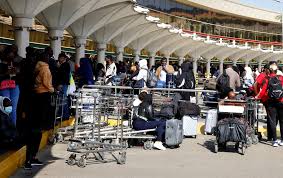
Passengers at Jomo Kenyatta International Airport (JKIA) have today faced massive flight disruptions Monday after a strike by the Kenya Aviation Workers Union (KAWU) paralysed key airport operations, exposing travellers to long delays, uncertainty and mounting frustration.
The industrial action, which followed a seven-day strike notice issued to the Kenya Civil Aviation Authority (KCAA), triggered widespread delays affecting both departures and arrivals.
Airport authorities confirmed that operations had been significantly disrupted, with dozens of flights either delayed or subjected to extended ground holding times due to delayed clearances.
Major airlines, including national carrier Kenya Airways, alerted passengers to schedule changes and urged them to monitor official communication channels for updates.
In a statement, the airline apologised for the inconvenience, saying it was working closely with aviation authorities and airport stakeholders to minimise disruption while maintaining safe operations.
“We sincerely regret the inconvenience and are working closely with the relevant aviation authorities and airport stakeholders to minimize disruption and maintain safe operations,” a statement by KQ read in part.
Low-cost carrier Jambojet also confirmed that all flights across its network had been delayed as a result of the strike.
The airline warned that delays could escalate as the situation evolved, citing delayed clearances and operational bottlenecks.
“As a result, all flights across our network are delayed, with the possibility of extended ground holding times, due to delayed clearances. These delays may increase as the situation evolves,” Jambojet said in a statement.
Scenes of anxiety unfolded at JKIA as stranded passengers scrambled for information, rebooking options or alternative travel arrangements.
Families travelling for business, medical appointments and international connections were among those hardest hits, with many expressing frustrations over the lack of prior resolution to the labour dispute.
At the centre of the crisis is a protracted standoff between KAWU and KCAA.
The union accuses the regulator of failing to address longstanding labour grievances, including the absence of salary reviews for employees who have served for more than 11 years.
KAWU is also pushing for the proper implementation of Collective Bargaining Agreements (CBA) and the transition of contract staff into pensionable employment terms.
Despite the looming strike notice, airline owners and industry players argue that KCAA failed to decisively intervene or secure a last-minute settlement to avert the disruption, leaving passengers exposed to untold suffering.
While KCAA said it had activated operational continuity measures to safeguard critical aviation safety and air navigation services, the practical impact on travellers told a different story.
In a statement, the authority maintained that essential safety functions remained operational under established contingency protocols and that it continued to engage stakeholders in line with labour laws and court directives. It reiterated its commitment to due process and constructive dialogue.
“The authority continues to engage relevant stakeholders in line with applicable labour laws and court directions. We reiterate our respect for due process and remain open to constructive dialogue,” KCAA noted.
However, the unfolding chaos at the country’s busiest airport underscores the high cost of unresolved industrial disputes within critical infrastructure sectors.
With JKIA serving as a regional aviation hub, the strike not only disrupted domestic and international travel but also threatened Kenya’s reputation as a reliable gateway to East Africa.
As negotiations continue, thousands of passengers remain in limbo, bearing the brunt of a standoff that many believe could and should have been resolved before grinding airport operations to a halt.