How government plans to boost coffee production to enhance farmers income

By Nicholas Waitathu
The government has announced new plans to push for more reforms to revitalise the coffee subsector, thus renewing farmers’ morale to increase production and thus enhance Kenya’s profile in the global coffee market.
Agriculture Principal Secretary Kiprono Rono said government has lined up a number of strategies –increasing financial muscle, boosting production, taming malpractices along the value chain and increasing seedlings production.
“Government aim is to restore glory in the agriculture subsector which in 1960s and 1980s was the leading foreign exchange earner.
The approach is ensuring the vibrancy is returned will be fast tracked under a multifaceted tactic that will involve farmers as the major producers, leaders, government, development partners and private sector,” said Rono.
Addressing farmers and other coffee value chains recently at Ruiru, Rono explained government focus working with farmers is to increase production from the current between 40,000 and 50,000 metric tonnes to more than 150,000Mt in the next three years.
Kenya is behind Ethiopia, Uganda, Ivory Coast and Tanzania in terms of coffee production.
Though it is globally reputed for production of fine Arabica coffee with high aroma and thus used by world coffee producers to blend their coffees.
The made the remarks during the 4th National Kenya Agricultural and Livestock Research Organisation (KALRO) open research week and 20th Ruiru coffee Fair at Coffee Research Institute (CRI), in Kiambu County.
In 1987/88 coffee year, Kenya reached her peak production of 129,000 metric tonnes but since then following multiple factors including introduction of Structural Adjustment Programmes (SAPs) but Bretton wood institutions, bad governance, stiff competition by other beverages, inadequate financial extension and escalating effects of climate change, yields have plummeted to between 30,000 metric tonnes and 50,000 metric tonnes currently.
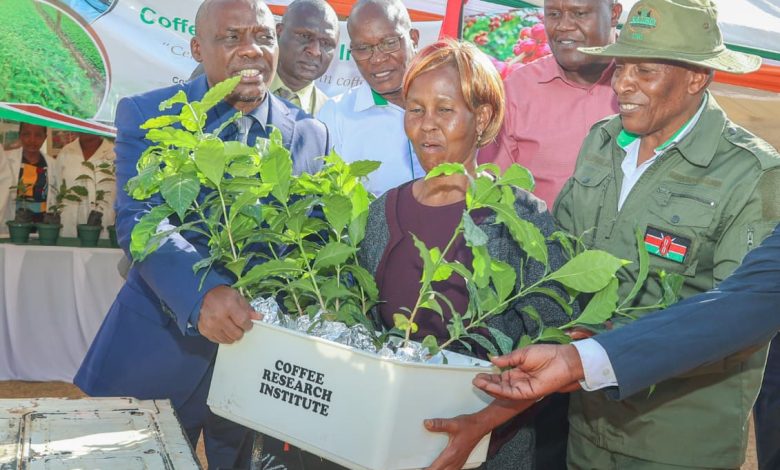
To address seedlings scarcity Rono confirmed that Government will spend Sh500 million in the current financial year to boost CRI seedlings production efforts.
“The factored, money to the fiscal year will be expended to rehabilitation of old nurseries as well as establishing new one. The strategy will equally focus on decentralizing seedlings production by establishing nurseries near farming areas,” he added.
Under the same strategy, the PS explained that youth will be involved under a seed propagation programme. Under the national fertiliser subsidy programme, coffee farmers he said will also benefit from the synthetic manure at the stated cost of Sh2, 500 per bag.
He directed New Kenya Planters Cooperative Union (New KPCU) to work out logistics ease distribution of the subsidised fertiliser to majority of coffee farmers.
Counties in North Rift, Nyanza, and Western Kenya have emerged as new coffee regions as traditional regions mostly in Mount Kenya region face threat of encroachment of real estates and emergence of new economic ventures such as horticulture farming.
KALRO director general Dr. Patrick K. Ketiem confirmed that over the years, CRI has consistently developed technologies and innovations aimed at addressing the challenges faced by coffee farmers and other stakeholders across the value chain.
“In addition, CRI has inventoried over 100 Climate-Smart Technologies, Innovations, and Management Practices (TIMPs) addressing both pre- and post-harvest challenges.
These innovations are geared toward building a resilient and sustainable coffee production system in the face of global climate change,” said Dr. Ketiem.
Building on this success, he added CRI is now advancing research on drought-tolerant varieties suited for lower altitude areas, as well as Robusta and Arabusta coffee varieties for the Lake Basin and Coastal regions.
This diversification is critical in expanding coffee production into new ecological zones and strengthening climate resilience.