Shame as MPs sit on Sh723million as thousands of needy students miss school

Auditor-General Nancy Gathungu has exposed serious lapses in the disbursement of bursaries under the National Government Constituencies Development Fund (NG-CDF), revealing that millions meant to support needy learners were never utilised.
In a 2026 performance audit covering the 2024/25 financial year, Gathungu flagged five constituencies for failing to present bursary cheques worth Sh722.64 million to banks, effectively locking out thousands of deserving students from accessing education support.
The report warns that the delays likely forced many learners out of school due to unpaid fees.
The audit estimates that, based on an average annual school fee of Sh40,000 in public secondary schools, the unutilised funds could have fully supported approximately 18,065 students in extra-county schools.
“The failure to present the cheques to the banks and the resultant stale cheques resulted in loss of learning time by beneficiaries, as learners were sent home for school fees despite having been awarded the bursaries,” the report states.
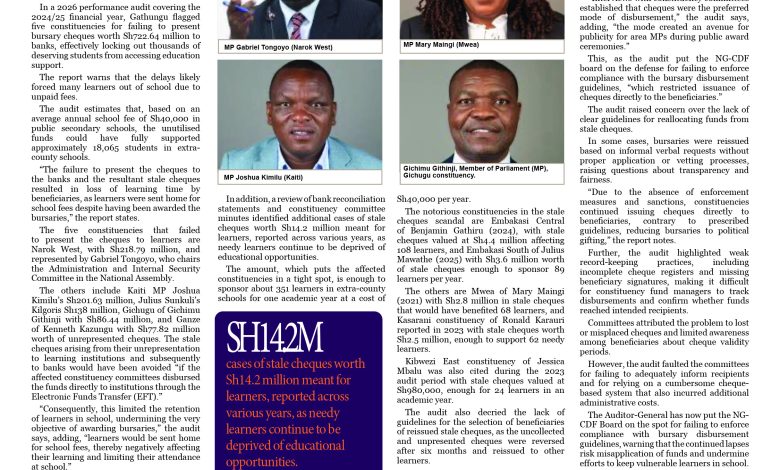
The five constituencies that failed to present the cheques to learners are Narok West, with Sh218.79 million, and represented by Gabriel Tongoyo, who chairs the Administration and Internal Security Committee in the National Assembly.
The others include Kaiti MP Joshua Kimilu’s Sh201.63 million, Julius Sunkuli’s Kilgoris Sh138 million, Gichugu of Gichimu Githinji with Sh86.44 million, and Ganze of Kenneth Kazungu with Sh77.82 million worth of unrepresented cheques.
The stale cheques arising from their unrepresentation to learning institutions and subsequently to banks would have been avoided “if the affected constituency committees disbursed the funds directly to institutions through the Electronic Funds Transfer (EFT).”
“Consequently, this limited the retention of learners in school, undermining the very objective of awarding bursaries,” the audit says, adding, “learners would be sent home for school fees, thereby negatively affecting their learning and limiting their attendance at school.”
In addition, a review of bank reconciliation statements and constituency committee minutes identified additional cases of stale cheques worth Sh14.2 million meant for learners, reported across various years, as needy learners continue to be deprived of educational opportunities.
The amount, which puts the affected constituencies in a tight spot, is enough to sponsor about 351 learners in extra-county schools for one academic year at a cost of Sh40,000 per year.
The notorious constituencies in the stale cheques scandal are Embakasi Central of Benjamin Gathiru (2024), with stale cheques valued at Sh4.4 million affecting 108 learners, and Embakasi South of Julius Mawathe (2025) with Sh3.6 million worth of stale cheques enough to sponsor 89 learners per year.
The others are Mwea of Mary Maingi (2021) with Sh2.8 million in stale cheques that would have benefited 68 learners, and Kasarani constituency of Ronald Karauri reported in 2023 with stale cheques worth Sh2.5 million, enough to support 62 needy learners.
Kibwezi East constituency of Jessica Mbalu was also cited during the 2023 audit period with stale cheques valued at Sh980,000, enough for 24 learners in an academic year.
The audit also decried the lack of guidelines for the selection of beneficiaries of reissued stale cheques, as the uncollected and unpresented cheques were reversed after six months and reissued to other learners.
“This was delayed service delivery, and there were no guidelines to govern the selection of beneficiaries for the reissued cheques, giving constituency committees full discretion to decide which learners to support,” the audit notes.
For instance, a review of bursary committee minutes in Mwea and Embakasi South constituencies revealed that stale cheques were reissued to learners “based on verbal requests made to the NG-CDF offices, without supporting application forms or vetting of applicants’ need or vulnerability.”
Of the sampled constituencies, Kasarani constituency bursary committee minutes had a documented vetting process for reissued stale cheques.
“Interviews with constituency committees established that cheques were the preferred mode of disbursement,” the audit says, adding, “the mode created an avenue for publicity for area MPs during public award ceremonies.”
This, as the audit put the NG-CDF board on the defense for failing to enforce compliance with the bursary disbursement guidelines, “which restricted issuance of cheques directly to the beneficiaries.”
The audit raised concern over the lack of clear guidelines for reallocating funds from stale cheques.
In some cases, bursaries were reissued based on informal verbal requests without proper application or vetting processes, raising questions about transparency and fairness.
“Due to the absence of enforcement measures and sanctions, constituencies continued issuing cheques directly to beneficiaries, contrary to prescribed guidelines, reducing bursaries to political gifting,” the report notes.
Further, the audit highlighted weak record-keeping practices, including incomplete cheque registers and missing beneficiary signatures, making it difficult for constituency fund managers to track disbursements and confirm whether funds reached intended recipients.
Committees attributed the problem to lost or misplaced cheques and limited awareness among beneficiaries about cheque validity periods.
However, the audit faulted the committees for failing to adequately inform recipients and for relying on a cumbersome cheque-based system that also incurred additional administrative costs.
The Auditor-General has now put the NG-CDF Board on the spot for failing to enforce compliance with bursary disbursement guidelines, warning that the continued lapses risk misapplication of funds and undermine efforts to keep vulnerable learners in school.