Power struggle rocks FKF as Hussein moves to oust Ndege

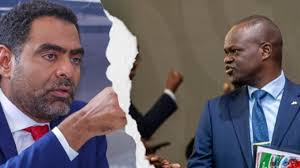
Tensions at the Football Kenya Federation (FKF) have reached a boiling point, with Secretary General and Chief Executive Officer Harold Ndege reportedly facing imminent dismissal following a serious fallout with FKF President Hussein Mohammed.
The once-promising relationship between the two senior officials appears beyond repair, raising questions about governance, accountability, and leadership within Kenya’s football body.
Ndege, a former Kenyan international and ex-Tusker FC defender known for his sharp dressing style and deep understanding of local football, was appointed FKF CEO in February 2025. He replaced Patrick Korir, who served in an interim capacity for four months after Barry Otieno stepped aside to contest the FKF presidential elections held in December 2024.
Under the FKF Constitution, the appointment of the Secretary General—who also functions as CEO—is made by the National Executive Committee (NEC) upon recommendation of the FKF President. The same process applies in cases of dismissal, meaning any decision to remove Ndege must be approved by the NEC.
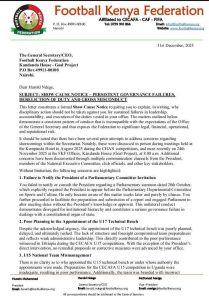
On January 7, 2026, President Hussein issued a show-cause notice to Ndege, citing sustained failures in leadership, accountability, and execution of duties. The notice, shared with 13 key NEC members including Vice President McDonald Mariga, regional representatives, and co-opted officials, required Ndege to respond in writing to 21 issues raised against him. Sources close to the federation indicate that internal attempts to resolve the disputes through consultation had failed, leaving the president with little option but to escalate the matter formally.
Among the most serious accusations is Ndege’s alleged failure to notify or consult the president regarding a Parliamentary summons dated October 28, 2025, which required Hussein Mohammed to appear before the Departmental Committee on Sports and Culture. The president reportedly only learned of the summons weeks later, by chance. Further, Ndege is accused of submitting documents to Parliament and altering meeting dates without presidential approval, a move described as a grave governance failure.
Administration of national youth teams also features prominently in the charges. FKF claims the appointment of the U17 technical bench was poorly planned, delayed, and rushed, compromising preparation and contributing to Kenya’s poor showing at the CECAFA U17 tournament in Ethiopia. Similar lapses were reported for the U15 national team’s CECAFA assignment in Uganda, where logistical failures, incorrect team merchandise, and unclear authority over technical appointments drew criticism.
Complaints from FKF branch officials suggest that Ndege has struggled with communication and coordination. Calls, emails, and messages reportedly go unanswered, leaving branches frustrated and directing complaints to the president.
This has, according to sources, heightened Hussein Mohammed’s frustration and fueled the perception that the CEO is unwilling or unable to manage day-to-day operations effectively.
Ndege, who took unpaid leave from his position at the Kenya Revenue Authority to assume the FKF CEO role, oversees federation correspondence with affiliates, committees, FIFA, and the Confederation of African Football (CAF), manages the annual budget, financial reporting, and staff appointments. Critics argue that failure to execute these responsibilities diligently has contributed to the current impasse.
A source familiar with FKF operations told this publication, “From our observation, Hussein appears fed up. The only negotiation on the table is Ndege’s exit. However, the NEC must approve any dismissal proposal from the president, so the process is still ongoing.”
The power struggle highlights deeper governance challenges within FKF, where executive authority, branch coordination, and accountability mechanisms remain contested.
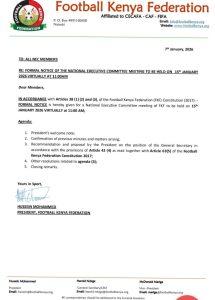
As the NEC prepares to meet on January 15, 2026, to deliberate Ndege’s future, the outcome will set a precedent for leadership accountability and operational discipline in Kenya’s football administration.