Plan for El Niño, not Vision 2060, Gachagua to Ruto as Matiang’i demand action on economy
Speaking separately today, the two opposition leaders accused the government of prioritising long-term promises while failing to address pressing concerns affecting millions of Kenyans, including the rising cost of living, agriculture, infrastructure, illicit alcohol, insecurity and the anticipated El Niño rains.

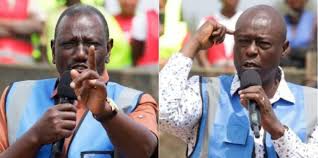
Former Deputy President and leader for Democracy for Citizens Party (DCP) Rigathi Gachagua and former Interior Cabinet Secretary Fred Matiang’i have intensified attacks on President William Ruto’s proposed Vision 2060 development blueprint, dismissing it as a distraction from the country’s immediate economic, governance and security challenges.
Speaking separately today, the two opposition leaders accused the government of prioritising long-term promises while failing to address pressing concerns affecting millions of Kenyans, including the rising cost of living, agriculture, infrastructure, illicit alcohol, insecurity and the anticipated El Niño rains.
Speaking in Nyandarua County during a church service, Gachagua said Kenyans were not interested in “dreams” extending to 2060 but wanted practical solutions to challenges confronting them today.
“We have seen the President come here with Vision 2060. Kenyans do not want visions; they want action. We do not want dreams,” Gachagua said.
Gachagua challenged the government to explain its preparedness for the expected El Niño rains, saying vulnerable communities needed reassurance that adequate measures had been put in place to prevent flooding and protect lives and property instead of talking of mere “dreams”.
Instead of discussing distant development plans, he said, the government should be outlining emergency response measures for areas likely to be affected by heavy rainfall.
Gachagua also questioned the administration’s handling of law and order.
“Kenyans want to know when these goons will be dealt with. Stop telling people about Vision 2060 and tell them what you are doing today,” he said.
Turning to agriculture, the former Deputy President accused the government of neglecting farmers by allowing imports to undermine local produce and failing to honour key pledges made before the 2022 General Election.
“Farmers in Mwea and Ahero do not want to hear about Vision 2060. They want the government to stop importing rice so that locally produced rice can be bought here in Kenya. They need that money now to educate their children,” he said.
The former DP claimed imported rice had flooded the local market while stocks from Mwea and Ahero remained unsold, leaving farmers in financial distress.
Gachagua further alleged that sugarcane farmers in western Kenya were suffering after cane prices reportedly dropped from Sh6,500 to Sh5,000 per tonne.
“Hao wakulima hawataki mambo ya Vision 2060, wanataka bei ya miwa iongezeke,” he said.
He also linked poor maize harvests in parts of the Rift Valley to the distribution of fake fertiliser, arguing that farmers wanted quality farm inputs and accountability rather than future development promises.
The former Deputy President criticised the government’s failure to implement the Guaranteed Minimum Return (GMR) framework that had been discussed before the election, saying agreements reached during the Nyandarua Economic Forum on potatoes, carrots and feeder roads had not been honoured.
He also cited stalled infrastructure projects, including the Murungaru–Naivasha Road, saying residents could not wait until 2060 for roads promised years ago.
On the dairy sector, Gachagua claimed the closure of the Nyahururu KCC plant had left farmers unpaid for four months, alleging that the factory was being allowed to collapse to benefit private interests.
He further accused the government of failing to contain the resurgence of illicit alcohol in parts of the Central region despite previous crackdowns.
“Tunge taka kujua mpango ya kumaliza hii pombe. Hiyo maneno ya 2060 wachana nayo,” he said.
Gachagua also criticised the 0.8 per cent tea levy, arguing that it had reduced the competitiveness of Kenyan tea and could lower bonuses paid to farmers.
He urged sections of the private sector, civil society and other stakeholders to boycott the government’s planned nationwide consultations on Vision 2060, maintaining that the process risked diverting attention from urgent national priorities.
His criticism was echoed by former Interior Cabinet Secretary and Jubilee Party presidential aspirant Fred Matiang’i, who dismissed the Vision 2060 initiative as an attempt to divert public attention from unresolved governance and constitutional issues.
Matiang’i questioned the timing of the proposed development framework, arguing that the government should first address challenges affecting citizens before embarking on another long-term planning exercise.
His remarks add to growing opposition criticism of the government’s decision to begin nationwide consultations on a successor to Vision 2030, Kenya’s long-term development blueprint.
President Ruto has defended the initiative, saying Kenya requires a new development framework anchored in the 2010 constitution and insulated from electoral politics.
Speaking during a church service in Uasin Gishu County, the President said Vision 2030 was formulated before the promulgation of the current Constitution and that the country now needed a new roadmap to guide development beyond its expiry.
“It is going to be a conversation about the future of Kenya, and we are going to put it into law,” Ruto said.
The President said the consultations would involve the private sector, academia, civil society, faith-based organisations, professional bodies, workers, young people and the creative industry.
The government has announced that nationwide public consultations on Vision 2060 will begin on August 12, 2026 with the process expected to culminate in a citizen-driven development charter.