Mudavadi’s referendum push: A power play for the Prime Minister’s seat

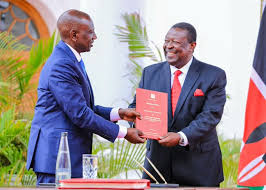
The renewed push for a constitutional referendum by Prime Cabinet Secretary and Foreign Affairs CS Musalia Mudavadi is increasingly being interpreted less as a governance necessity and more as a calculated political strategy aimed at repositioning himself for a powerful executive role ahead of the 2027 general elections.
Stripped of the legal jargon around electoral boundaries and constitutional gaps, the referendum debate has been widely interpreted to serve a more personal political end, notably the resurrection or entrenchment of the Prime Minister’s office and Mudavadi’s pathway to it.
“…we are not going to amend the constitution to create a position for you. We are kicking you out with your president and the entire team in 2027. This is cast in stone, Macharia Njeru, an advocate of the High Court and former chairman and vice chairman of the Independent Policing Oversight Authority (IPOA) and Judicial Service Commission (JSC) respectively posted on his X handle.
Similarly, Senior Counsel Paul Muite and constitutional lawyer who doubles as the former Makueni governor Kivutha Kibwana also punched holes into Mudavadi’s push.
“The referendum needed is under Article One of the constitution, sovereignty of the people to send Parliament and the president home now not in 2027.The looming constitutional storm, created by the political leaders,” Muite said through a post on his X handle.
On his part, Kibwana noted that: “PCS Musalia Mudavadi recently proposed that in 2027 we hold a general election and a referendum. The political elite are still hungering for the NADCO Prime Minister, two Deputy Prime Ministers, Assistant Ministers to solidify ethnic politics. Citizens and even president said NO to BBI #jobsForBoys,” Kibwana posted on his X handle.
In the post–Raila Odinga political landscape, the Prime Minister’s position has regained strategic allure. Raila had long embodied the role’s political weight, using it as both a bargaining chip and a stabilising force. With his death, the seat is symbolically vacant, and Mudavadi currently Prime Cabinet Secretary seems keen to inherit not just the title, but the national stature that comes with it.
Currently, President Ruto is now under pressure to ensure full implementation of the 10-point agenda contained in the Memorandum of Understanding (MoU) he signed with the late ODM leader after the party resolved to stay in the broad-based government until 2027.
Analysts say implementation of the MoU to an extent that satisfies the ODM rank and file will determine whether its relationship with Ruto’s UDA will continue beyond 2027 or it will seek new alliances or field its own candidate.
There are those who say the massive loss of Raila on October 15 leaves the deal with UDA as the only ideal option for the party to remain in government as it continues to search for a viable successor.
On Tuesday, November 4, 2025, Chief of Staff and Head of Public Service Felix Koskei met with the committee the two principals had formed to find ways of ensuring implementation of the MoU’s commitments, which include full implementation of the National Dialogue Committee (NADCO) Report; inclusivity in public life; protection and strengthening of devolution; safeguarding youth livelihoods; and promoting leadership and integrity.
Others are ensuring the right to peaceful assembly; addressing the national debt; fighting corruption; preventing wastage of public resources; and protecting and promoting sovereignty of the people, rule of law, and constitutionalism.
Some of the specific issues covered in the 10-point agenda include economic investment in the youth; right to peaceful assembly and compensation for victims and a stop to abductions.
While President Ruto and Raila also formed a committee on compensation for victims of demonstrations, which is chaired by his Senior Advisor on Constitutional Affairs and Human Rights Prof Makau Mutua, its work was stopped by the courts leading to the resignation of its vice chair, Law Society of Kenya President Faith Odhiambo on October 7.
The committee on implementation of the 10-point agenda, which is chaired by former ODM Nominated Senator Gladys Zani, was supposed to make periodic progress reports to the two principals but with Raila’s death, the onus is now on Ruto to ensure the pact is actualised.
The team, which has Fatuma Ibrahim, Kevin Kiarie, Gabriel Oguda, and Javas Bigambo as members, was tasked to undertake inclusive and extensive consultations with members of the public and all relevant stakeholders and deliver its final report by March 7 next year, the first anniversary of the MoU.
It is fully funded and facilitated by ODM and UDA with Secretaries General Edwin Sifuna and Hassan Omar heading a joint secretariat formed to support its activities.
Critics, however, argue that the fact that the committee’s work has so far not been felt could mean Ruto is buying time before reneging on his promise while ensuring ODM has little time to reorganise itself.
Oburu has already hinted that ODM could negotiate with Ruto for a pre-election pact but stated that the party will not accept anything less than Deputy President, an asserting that has caused jitters among allies of the current holder of the position, Prof Kithure Kindiki.
Days later, ODM national chairperson and Homa Bay Governor Gladys Wanga reiterated: “We are in broad-based to stay because that is where Raila Odinga left us. In 2027, we are either the government or in the coalition that forms the government.”
It is for this reason that implementing the NADCO Report, which, among others, recommended the establishment and entrenchment of an Office of the Prime Minister in the Constitution as a means of coordination of functions of the Executive arm of government.
By framing the referendum as urgent and unavoidable, Mudavadi places himself at the centre of a national conversation, projecting statesmanship while quietly advancing elite power-sharing. The proposed constitutional changes conveniently align with Kenya’s long tradition of elite consensus politics, where governance reforms double as succession tools.
Mudavadi has said the 2027 general elections are likely to be declared invalid if there is no referendum to streamline the constitutional requirements.
In his speech during the 46th Moloogoli festival held in Mbale, Vihiga County, on Friday, December 26, 2026, Mudavadi said the 2027 general elections can only be conducted after a referendum is conducted.
Mudavadi said the Independent Electoral and Boundaries Commission (IEBC) cannot conduct general elections without valid population census data and a valid boundaries review.
“Remember, no valid population census data, no valid boundaries review, and no general elections. That is the law and not my words. We must embrace the referendum as a legal necessity to save our democracy… Allow me to state without fear or contradiction that there is a need for constitutional review. As a leader, I must speak the truth about the looming constitutional storm,” Mudavadi stated.
Heading into 2027, pundits contend, Mudavadi’s referendum campaign could influence voter sentiment in multiple ways. If successful, it positions him as a leader capable of navigating constitutional reform and safeguarding electoral legitimacy. It also potentially influences coalition dynamics, especially as parties and voters recalibrate their loyalties in a post-Raila environment.
However, if the referendum becomes perceived as politically motivated or mishandled, political analysts say, it could deepen divisions and undermine trust in the electoral process. The challenge for Mudavadi will be to balance legal necessity with political prudence, ensuring that constitutional reform enhances democracy rather than deepening national fault lines.