Mt Kenya rebellion exposes fault lines in opposition’s 2027 unity plan
The rebellion exposes the deeper problem confronting the opposition amid the growing agreement on the need to defeat Ruto, but little agreement on whose political machinery should lead the charge.

The opposition’s much-touted unity project is running into an uncomfortable reality: its biggest challenge may not be defeating President William Ruto, but agreeing on who controls the political vehicle that will carry the fight to the 2027 election.
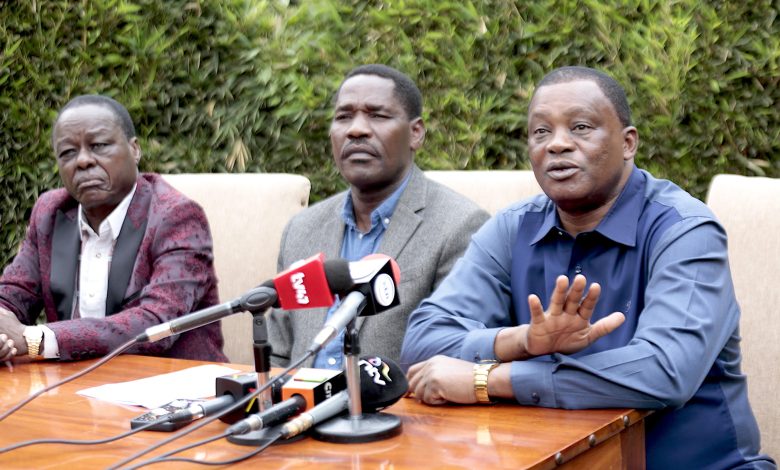
That fault line burst into the open today when three Mt Kenya political parties pushed back against former Deputy President Rigathi Gachagua’s campaign for leaders in the region to dissolve their parties and join his Democracy for the Citizens Party (DCP).
Former Meru Governor and Party of National Unity (PNU) leader Peter Munya, speaking alongside Democratic Party (DP) leader Justin Muturi and Devolution Empowerment Party (DEP) leader Lenny Kivuti, rejected the proposition as an attempt to subordinate independent political formations to one party.
The leaders’ message was blunt: they are prepared to work with Gachagua and other opposition figures, but they will not surrender their parties to DCP.
“We wish to state unequivocally that every political party is an independent institution established under the Constitution and the laws of Kenya, with its own members, delegates, elected officials, and governance structures,” Munya said while reading their joint statement.
He said no individual could order another party to dissolve or dictate its political future, arguing that such decisions could only be taken by the lawful organs of individual parties in accordance with their constitutions and the Political Parties Act.
“Unity must be anchored on mutual respect, consultation, and voluntary cooperation, not coercion, political ultimatums, or demands for surrender,” Munya said.
The rebellion exposes the deeper problem confronting the opposition amid the growing agreement on the need to defeat Ruto, but little agreement on whose political machinery should lead the charge.
Gachagua has increasingly positioned DCP as the dominant political vehicle in Mt Kenya, particularly after its victory in the Ol Kalou parliamentary by-election.
He has subsequently pushed for leaders and parties in the region to consolidate behind DCP, while announcing plans for the party to field candidates across all 47 counties.
But Munya, Muturi and Kivuti have challenged the assumption that Mt Kenya can be politically consolidated under one banner—or that Gachagua automatically speaks for the region.
“We reject any impression that the Honourable Gachagua has been appointed or mandated to speak on behalf of all the people or political parties of the Mt Kenya region. No such authority has been conferred upon him,” Munya said.
The statement is significant because the disagreement goes beyond party structures. It touches on the larger question of who gets to negotiate on behalf of Mt Kenya in the emerging opposition alliance and, ultimately, who will control its bargaining power over the 2027 presidential contest.
Munya warned against attempts to turn political cooperation into political absorption, saying Mt Kenya had historically embraced political pluralism.
The timing could hardly be more difficult for the opposition.
While Gachagua is seeking to consolidate his regional base through DCP, Wiper leader Kalonzo Musyoka is attempting to revive Azimio la Umoja as a broader opposition umbrella.
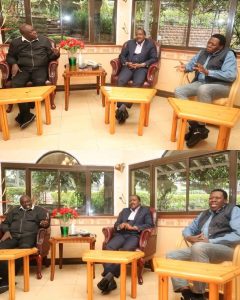
Azimio recently admitted DEP, DP and Umoja na Maendeleo Party (UMP), while Eugene Wamalwa’s Democratic Action Party-Kenya (DAP-K) returned to the coalition. The coalition also appointed Jubilee deputy party leader Fred Matiang’i to its National Executive Committee.
Kalonzo has been tasked with reaching out to other opposition formations, including DCP, Martha Karua’s People’s Liberation Party (PLP), former Chief Justice David Maraga and Nairobi Senator Edwin Sifuna’s emerging Linda Mwananchi movement.
But the response from DCP suggests that Azimio’s revival is far from straightforward.
Embakasi North MP James Gakuya has flatly rejected any possibility of DCP returning to the coalition, describing Azimio as an outdated political arrangement.
“Personally, and the whole fraternity of DCP, we have no space in Azimio. Even going forward, we cannot recognise it at all,” Gakuya said.
“If we are going to make any formation going forward, it should not be Azimio at all. That one we are going to reject in totality.”
Gakuya also raised a question that exposes another unresolved fault line within the opposition: which ODM would be incorporated into a revived Azimio following the party’s cooperation with the Ruto administration?
“The other big question is that we have a big battle in ODM. Which ODM are you bringing back to Azimio? The Oburu ODM faction or the young Turks faction?” he asked.
The disagreement comes even as opposition leaders publicly project unity.
In a bid to forge a united front within the opposition, today, separately, Kalonzo met Gachagua and Wamalwa for consultations on what he described as “the way forward” for the country. The meeting followed separate engagements with Sifuna and other opposition figures.
The talks point to a potentially broad alliance, but the political arithmetic remains unsettled. The opposition has not agreed on a formal coalition structure, presidential flagbearer, power-sharing formula or even the precise political vehicle through which it will contest the election.
That uncertainty is feeding suspicion among the various formations.
Saboti MP Caleb Amisi has already warned that reviving Azimio without confronting the failures that contributed to its 2022 defeat could amount to political repetition rather than strategy.
“Azimio is a failed coalition; you can’t remove Ruto with Azimio. Removing Ruto is not a guinea pig experiment; you must be very intentional,” Amisi said.
His warning captures the dilemma confronting the opposition. Kalonzo argues that time is running out and an existing coalition offers a ready-made framework. Gachagua, meanwhile, appears intent on building DCP into a formidable national vehicle from a strong Mt Kenya base.
Other parties are resisting both approaches because they fear that a grand coalition could eventually translate into the dominance of one leader, one party or one region.