Kuria, Owalo and the politics of ‘projects’ ahead of 2027
Their exits, framed as a return to active politics, have reignited an old Kenyan debate on whether they are leaders driven by personal conviction and ideological clarity, or are they carefully deployed political projects designed to advance broader power interests around the presidency

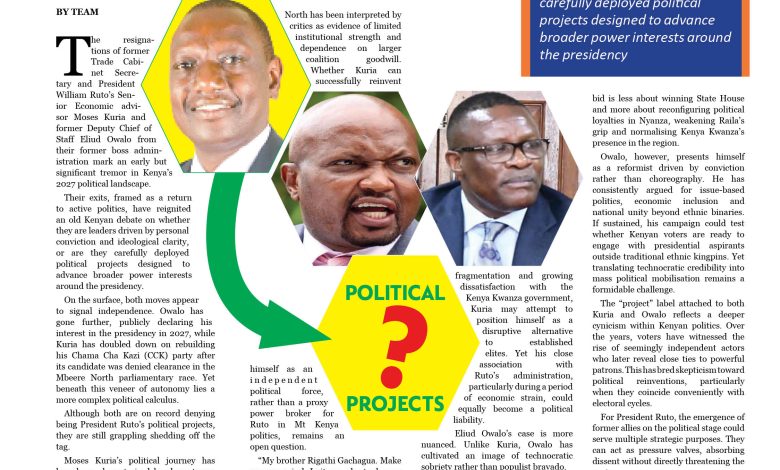
The resignations of former Trade Cabinet Secretary and President William Ruto’s Senior Economic advisor Moses Kuria and former Deputy Chief of Staff Eliud Owalo from their former boss administration mark an early but significant tremor in Kenya’s 2027 political landscape.
Their exits, framed as a return to active politics, have reignited an old Kenyan debate on whether they are leaders driven by personal conviction and ideological clarity, or are they carefully deployed political projects designed to advance broader power interests around the presidency.
On the surface, both moves appear to signal independence. Owalo has gone further, publicly declaring his interest in the presidency in 2027, while Kuria has doubled down on rebuilding his Chama Cha Kazi (CCK) party after its candidate was denied clearance in the Mbeere North parliamentary race. Yet beneath this veneer of autonomy lies a more complex political calculus.
Although both are on record denying being President Ruto’s political projects, they are still grappling shedding off the tag.
Moses Kuria’s political journey has long been characterised by sharp turns, controversy and reinvention. Once a fierce critic of Ruto, Kuria later became one of his most vocal allies, eventually earning a Cabinet slot.
His tenure in government was marked by combative rhetoric, public spats and policy gaffes that often put the administration on the defensive. For some, his resignation signals a recognition that his political brand thrives better outside government, where populist messaging and ethnic mobilisation are easier to deploy.
However, the perception that Kuria remains a “Ruto project” refuses to fade. His Chama Cha Kazi party, despite being positioned as an alternative political vehicle, has largely aligned itself with Kenya Kwanza interests.
The denial of its candidate in Mbeere North has been interpreted by critics as evidence of limited institutional strength and dependence on larger coalition goodwill. Whether Kuria can successfully reinvent himself as an independent political force, rather than a proxy power broker for Ruto in Mt Kenya politics, remains an open question.
“My brother Rigathi Gachagua. Make up your mind. Is it me who took your votes, or were your votes stolen?” Kuria sharply responded to claims made by former Deputy President Rigathi Gachagua that his CCK candidate cost the opposition victory in the Mbeere North parliamentary by-election.
Kuria made the remarks through his official X account, formerly Twitter on the night of Wednesday, December 10, 2025.
Kuria dismissed Gachagua’s remarks as contradictory and politically dishonest, accusing the former DP of attempting to scapegoat others instead of accepting the election outcome.
Political pundits hold that Kuria’s relevance ahead of 2027 will likely hinge on the Mt Kenya succession question.
As the region grapples with internal fragmentation and growing dissatisfaction with the Kenya Kwanza government, Kuria may attempt to position himself as a disruptive alternative to established elites. Yet his close association with Ruto’s administration, particularly during a period of economic strain, could equally become a political liability.
Eliud Owalo’s case is more nuanced. Unlike Kuria, Owalo has cultivated an image of technocratic sobriety rather than populist bravado.
His move to declare presidential ambitions appears bold, even quixotic, given Kenya’s deeply entrenched ethnic arithmetic. Owalo hails from Nyanza, a region historically dominated by opposition politics and long associated with Raila Odinga. Any presidential bid from the region inevitably invites scrutiny over whether it represents genuine ideological divergence or a strategic attempt to fracture opposition unity.
Critics argue that Owalo’s rise within Ruto’s inner circle and subsequent resignation fits a familiar script of nurturing alternative voices in opposition strongholds to dilute the influence of dominant political figures.
In this reading, Owalo’s presidential bid is less about winning State House and more about reconfiguring political loyalties in Nyanza, weakening Raila’s grip and normalising Kenya Kwanza’s presence in the region.
Owalo, however, presents himself as a reformist driven by conviction rather than choreography. He has consistently argued for issue-based politics, economic inclusion and national unity beyond ethnic binaries. If sustained, his campaign could test whether Kenyan voters are ready to engage with presidential aspirants outside traditional ethnic kingpins. Yet translating technocratic credibility into mass political mobilisation remains a formidable challenge.
The “project” label attached to both Kuria and Owalo reflects a deeper cynicism within Kenyan politics. Over the years, voters have witnessed the rise of seemingly independent actors who later reveal close ties to powerful patrons. This has bred skepticism toward political reinventions, particularly when they coincide conveniently with electoral cycles.
For President Ruto, the emergence of former allies on the political stage could serve multiple strategic purposes. They can act as pressure valves, absorbing dissent without directly threatening the centre.
They can also function as testing grounds for narratives and alliances ahead of 2027. Whether by design or coincidence, their moves complicate opposition cohesion while giving the ruling establishment plausible deniability.
“There is also genuine risk. Political projects, once unleashed, can develop ambitions of their own. Should Kuria successfully tap into Mt Kenya discontent, or Owalo capture youth and urban constituencies disillusioned with traditional opposition figures, they could reshape alliances in unpredictable ways. As members of the broad-based government, we are a bit skeptical on this approach,” An ODM insider intimated.