Kenya grinds to a halt as fuel price strike paralyses transport


Kenya’s transport network ground to a near standstill beginning today at dawn after a nationwide strike by public transport operators over soaring fuel prices paralysed movement across major towns and highways, leaving thousands of commuters stranded and businesses disrupted.
The coordinated shutdown, led by the Transport Sector Alliance (TSA), saw matatus, buses, boda bodas, trucks, digital taxis and other transport operators withdraw services in protest against the latest fuel price hikes announced by the Energy and Petroleum Regulatory Authority (EPRA).
By dawn today, May 18, 2026, major roads in Nairobi and its environs — including Thika Road, Mombasa Road, Jogoo Road, Waiyaki Way and Ngong Road — were unusually clear of traffic as most public service vehicles stayed off the roads.
A spot check by The Informer Media Group revealed that thousands of commuters heading to the Nairobi Central Business District (CBD) were forced to walk long distances after failing to secure transport.
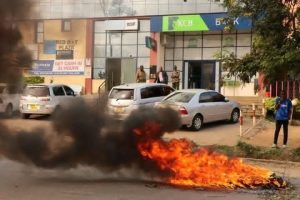
In areas such as Githurai, Ruiru, Kawangware, Ruaka, Utawala and Kitengela, protesters barricaded roads and lit tyres, causing chaos and forcing motorists to make abrupt U-turns.
Thick smoke billowed over sections of Thika Superhighway near Kenyatta Road as burning tyres blocked parts of the carriageway.
At the Ruiru stage and along sections of Thika Road, stranded passengers waited for hours at deserted bus stops, while the few matatus that remained operational doubled fares from the usual Sh100 to Sh200 for trips to the CBD.
Transport was also paralysed along the Nairobi-Namanga highway after rioting youth barricaded roads in Kitengela, Kajiado County, early Monday morning.
Motorists travelling between Nairobi and Kajiado parked vehicles by the roadside as movement became impossible.
Hundreds of youths reportedly pulled down a mabati structure belonging to the Kajiado County Government that was being used for revenue collection at the border with Machakos County.
Businesses in Kitengela Town were forced to close as groups of idle youths thronged the streets amid rising tension.
Similar scenes were witnessed in Kisii, where public transport operators boycotted work, leaving residents stranded.
The strike followed a notice issued by the Motorists Association of Kenya (MAK) and other transport stakeholders after a meeting in Nairobi last week.
“Under the Transport Alliance, transport associations hereby issue a nationwide strike notice effective Monday, May 18, 2026, in protest against the continued sharp and unjustified increase in fuel prices imposed by the Government through EPRA,” the alliance said in a statement.
The TSA coalition — which includes the Federation of Public Transport Sector (FPTS), Matatu Owners Association, Association of Matatu Transport Owners (AMTO), Truckers Association of Kenya, Digital Taxi Association of Kenya and boda boda associations — described the strike as “99 per cent successful.”
“This action is not only for transport operators, but for every Kenyan citizen,” the alliance said.
“The ordinary mwananchi is the ultimate victim of high fuel prices, paying more for transport, food, electricity and essential commodities.”
The alliance is demanding an immediate reversal of the latest fuel price increases announced on May 14, 2026 with calls for diesel and petrol prices to be reduced to about Sh152 per litre and eventually stabilised between Sh140 and Sh150.
The protesters are also demanding the resignation of Energy Cabinet Secretary Opiyo Wandayi, the disbandment of EPRA, restoration of a competitive fuel procurement system and revival of the Changamwe Oil Refinery.
The industrial action comes amid mounting concern from business leaders over the economic impact of rising fuel costs.
The Kenya National Chamber of Commerce and Industry (KNCCI) warned that the latest fuel review could reduce profit margins for micro, small and medium enterprises (MSMEs) by up to 15 per cent while significantly increasing transport and food distribution costs.
KNCCI President Erick Rutto described the latest review as “an economy-wide shock,” warning that transport and logistics costs could rise by between 10 and 20 per cent, with food prices expected to increase by up to seven per cent as businesses pass the additional costs to consumers.
Under the latest EPRA pricing cycle effective May 15 to June 14, diesel prices in Nairobi rose by Sh46.29 to Sh242.92 per litre, while super petrol increased by Sh16.65 to Sh214.25 per litre.