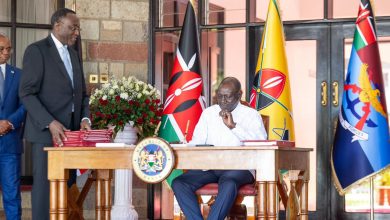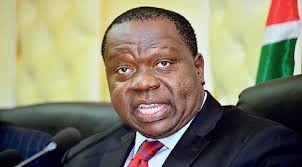
Fred Matiang’i’s re-emergence on Kenya’s national political stage as one of the potential 2027 presidential contenders under the United Opposition banner on a Jubilee Party ticket has reignited debate about leadership, state authority and the kind of presidency Kenya may be headed toward.
Having been once among the few and most powerful Cabinet Secretaries under retired President Uhuru Kenyatta, Matiang’i’s journey from the nerve centre of government to opposition politics reflects both continuity and rupture in Kenya’s governance trajectory.
As Cabinet Secretary for Information, Communication and Technology, later Education, and eventually Interior and Coordination of National Government, Matiang’i became synonymous with a firm, no-nonsense approach to public administration.
Unlike many technocrats who fade into bureaucratic obscurity, the career university don built a national profile rooted in execution, enforcement and institutional discipline. For his supporters, this record positions him as uniquely suited to confront Kenya’s entrenched governance failures.
His tenure in the Education ministry marked his first major national test. He oversaw the controversial but largely effective reforms of the national examinations system, dismantling powerful cheating cartels that had turned exams into a multi-billion-shilling underground economy.
Despite intense political pressure, resistance from education elites and public protests, the reforms held. For the first time in years, examination results reflected learning outcomes rather than syndicates, a feat that earned him both admiration and political enemies.
That reputation followed him to the Interior ministry, arguably the most powerful and politically sensitive docket in government.
However, the current crisis in the Competency Based Curriculum (CBC) and the Competency Based Education (CBE) including the ongoing confusion of placement of the Grade 10 pupils, capitation funding crisis for secondary students and withdrawal of school feeding programs by the Kenya Kwanza led administration has eroded these gains.
As Interior CS, Matiang’i chaired the National Security Council Committee, effectively becoming the operational face of state authority. His leadership coincided with a period of heightened enforcement against illicit trade, illegal gambling, counterfeit goods, alcohol cartels and cross-border criminal networks. Supporters argue that his approach restored a measure of state control in areas where cartels had effectively replaced government.
However, his record is not without controversy. During his stint at the Interior Ministry, cases of enforced disappearances, extra-judicial killings and summary executions by law enforcement agencies continue to haunt him even to date.
Critics also accuse him of authoritarian tendencies, excessive use of state power and insufficient regard for civil liberties.
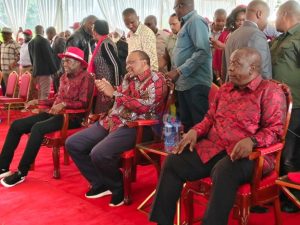
His tenure at Interior coincided with aggressive security operations, media tensions and accusations of shrinking democratic space. These criticisms now form the central fault line of his presidential bid, whether Kenya needs a strong enforcer to restore order, or a softer conciliator to heal political divisions.
However, Matiang’i is on record exonerating himself from blame and offered to defend himself if required to do so.
The former CS even called for public inquest into extra-judicial killings saying he is ready to answer questions for River Yala bodies and the murders of Chris Msando, Jacob Juma and Kipyegon Kenei.
Critically, Matiang’i also distinguished himself by his public stance on electoral integrity. Ahead of the 2022 General Election, he issued a stark warning that if the Independent Electoral and Boundaries Commission (IEBC) cleared candidates without rigorous scrutiny, Parliament risked being populated by money launderers and individuals of questionable character. The remarks, controversial at the time, now resonate in a political climate marked by persistent questions about campaign financing, unexplained wealth and the criminalisation of politics.
To his backers, that warning underscores why Matiang’i fits the bill as a reformist presidential candidate.
They argue that Kenya’s core crisis is not ideological but institutional a collapse of accountability, rule of law and respect for public office. In that framing, Matiang’i’s strength lies not in populist rhetoric but in administrative competence and political courage. He represents a return to a presidency that prioritises state capacity over political convenience.
“Matiang’i has government institutional memory and has no baggage. That is why he is the right man to takeover as the president to fix all the messes in this country,” Justus Wekesa, a political analyst noted.
His alignment with the United Opposition and the Jubilee Party also signals a broader political recalibration and they have pledge to unveil their flag bearer for the State House race to challenge President William Ruto’s re-election bid.
Other United Opposition leaders also eying to be the coalition’s flag bearer include; Wiper Patriotic Front (WPF) leader Kalonzo Musyoka, former Deputy President and DCP party leader Rigathi Gachagua, DAP-Kenya head Eugene Wamalwa, and PLP-Kenya leader Martha Karua.
Once the chief enforcer of the Kenyatta administration, he now positions himself as a corrective to what opposition leaders describe as a breakdown of governance under the current administration.

This shift allows him to tap into nostalgia for a state that appeared functional, predictable and firm particularly among urban voters, civil servants and professionals disillusioned by economic hardship and perceived state capture.
In the 2027 equation, Matiang’i’s appeal lies in contrast. Against a political class often defined by personality politics and ethnic arithmetic, he projects technocratic seriousness and institutional memory.