Inside the Sh20billion World Bank funded KOSAP project
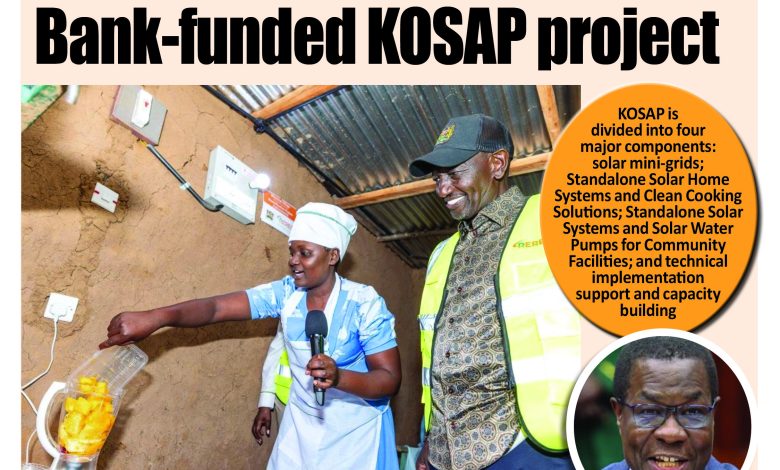
KOSAP is divided into four major components: solar mini-grids; Standalone Solar Home Systems and Clean Cooking Solutions; Standalone Solar Systems and Solar Water Pumps for Community Facilities; and technical implementation support and capacity building.

A Sh20 billion World Bank-funded energy project targeting some of Kenya’s most marginalised and remote communities is entering a critical phase, with the Rural Electrification and Renewable Energy Corporation (REREC) emerging as the pace-setter in a programme designed to transform access to clean and reliable energy across 14 underserved counties.
Investigations by The Informer Media Group, backed by official records from the Ministry of Energy and Petroleum and Parliament, show that REREC has already completed or is substantially ahead in implementing 31 of the 120 solar-powered mini-grids being rolled out under the Kenya Off-Grid Solar Access Project (KOSAP).

The development places REREC ahead of schedule as the government races towards a major infrastructure handover scheduled for September 30, 2026, when the corporation is expected to deliver 31 out of the project targeted 120 newly built solar mini-grids to remote communities.
The project, backed by a USD150 million World Bank investment, is designed to increase access to modern, clean and reliable energy services in 14 traditionally underserved counties.
But behind the ambitious rollout is a complex division of responsibilities involving the Ministry of Energy and Petroleum, Kenya Power and Lighting Company (KPLC) and REREC, raising the stakes for both agencies to deliver within the programme’s timelines.
KOSAP is divided into four major components: solar mini-grids; Standalone Solar Home Systems and Clean Cooking Solutions; Standalone Solar Systems and Solar Water Pumps for Community Facilities; and technical implementation support and capacity building.

The progress report before the Senate Standing Committee on Energy, chaired by Elgeyo Marakwet Senator William Kisang, shows that REREC is implementing 31 of the 120 mini-grids in four counties—Turkana, Marsabit, Samburu and Isiolo.
Turkana accounts for 12, Marsabit 10, Samburu four and Isiolo five.
The remaining 89 solar-powered mini-grids are being implemented by KPLC, headed by Group Managing Director Eng. Joseph Siror.
The figures underline the scale of the undertaking. The mini-grids are designed to support between 75 and 1,835 active users per site, with the broader rollout expected to connect thousands of households to green energy and water infrastructure.
The water component is equally expansive.
REREC, under Dr Rose Mkalama, is responsible for solarising 316 existing boreholes across the 14 counties under the Solar Water Pumps for Community Facilities component. KPLC, meanwhile, is implementing Standalone Solar Systems for community facilities.
Appearing before the Senate Energy Committee on August 4, Mkalama told lawmakers that she had personally inspected 31 active construction sites, giving the committee a direct account of the progress being made on the ground.
She assured senators that the multi-component programme was “on track” to meet its end-of-September commissioning timeline, pushing back against concerns raised by Tana River Senator Danson Mungatana over potential localised delays.
The project’s water infrastructure footprint stretches across some of Kenya’s most water-stressed regions.

Isiolo and Tana River lead with a combined 57 solarised boreholes under construction, followed by Narok with 35. Taita Taveta and Lamu each have 34 installations, while West Pokot and Turkana have 33 apiece. Additional projects are underway in Kwale, Garissa, Wajir and Mandera.
Data from 256 completed borehole sites indicates that the programme is targeting 5,390 household connections, translating to an average of 21 households per water source.
However, the connection density varies depending on settlement patterns. Isiolo averages 26 households per borehole, Narok 25, Kwale 24, Mandera 23 and Wajir 22.


The project’s four-tier approach is intended to maximise the reach of off-grid energy by combining localised solar mini-grids, standalone solar home systems, clean cooking technologies and specialised photovoltaic pumping systems.
The anticipated September 30 handover will see functioning energy and water systems handed over to the marginalised communities that have historically remained outside the national grid.