Gachagua alleges 2027 poll rigging plot, points finger at IEBC–Miru tender
“The tender process and result has already been preconceived and is awaiting rubber stamping,” Gachagua alleged, describing the procurement as “a mundane public relations exercise to manage other bidders and 55 million Kenyans," Gachagua claimed.

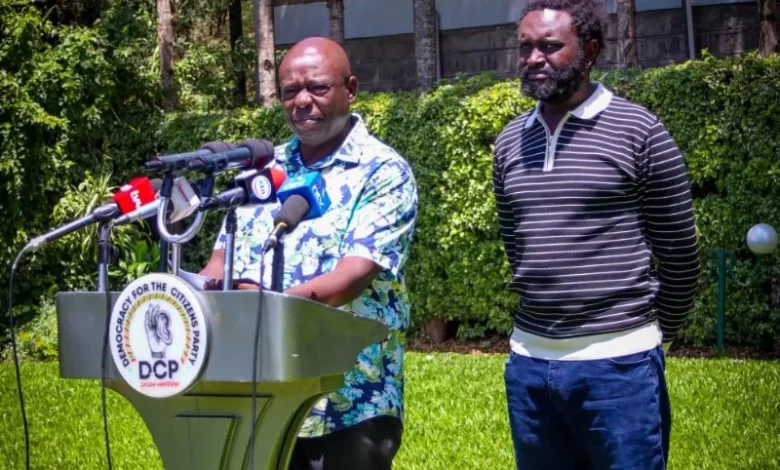
Former Deputy President Rigathi Gachagua has today made damning claims citing an alleged plot to rig the 2027 General Election saying that plans are already underway and claimed that the procurement of a new Integrated Election Management System (IEMS) has been designed to favour South Korean technology firm Miru Systems Company Limited.
Speaking at his Karen residence earlier today, Wednesday, August 26, 2026, ahead of his departure for the United States, Gachagua accused the Independent Electoral and Boundaries Commission (IEBC) leadership of conducting a predetermined tender process disguised as a competitive procurement.
He alleged that IEBC Chairman Erastus Edung Ethkon and Vice Chairperson Fahima Araphat Abdallah were orchestrating the process to ensure Miru wins the contract.
“The tender process and result has already been preconceived and is awaiting rubber stamping,” Gachagua alleged, describing the procurement as “a mundane public relations exercise to manage other bidders and 55 million Kenyans,” Gachagua claimed.
The allegations come as IEBC undertakes procurement of an IEMS ahead of the 2027 election.
However, by this evening, IEBC had not respeonded to the claims and efforts to reach the IEBC Chairman Erastus Edung Ethgekon for comment were not fruitful.

The commission advertised the tender on August 11, 2026, seeking a supplier to provide, deliver, install, test, commission, support and maintain the system, including hardware and accessories. The deadline for submission is September 1, 2026, at 10am.
“The Independent Electoral and Boundaries Commission (IEBC) invites tenders from interested eligible bidders for the supply, delivery, installation, testing, commissioning, support and maintenance of the Integrated Elections Management System (IEMS), hardware equipment and accessories until 1st September, 2026 at 10am East African Time,” the commission said in its tender notice.
The system will form part of the technology infrastructure used to manage elections, while a separate procurement covers ballot papers, tactile folders, the register of voters and statutory election result declaration forms.
Gachagua claimed IEBC had removed its procurement manager and installed a replacement as part of efforts to influence the outcome. He further alleged that Ethkon and Abdallah had received commissions in advance to secure the tender for Miru. He did not provide evidence to support the allegations, and there was no immediate response from IEBC.
Gachagua also alleged that Interior Principal Secretary Raymond Omolo and Immigration PS Belio Kipsang had held meetings with Miru officials over access to Kenya’s voter registration database for what he described as “integration purposes.”
Gachagua questioned the integrity of the procurement specifications, claiming they had been crafted around Miru’s capabilities rather than developed as vendor-neutral, performance-based requirements.
He challenged IEBC to release minutes of internal committees, technical working papers, market surveys and approval records showing how the specifications were developed.
“Can IEBC produce documentary evidence showing who drafted the technical specifications?” he asked.
He also questioned whether the qualification requirements could unfairly exclude other potential suppliers and demanded that the commission explain what market analysis had been undertaken to establish that multiple qualified manufacturers could meet the requirements.
Gachagua further raised concerns over the Sh30 million tender security required from bidders, questioning whether suppliers had been provided with sufficient information to assess the commercial risks involved.
“Why did IEBC require a tender security of Sh30 million while failing to disclose sufficient information regarding the quantities, commercial scope, estimated procurement value, or the budgetary basis necessary to demonstrate compliance with Section 61 of the PPADA, and how were bidders expected to assess commercial risk under those circumstances?” he asked.
The DCP leader linked his concerns to Article 227 of the Constitution, which requires public procurement to be fair, equitable, transparent, competitive and cost-effective, as well as Sections 60 and 61 of the Public Procurement and Asset Disposal Act.
“The IEBC must tell Kenyans whether this procurement process is in line with the provisions of Article 227 of the Constitution and Sections 60–61 of the Public Procurement and Asset Disposal Act (PPADA),” he said.
Gachagua also questioned the track record of Miru Systems, citing alleged problems with electoral technology associated with the company in other jurisdictions.
He claimed equipment malfunctions affected a significant number of polling stations during the Democratic Republic of Congo’s 2023 elections, potentially affecting millions of voters.
He also referred to disputed elections in the country and sanctions imposed by the United States Treasury Department on senior Congolese electoral officials.
He cited alleged problems during technology trials in the Philippines in 2024 and claimed voting machines malfunctioned at between 70 and 75 per cent of polling stations during elections in Iraq’s Kurdistan Region in October 2024.
Gachagua also alleged that the South Korean government had previously distanced itself from Miru following delayed delivery of ballot verification kits to the Democratic Republic of Congo in 2018.
The former Deputy President further alleged that Miru’s technology could be used to interfere with Kenya’s voter register during the transition from existing Smartmatic KIEMS kits to new Miru systems.
He claimed voter registration and data management could be manipulated in areas he identified as opposition strongholds, including Western Kenya, Nyanza except Kisii and Nyamira, the Mt Kenya region, Lower Eastern, Nairobi, Taveta, Lamu and parts of the Rift Valley.
“The real mischief of IEBC is to interfere with the voter register during the transfer of data from the Smartmatic KIEMS kits to the Miru Technologies Kits,” Gachagua claimed. “This will cause massive vote rigging and voter suppression in some areas.”
He further alleged that Parliament had delayed passage of the Elections Amendment Bill 2024, which he said would require electoral technology suppliers to grant IEBC intellectual property rights and ownership of the systems used in elections.
Gachagua also linked recent ownership changes at De La Rue Kenya Limited, which has the capacity to print election materials, to what he described as preparations for electoral fraud in 2027.
He challenged the IEBC leadership to choose between protecting the integrity of the electoral process and what he termed political interests.
“You have a choice to make: stand with Kenyans, the 55 million of them, or choose to burn this country,” Gachagua told the IEBC chairman.