EDITORIAL: Don’t cover up the South C building collapse culprits

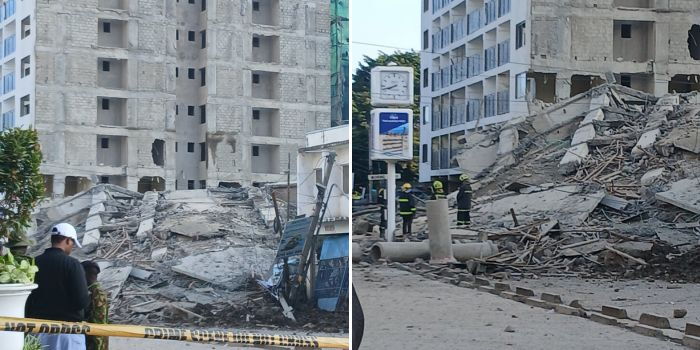
The recent tragic collapse of a 16-storey building under constructio in South C, Nairobi that claimed two lives must not be reduced to another footnote in Kenya’s long history of preventable urban disasters.
This was not an “accident” in the truest sense of the word. It was the predictable outcome of regulatory failure, professional negligence and institutional complicity and any attempt to cover up those responsible would amount to a betrayal of the victims and the public.
At the centre of this tragedy is the disturbing revelation that City Hall, under the leadership of Nairobi Governor Johnson Sakaja irregularly approved four additional floors on the building. In a city where zoning laws, structural limits and safety standards exist precisely to protect lives, such approvals are not minor clerical errors. They fundamentally alter the structural integrity of a building. When approvals are issued outside the law, they transform concrete and steel into instruments of death.
The question that must be answered openly and without fear is who at the Nairobi County government approved the extra floors, under what authority, and in exchange for what.
Nairobi’s development approval process has long been plagued by corruption, political interference and backroom deals. This collapse once again exposes how planning desks have become toll stations where public safety is traded for private gain.
But City Hall is not alone in this chain of culpability. The National Construction Authority (NCA), whose mandate is to inspect, register and regulate construction works, cannot escape responsibility.
If a building rises four floors beyond its approved design, inspectors either failed to act or deliberately looked away. Both scenarios are equally damning. Regulatory silence in the face of visible violations is not incompetence; it is complicity.
The National Environment Management Authority (NEMA) must also account for its role.
The environmental impact approvals are not mere paperwork exercises. They assess whether a development is suitable for its location, density and surrounding infrastructure. Any significant alteration to an approved project including the addition of multiple floors requires review. If NEMA approvals remained unchanged while the building ballooned upwards, then the agency failed in its statutory duty.
Professional bodies cannot hide behind bureaucratic fog either. The Engineers Board of Kenya (EBK) is responsible for licensing engineers and enforcing professional standards.
A structurally unsound building does not design itself. Engineers sign off drawings, supervise works and certify safety. If professional standards were ignored or signatures were sold, the board must identify, name and discipline those involved including deregistration and prosecution where necessary.
The same scrutiny applies to the Quantity Surveyors Association, whose members oversee costs, materials and project scope. The addition of four floors is not a minor variation; it fundamentally changes a project’s budget, materials and risk profile. Such a change would have required professional input. Silence here again suggests either negligence or collusion.
What makes this tragedy particularly painful is that the victims were not reckless. They trusted the system the approvals, the inspections, the stamps and certificates that are supposed to guarantee safety. When that system fails, accountability must be total, not selective.
Kenya does not suffer from a lack of laws or institutions. It suffers from selective enforcement and convenient amnesia after lives are lost. If the South C collapse is buried under taskforces, transfers and quiet retirements, then the country will have learned nothing. The next collapse will not be a surprise, rather, it will be a confirmation.
Justice for the two lives lost demands more than condolences. It demands arrests, prosecutions and permanent professional consequences. Anything less is a cover-up and an open invitation for the next building to fall.