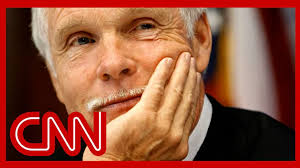
Media mogul Ted Turner, the visionary founder of CNN and Turner Broadcasting System, has died at the age of 87.
His private holding company, Turner Enterprises, confirmed that the billionaire businessman and noted environmentalist passed away on Wednesday, May 6, 2026.
Turner, who had largely withdrawn from public life in recent years following a diagnosis of Lewy body dementia, leaves behind a towering legacy that reshaped global media and television news.
In a statement, CNN chairman and CEO Mark Thompson paid tribute to the network’s founder, describing him as “an intensely involved and committed leader, intrepid, fearless and always willing to back a hunch and trust his own judgment.”
He added: “He was and always will be the presiding spirit of CNN. Ted is the giant on whose shoulders we stand.”
Turner revolutionized broadcasting by launching Cable News Network in 1980, the world’s first 24-hour news channel.
At a time when traditional evening bulletins dominated, the concept was seen as risky. However, CNN went on to transform how news is delivered and consumed, setting the pace for modern, round-the-clock journalism and paving the way for competitors such as Fox News and MSNBC.
A brash, unconventional figure often nicknamed “Captain Outrageous,” Turner built a media empire through Turner Broadcasting System, pioneering the “superstation” model that used satellite technology to beam programming nationwide.
His portfolio grew to include influential cable channels such as TBS, TNT, Cartoon Network and Turner Classic Movies.
Beyond television, Turner had a diverse business and cultural footprint.
He owned the Atlanta Braves baseball franchise, which he famously branded “America’s Team,” and the Atlanta Hawks basketball team. Under his ownership, the Braves won the 1995 World Series.
He also ventured into hospitality with Ted’s Montana Grill and played a significant role in professional wrestling through World Championship Wrestling (WCW).
Turner’s life was marked by bold decisions and occasional controversy.
His attempt to colorize classic black-and-white films from the MGM library drew sharp criticism from filmmakers and critics, including Roger Ebert. He later abandoned the practice but retained the film library, which became the backbone of Turner Classic Movies.
Born Robert Edward Turner III in Cincinnati in 1938, he took over his father’s billboard advertising business after his father’s death in 1963, transforming it into a communications powerhouse.
Despite being expelled from Brown University, Turner’s instincts and risk-taking propelled him to the top ranks of American business.
A committed philanthropist, Turner donated $1 billion to the United Nations and co-founded the Nuclear Threat Initiative, reflecting his deep interest in global issues and environmental advocacy. He was previously married to actress Jane Fonda.
Turner’s passing marks the end of an era for the media industry. His influence on journalism, entertainment and global communication remains profound, cementing his place as one of the most consequential media pioneers of the modern age.