Uhuru’s second gamble against Ruto, backs Matiang’i for president
For Uhuru, the gamble is twofold; reuniting a demoralised Jubilee Party and rebuilding a coalition capable of challenging President William Ruto’s re-election bid in 2027

Retired President Uhuru Kenyatta has projected his second gamble against his former ally turned political foe, President William Ruto by throwing his political weight behind former Interior Cabinet Secretary Fred Matiang’i as his preferred 2027 presidential candidate, signaling a fresh bet reminiscent of his 2022 support for the late former Prime Minister Raila Odinga.
And in a public tongue-lashing outburst against Jubilee Secretary General Jeremiah Kioni, the retired president sought to bring his house to order through a riot act, accusing him of stalling efforts to reposition the party within the emerging opposition alliance after Raila’s death.
Uhuru also ordered an immediate stop towards attacks targeting impeached former Deputy President Rigathi Gachagua, now Democracy for Citizens Party (DCP), a move widely seem as a conciliatory in solidifying the larger Mount Kenya rich vote bloc.
Uhuru’s support for Matiang’i signals a calculated but risky political gamble reminiscent of his 2022 support for Odinga, a campaign that ended in defeat and fractured the Azimio coalition.
The Informer Media Group has learned that the retired president is pushing for a more aggressive reorganisation of the party to prepare for an alliance that would center Matiang’i as a unifying figure for Mt. Kenya’s disenchanted voters and the rest of the country under the United Opposition that brings together Kalonzo Musyoka (Wiper), Martha Karua (PLP), Eugene Wamalwa (D-APK), Gachagua (DCP), Trans Nzoia governor George Natembeya and Justin Muturi (DP Party).
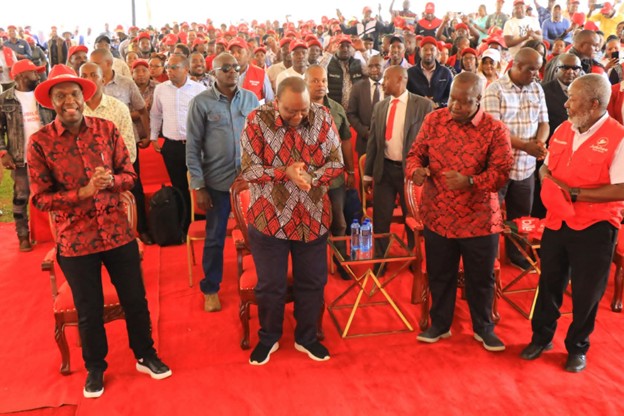
“We won’t allow any Jubilee member to abuse leaders, including Gachagua or anyone else. We need peace in this country,” he stated during yesterday’s Jubilee Party delegates meeting held at Thika Greens in Murang’a county.
Uhuru said Matiang’i had demonstrated exceptional capability and commitment to public service.
“I’m supporting Matiang’i because of his capacity, not his tribe. In fact, I don’t even know his home; I’ve never visited him, but he is a hardworking leader,” said Uhuru.
On his part, Matiang’i emphasised the need to build a country that values contribution over ethnicity, gender, or age. He reminded Kenyans of the spirit that has long defined the nation, one of resilience, endurance, and collective purpose.
“With the Kenyan spirit, we are a long-distance country; we always stay in the task and get there,” Matiang’i said, drawing parallels between Kenya’s global reputation for long-distance running and the country’s ability to persevere through challenges.
Political pundits contend that Uhuru’s renewed involvement will be a critical factor in 2027 polls.
Having lost political ground after the Azimio coalition’s defeat, Uhuru has faced pressure from within Jubilee to either rebrand or dissolve the party. His endorsement of Matiang’I once considered his most trusted Cabinet ally signals a strategic attempt to revive his political influence and reassert control over a fractured opposition landscape.
For Uhuru, the gamble is twofold; reuniting a demoralised Jubilee Party and rebuilding a coalition capable of challenging President William Ruto’s re-election bid in 2027.
It also represents a bid to restore the political identity of the Mt. Kenya region, which remains deeply divided between Ruto loyalists and those nostalgic for Uhuru’s leadership.