Trump’s China election claims threaten fragile US-China diplomatic thaw
In a rare prime-time address on Thursday last week, Trump revived his long-standing concerns over US election security, alleging that China had improperly obtained data on millions of American voters. He described the alleged breach as "an unprecedented election security nightmare" and suggested Beijing was attempting to influence US politics ahead of November's congressional elections.

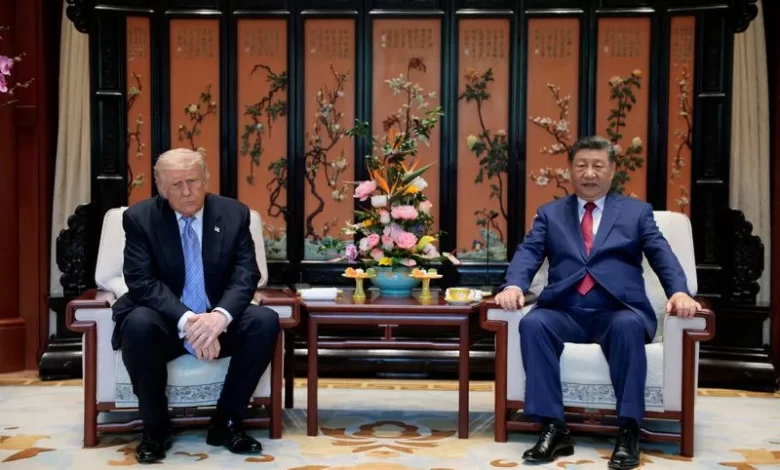
US President Donald Trump’s renewed accusations that China interfered in American elections have cast fresh uncertainty over a fragile diplomatic truce with Chinese President Xi Jinping, just two months before a planned leaders’ summit in Washington.
In a rare prime-time address on Thursday last week, Trump revived his long-standing concerns over US election security, alleging that China had improperly obtained data on millions of American voters.
He described the alleged breach as “an unprecedented election security nightmare” and suggested Beijing was attempting to influence US politics ahead of November’s congressional elections.
“The Chinese government wanted the US president to lose the next election, and the reason they wanted me to lose is because they knew I was wise to them,” Trump said.
Beijing swiftly rejected the allegations, dismissing them as baseless and politically motivated.
Chinese Foreign Ministry spokesperson Lin Jian said the accusations were “pure fabrication” and amounted to “a malicious smear campaign.”
“China has no interest in interfering in US elections and has never done so,” Lin said during a regular media briefing. “We urge the United States to take a long, hard look at itself and stop making unfounded accusations against China.”
Earlier, Liu Chang, spokesperson for the Chinese embassy in Washington, had also insisted that China “has never and will never interfere in the presidential elections of the United States.”
Trump’s latest remarks represent a notable shift from his recent conciliatory tone toward Beijing despite Washington’s continued view of China as its principal strategic competitor.
The comments also risk undermining a carefully negotiated trade truce that halted last year’s tariff dispute between the world’s two largest economies.
After imposing triple-digit tariffs on Chinese imports in 2025, Trump eased his stance last October amid concerns that China’s restrictions on rare-earth metal exports could disrupt US manufacturing.
Relations further improved in May when Xi hosted Trump on a state visit, during which the US president praised Xi as a “friend” and softened his rhetoric on sensitive issues, including Taiwan.
Trump subsequently invited Xi to Washington for talks scheduled for September 24 and is also considering attending the Asia-Pacific Economic Cooperation (APEC) summit in Shenzhen, China, in November.
However, China has yet to confirm Xi’s visit to Washington.
According to people familiar with the discussions, Beijing has privately informed the Trump administration that future high-level engagements will depend on maintaining stable and positive bilateral relations.
While Trump’s renewed accusations could strain diplomatic ties, analysts note that Beijing may choose to downplay the remarks in order to preserve dialogue and avoid jeopardising the broader effort to stabilise relations between the two economic powers.