The Trump doctrine: Disrupting diplomacy, defining a New Order

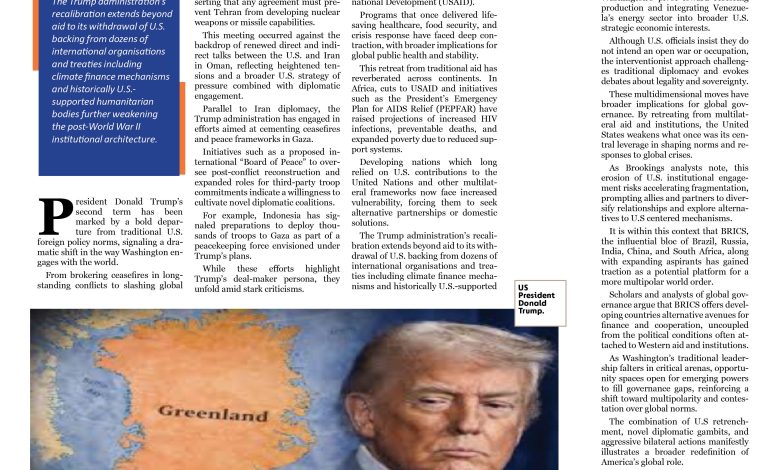
President Donald Trump’s second term has been marked by a bold departure from traditional U.S. foreign policy norms, signaling a dramatic shift in the way Washington engages with the world.
From brokering ceasefires in long-standing conflicts to slashing global aid and intervening in hemispheric politics, these moves are reshaping international institutions and accelerating the emergence of a multipolar global order.
One of the more visible aspects of Trump’s diplomacy has been his active role in attempting to resolve conflicts in the Middle East.
In recent months, Trump hosted Israeli Prime Minister Benjamin Netanyahu in Washington, for a record seventh time earlier this week and emphasised continuation of negotiations with Iran over its nuclear program, asserting that any agreement must prevent Tehran from developing nuclear weapons or missile capabilities.
This meeting occurred against the backdrop of renewed direct and indirect talks between the U.S. and Iran in Oman, reflecting heightened tensions and a broader U.S. strategy of pressure combined with diplomatic engagement.
Parallel to Iran diplomacy, the Trump administration has engaged in efforts aimed at cementing ceasefires and peace frameworks in Gaza.
Initiatives such as a proposed international “Board of Peace” to oversee post-conflict reconstruction and expanded roles for third-party troop commitments indicate a willingness to cultivate novel diplomatic coalitions.
For example, Indonesia has signaled preparations to deploy thousands of troops to Gaza as part of a peacekeeping force envisioned under Trump’s plans.
While these efforts highlight Trump’s deal-maker persona, they unfold amid stark criticisms.
Opponents argue that some ceasefire initiatives lean toward transactional diplomacy that prioritizes short-term visibility over sustainable peace.
Perhaps more consequential, however, have been Trump’s sweeping cuts to U.S. foreign aid and multilateral engagement.
Under Executive Order 14169 and related directives, Washington paused, restructured, and drastically reduced foreign development assistance including massive disruptions in the United States Agency for International Development (USAID).
Programs that once delivered life-saving healthcare, food security, and crisis response have faced deep contraction, with broader implications for global public health and stability.
This retreat from traditional aid has reverberated across continents. In Africa, cuts to USAID and initiatives such as the President’s Emergency Plan for AIDS Relief (PEPFAR) have raised projections of increased HIV infections, preventable deaths, and expanded poverty due to reduced support systems.
Developing nations which long relied on U.S. contributions to the United Nations and other multilateral frameworks now face increased vulnerability, forcing them to seek alternative partnerships or domestic solutions.
The Trump administration’s recalibration extends beyond aid to its withdrawal of U.S. backing from dozens of international organisations and treaties including climate finance mechanisms and historically U.S.-supported humanitarian bodies further weakening the post-World War II institutional architecture.
Critics contend these moves undermine longstanding global cooperation mechanisms and signal a narrowing of American leadership.
Simultaneously, the United States has dramatically intensified its involvement in the Western Hemisphere, most notably in Venezuela.
Following a surprise military operation in January this year that ousted Venezuelan President Nicolás Maduro, the U.S. is engaging directly with Venezuela’s interim leadership and facilitating new oil and investment agreements with international firms.
U.S. Energy Secretary Chris Wright’s recent visit to Caracas underscores Washington’s pivot toward restoring production and integrating Venezuela’s energy sector into broader U.S. strategic economic interests.
Although U.S. officials insist they do not intend an open war or occupation, the interventionist approach challenges traditional diplomacy and evokes debates about legality and sovereignty.
These multidimensional moves have broader implications for global governance. By retreating from multilateral aid and institutions, the United States weakens what once was its central leverage in shaping norms and responses to global crises.
As Brookings analysts note, this erosion of U.S. institutional engagement risks accelerating fragmentation, prompting allies and partners to diversify relationships and explore alternatives to U.S centered mechanisms.
It is within this context that BRICS, the influential bloc of Brazil, Russia, India, China, and South Africa, along with expanding aspirants has gained traction as a potential platform for a more multipolar world order.
Scholars and analysts of global governance argue that BRICS offers developing countries alternative avenues for finance and cooperation, uncoupled from the political conditions often attached to Western aid and institutions.
As Washington’s traditional leadership falters in critical arenas, opportunity spaces open for emerging powers to fill governance gaps, reinforcing a shift toward multipolarity and contestation over global norms.
The combination of U.S retrenchment, novel diplomatic gambits, and aggressive bilateral actions manifestly illustrates a broader redefinition of America’s global role.
While Trump’s approach seeks to prioritise direct U.S interests and quick diplomatic wins including resorting to gunboat diplomacy, it simultaneously signals a departure from collective action frameworks that characterised Western leadership for decades.
Indisputably, the result may be a world that is less anchored by shared institutions and more shaped by transactional power dynamics, regional blocs, and competitive multipolar influence thereby ushering in a new chapter of geopolitical complexity and uncertainty.
Kinyuru Munuhe is the Executive Director at Governance and Diplomacy Associates. He is also a Diplomacy, Geopolitics and Strategic Communications specialist. @AssociatesGda or @KINYURUMUNUHE