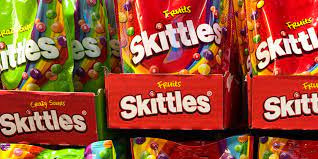
A consumer is suing candy maker Mars, alleging Skittles contain a “known toxin” that makes the rainbow candies “unfit for human consumption.”
Jenile Thames, a San Leandro resident, filed a class-action lawsuit against Mars Inc, the confection company that manufactures Skittles, alleging that people who consume Skittles “are at heightened risk of a host of health effects for which they were unaware stemming from genotoxicity – the ability of a chemical substance to change DNA.”
According to the civil claim, Mars has long been aware of the purported hazards linked with this chemical and officially said in February 2016 that it will phase out titanium dioxide. According to court documents, after France prohibited titanium dioxide in 2019, Mars stated that it would comply with the legislation.
Thames’ lawsuit claims that Mars “blew smoke” six years ago when it stated that the phase-out was only because “consumers now are asking food manufacturers to utilize more natural ingredients in their products.”
“Incredibly, Defendant even claimed that ‘artificial colours pose no known risks to human health or safety’,” Thames’ suit also said.
Thames claims that Mars continues to sell sweets containing titanium dioxide as an additive in the United States and is “failing to tell customers of the risks of consuming the poison.” (Ingredients listings differ, with some claiming titanium dioxide may or may not be present.)
“Instead, Defendant relies on the ingredient list which is provided in minuscule print on the back of the Products, the reading of which is made even more challenging by the lack of contrast in colour between the font and packaging, as set out below in a manner in which consumers would normally view the product in the store,” court papers contend.
Thames claimed that Mars fails to adequately inform Skittles customers about this alleged dangerous chemical, either before or at the time of purchase, and that the candies “should otherwise be regarded with caution.”
Titanium dioxide is “a pigment often used to give a hazy look and white background colour,” according to the European Food Safety Authority, and is commonly used in sweets and baking. The organization declared in 2021 that “titanium dioxide can no longer be deemed safe as a food ingredient.”
“A critical element in reaching this conclusion is that we could not exclude genotoxicity concerns after consumption of titanium dioxide particles,” the authority said. “After oral ingestion, the absorption of titanium dioxide particles is low, however they can accumulate in the body.”
The product costs between Sh100 and Sh400. According to the complaint, the defendant has not completely disclosed the ingredients of the candy.
The chemical is also used in the production of paints, coatings, adhesives, plastics, printing inks, toothpaste, and roofing materials, among other things.