Ruto’s tears, Kenya’s pain: Economic gloom behind president’s South Rift tour
The latest TIFA survey also revealed rising pessimism about the country’s overall direction. A commanding 76 per cent of Kenyans said the country was moving in the wrong direction which is the highest level recorded during TIFA’s tracking period.

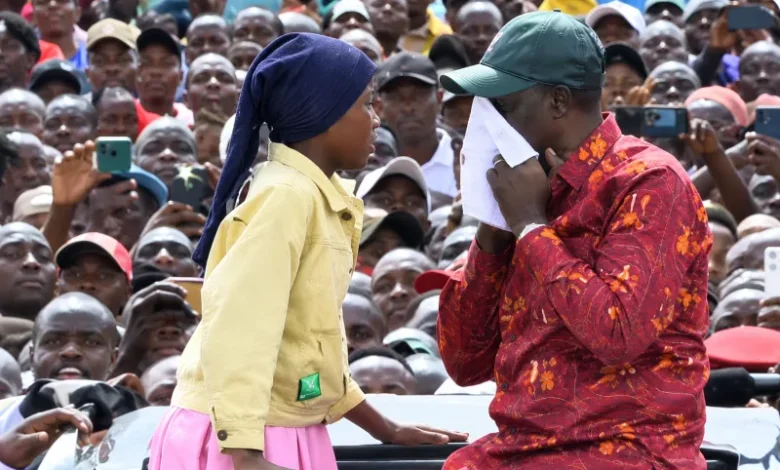
President William Ruto was today visibly moved to tears after listening to an emotional poem and personal struggles shared by a young girl during his development tour of Bomet, in a poignant moment that unfolded against a backdrop of growing public dissatisfaction with the country’s economic direction.
The emotional encounter came today, Wednesday, September 9, 2026 as the president began a four-day tour of the South Rift, taking him through Bomet and Kericho counties to inspect and commission roads, healthcare facilities, affordable housing projects and markets.
The young girl was lifted onto the roof of Ruto’s vehicle by his security detail before being warmly welcomed by the President, who embraced her and invited her to address the gathering.
“Si tusikize hii poem ya huyu mrembo?” loosely translated as (Let us listen to this beautiful young girl’s poem) Ruto asked the crowd, drawing an enthusiastic response.
The girl took the microphone and began reciting a poem in Kalenjin, initially drawing laughter and cheers from the crowd. But the mood quickly changed as she became overwhelmed by emotion and began crying while recounting her experiences and personal struggles.
She repeatedly paused as tears flowed, but continued with the poem, encouraged by cheers from the crowd and the President’s reassuring gestures.
Ruto repeatedly embraced the girl as she spoke. When she finished, the President reached into his pocket for a white handkerchief, using it first to wipe his own eyes before wiping away the girl’s tears.
The President appeared deeply emotional as he continued comforting her, at one point blowing his nose as the girl stood beside him. He later helped her down from the vehicle with the assistance of his security detail.
The touching scene offered a striking human moment during a tour dominated by government development projects and political messaging, but it also came as a new public opinion survey painted a grim picture of the economic mood confronting millions of Kenyans.
Two-thirds say they are worse off
According to the latest TIFA Research survey, 65 per cent of Kenyans say their personal or household economic situation has deteriorated since the 2022 General Election, when Ruto came to power.
Only 12 per cent said their economic circumstances had improved, while 23 per cent said their situation had remained unchanged.
The findings suggest that despite government efforts to showcase infrastructure and development projects, economic hardship remains deeply entrenched in households across the country.
TIFA said the proportion of Kenyans reporting worsening economic conditions has remained consistently high since the research firm began tracking the issue in May 2025.
The figure stood at 75 per cent in May 2025, 70 per cent in August, 67 per cent in November, 64 per cent in May 2026 and 65 per cent in June 2026.
Those reporting improvement rose from 10 per cent in May and August 2025 to 15 per cent in November and 19 per cent in May 2026, before falling sharply to 12 per cent in June.
TIFA said the latest figure reporting economic improvement was the lowest since August last year, when it stood at 10 per cent.
“With some two-thirds of Kenyans indicating a worsening of their economic situation, unless this changes over the next year, it could be challenging for all politicians seeking re-election, especially those identified with the incumbent government,” the research firm warned.
Economic pain cuts across regions
The economic pessimism is not confined to traditional opposition strongholds.
Majorities in all nine regions surveyed said their personal or household finances had worsened since 2022.
Mt Kenya recorded the highest proportion at 79 per cent, followed by Western at 74 per cent, South Rift at 71 per cent, and Lower Eastern and Nairobi at 69 per cent each.
Coast recorded 57 per cent, Nyanza 58 per cent, Central Rift 53 per cent and Northern 49 per cent.
Even in regions where the Broad-Based Government enjoys relatively stronger support, significant proportions of residents reported worsening economic circumstances.
The figures stood at 58 per cent in Nyanza, 53 per cent in Central Rift and 49 per cent in Northern.
Political affiliation, however, appeared to influence how respondents assessed their economic circumstances.
Among supporters of the Broad-Based Government, 19 per cent said their economic situation had improved, compared with only eight per cent among its opponents.
Half of BBG supporters said their situation had worsened, compared with 73 per cent among opponents.
TIFA cautioned that further research would be necessary to establish whether the difference reflects actual variations in economic circumstances or political perceptions.
76 per cent say Kenya is on the wrong track
The survey also revealed rising pessimism about the country’s overall direction.
A commanding 76 per cent of Kenyans said the country was moving in the wrong direction, the highest level recorded during TIFA’s tracking period.
Only 15 per cent believed Kenya was headed in the right direction, while eight per cent said the country was moving neither in the right nor wrong direction.
Mt Kenya registered the strongest negative sentiment at 90 per cent, followed by Nairobi at 89 per cent, Lower Eastern at 83 per cent and South Rift at 82 per cent.
Northern recorded the highest proportion of respondents who believed the country was moving in the right direction at 38 per cent, followed by Central Rift at 24 per cent, although positive assessments remained a minority.
TIFA’s tracking shows a substantial deterioration in public sentiment since 2023. The proportion saying Kenya was headed in the wrong direction increased from 48 per cent in March 2023 to 75 per cent in May 2025.
It subsequently fell to 62 per cent in August/September 2025 before climbing to 68 per cent in November, 74 per cent in May 2026 and 76 per cent in June.
Economy emerges as biggest problem
Economic concerns overwhelmingly dominated the list of problems facing the country.
About 70 per cent of respondents identified economic issues as Kenya’s most serious problem.
Unemployment and poverty accounted for 44 per cent, while inflation, high prices and high taxes accounted for another 25 per cent.
Corruption followed at 19 per cent.
The survey also established a strong relationship between household economic experiences and perceptions of the country’s direction.
Among respondents who believed Kenya was moving in the right direction, 39 per cent said their economic situation had improved since 2022.
Among those who believed the country was moving in the wrong direction, only seven per cent reported an improvement.
Conversely, 75 per cent of respondents who believed Kenya was on the wrong track said their household economic situation had deteriorated, compared with 25 per cent among those who viewed the country’s direction positively.
TIFA said the findings demonstrated that while economic conditions were not the only factor shaping public opinion, they played a major role in determining how Kenyans assessed the country’s trajectory.
A difficult political backdrop
The findings present a potentially difficult political environment for the Ruto administration as Kenya moves towards the 2027 General Election.
The president has increasingly used regional tours to highlight government achievements in infrastructure, healthcare, housing, markets and other development programmes, while seeking to demonstrate that his administration’s policies are improving the lives of ordinary citizens.
Yet the TIFA findings suggest that the impact of those projects has not yet translated into widespread improvement in household economic confidence.
The contrast was particularly striking in Bomet, where Ruto’s emotional interaction with the young girl provided a rare personal moment during a politically significant regional tour.
As the president wiped away his tears and comforted the visibly distressed girl, the scene unfolded against a national mood in which millions of Kenyans say they are struggling with the rising cost of living, unemployment, poverty, taxes and other economic pressures.
TIFA’s survey was conducted between June 13 and 22, 2026, through face-to-face interviews with 2,048 randomly selected adults across all 47 counties. It has a margin of error of plus or minus 2.18 percentage points, with larger margins applying to smaller sub-samples.