Ruto’s secret meeting with ODM leaders and his 2027 game plan

President William Ruto’s clandestine Christmas Day meeting with a faction of Orange Democratic Movement (ODM) leaders at his Kilgoris home marks a pivotal moment in Kenya’s political realignments ahead of the 2027 general elections.
Though conducted quietly, the meeting has far-reaching implications that extend beyond routine political consultations, signalling a deliberate strategy by Ruto to takeover ODM into UDA’s fold, reconfigure its power centres and potentially neutralise the enduring influence of its founding leader, the late former Prime Minister Raila Odinga to his advantage.
The talks, chaired by Ruto and attended by senior ODM figures including Oburu Oginga, Gladys Wanga, Junet Mohamed, Abdulswamad Nassir, and Cabinet secretaries Opiyo Wandayi and Wycliffe Oparanya, immediately set off alarm bells within ODM.
Notably absent were influential party stalwarts such as Secretary-General Edwin Sifuna, Siaya Governor James Orengo, and other deputy party leaders, underscoring deepening fault lines within the party.
The exclusion of the ODM stalwarts highlights a widening divide between ODM leaders willing to collaborate with the ruling United Democratic Alliance (UDA) and those determined to preserve ODM’s identity as an independent opposition force.
While the secrecy of the talks speaks volumes about the strategic calculus behind them, the implications extend far beyond the immediate political manoeuvring of the ruling United Democratic Alliance (UDA) and ODM.
At its core, this development signals a concerted effort by Ruto to weaken ODM from within, realign its power structure, and potentially subvert Raila Odinga’s enduring influence over key political constituencies.
ODM’s traditional strongholds Nyanza, Nairobi, Western Kenya and the Coast have become the focal point of this political chess game. Ruto’s overtures appear designed to fracture ODM’s base, co-opt key figures into his broad-based government, and weaken any unified opposition challenge in 2027.
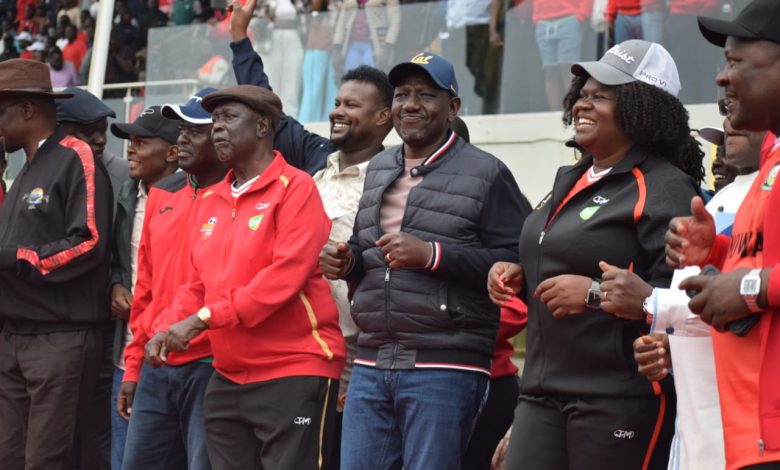
This strategy was further laid bare during a football tournament in Migori attended by Ruto, where Junet Mohamed and Gladys Wanga made remarks that exposed ODM’s internal contradictions.
Junet’s declaration that ODM was prepared to support Ruto’s re-election bid in 2027 represented a dramatic rhetorical shift for a party historically positioned as Kenya’s main opposition.
His remarks effectively normalised the idea of a long-term ODM–UDA realignment, reinforcing Ruto’s own suggestion that ODM could be accommodated as a partner rather than an adversary. For critics within the party, this signalled a dangerous dilution of ODM’s ideological purpose.
“As ODM, we will work within the broad-based government until 2027 to support President Ruto. We also hope to form the next government together from the start,” Oburu said while at Raila Odinga Stadium in Homa Bay town during the Genowa Governor’s Cup, an annual tournament organised by Homa Bay Governor Gladys Wanga.
Even more contentious was Junet’s assertion that only Oburu Oginga could legitimately declare a presidential candidacy on an ODM ticket. Citing the party constitution, Junet framed himself as a defender of discipline, but in doing so narrowed internal democratic space and alienated leaders calling for an open contest. His warning against alleged “coup plotters” seeking a National Delegates Conference (NDC) to elect substantive party leadership further securitised internal dissent, portraying legitimate debate as subversion.
These tensions have been compounded by claims from Junet and Wanga that former President Uhuru Kenyatta is financing divisions within ODM allegations that, whether true or not, reinforce a siege mentality among the party’s leadership.
Oburu Oginga’s own intervention, projecting continuity and reaffirming commitment to cooperation with Ruto, placed him firmly among ODM pragmatists who prioritise access to state power over electoral confrontation. However, this stance risks alienating ODM supporters who expect the party to provide a clear alternative to the current administration.
However, retired President Uhuru Kenyatta dismissed claims that he is seeking to divide the Orange Democratic Movement (ODM), saying he respects the party and its members and has no intention of interfering in its internal affairs.
Speaking during the burial of former Lugari MP Cyrus Jirongo, Kenyatta said he would not take attacks against him lightly.
His remarks came amid growing tensions within ODM, with party Secretary General Edwin Sifuna later defending the former president and issuing an apology on behalf of the party.
A week earlier, National Assembly Minority Leader Junet Mohamed had accused Kenyatta of destabilising ODM.
The claims have emerged as unity talks among Western region leaders and differing positions on President William Ruto’s re-election continue to expose sharp divisions within the opposition. A visibly agitated Kenyatta went on the offensive against his critics, vowing to confront them head-on.
“You very well know I am retired, but being retired does not mean you can poke me in the eye and expect no retaliation. I will also poke you back. We have no fear, but we must respect each other,” he said.
The prospect of an ODM–UDA merger, though still embryonic, looms large. Such a merger could effectively dismantle ODM as it is currently known, consolidating Ruto’s influence in regions long loyal to Raila Odinga.
If realised before mid-2027, it would create a formidable political machine capable of marginalising rival opposition formations. Yet the strategy is fraught with risk. Disgruntled ODM factions opposed to the merger could defect to a united opposition front, potentially splitting votes and complicating Ruto’s re-election bid.
ODM’s internal crisis is further shaped by its looming National Delegates Conference, expected in 2026, which is meant to address leadership succession following Raila Odinga’s death.
The absence of Raila’s unifying authority has left a vacuum now fiercely contested by rival factions with divergent visions for the party’s future. Calls for an NDC, championed by a section of party members including Raila’s daughter Winnie Odinga, have revived memories of the chaotic 2014 Kasarani NDC, which was disrupted by “men in black” allegedly deployed to thwart an internal coup against Raila.
That episode serves as a cautionary tale. It exposed ODM’s vulnerability to internal sabotage and external manipulation, reportedly involving party insiders and external actors aligned with the then Jubilee government. The question now is whether ODM can hold a free, fair and credible NDC without interference, especially given the growing influence of ODM leaders who have since joined Ruto’s government.
The ideological divide within ODM has sharpened since Raila’s passing. One faction, aligned with pragmatism and power-sharing, argues that ODM’s future lies in cooperation with Ruto, possibly even providing a running mate in 2027.
This camp includes several former ODM power brokers now serving as Cabinet secretaries, who have relinquished party positions but continue to exert influence. The opposing faction insists that ODM must remain a robust opposition party, warning that collaboration with Ruto represents a betrayal of the party’s founding values.
The involvement of UDA and the state in ODM’s internal affairs raises serious concerns about the independence of any forthcoming NDC. With pro-Ruto figures embedded within government and retaining strong networks inside ODM, fears abound that the conference could be manipulated through delegate control, intimidation or procedural interference.
Winnie Odinga’s emergence as a vocal advocate for a transparent NDC symbolises a generational push to safeguard ODM’s ideological soul. Yet her challenge is formidable. She must navigate entrenched interests, factional rivalries and external pressure, all while attempting to preserve party unity and credibility.
Ultimately, ODM stands at a critical crossroads. Its struggle is not merely about leadership succession but about identity whether it remains Kenya’s leading opposition force or transforms into a junior partner within Ruto’s political architecture. The outcome of this internal battle will shape not only ODM’s future but also the broader trajectory of Kenyan politics ahead of 2027.
For President Ruto, the strategy represents a high-stakes gamble to co-opt ODM and consolidate power, or trigger a backlash that re-energises a fragmented opposition, whereas, for ODM, the stakes are existential. Failure to conduct a credible NDC and manage its internal divisions risks fracturing the party beyond repair and surrendering its historic role in Kenya’s democratic contest.