Ruto urges Africa to ditch foreign funding for infrastructure financing

President William Ruto has urged African nations to prioritise domestic resource mobilisation to fund critical infrastructure, warning that overreliance on foreign capital is hindering the continent’s development ambitions.
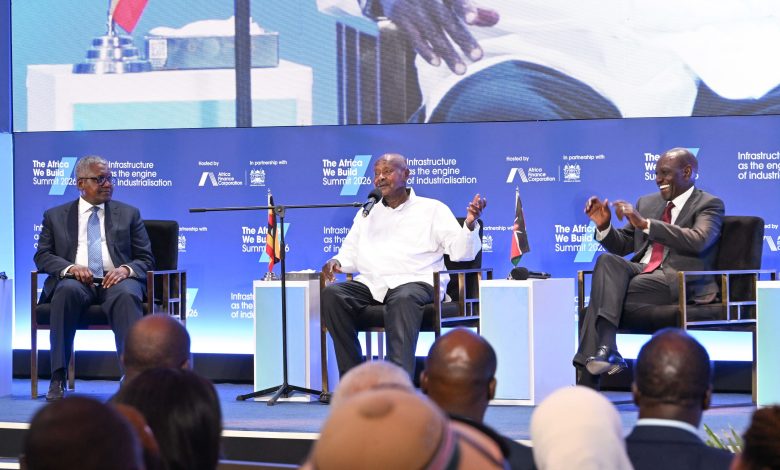
Speaking during the opening of the The Africa We Build Summit 2026 in Nairobi, Ruto said Africa must take greater control of its development agenda by leveraging internal capital to finance projects such as roads, ports, airports and oil refineries.
“We must harness the immense capital within Africa to drive the infrastructure development our nations urgently require. Our ambitions will remain unrealised if we continue depending on external capital whose primary interest lies in profit rather than advancing our shared prosperity,” Ruto said.
The summit, co-hosted by the Africa Finance Corporation (AFC), also marked the release of the Africa Infrastructure Report, a key document expected to shape the continent’s development trajectory. Ruto welcomed AFC’s decision to establish its regional headquarters in Nairobi, describing it as a strong endorsement of Kenya’s position as a leading investment hub.
Cautioning against the conditions often tied to foreign financing, the President invoked the saying, “he who pays the piper calls the tune,” noting that external funding frequently comes with competing interests, including securing raw materials for foreign industries.
Among leaders present at the summit was Yoweri Museveni, who echoed Ruto’s call for Africa to tap into its own financial resources.
Museveni pointed to pension funds as a largely untapped source of capital, arguing that Africa’s development challenges stem more from ideology than lack of money.
“Africa’s GDP is only about $3.6 trillion despite our vast land and population. Countries like China transformed themselves through discipline and clarity of purpose. Therefore, Africa’s problem is not money; it is ideological,” Museveni said.
The high-level meeting also drew key figures including AFC President and CEO Samaila Zubairu, Prime Cabinet Secretary Musalia Mudavadi, and Nigerian industrialist Aliko Dangote.
“As I emphasised in Nairobi during Tokyo International Conference on African Development ten years ago, we must stop addressing our problems in isolation. If we resolve the strategic bottlenecks of ideological disorientation, weak states, fragmented markets, low value addition, underdeveloped infrastructure, and gaps in human resources, Africa will be unstoppable,” Museveni added.
Ruto highlighted Kenya’s National Infrastructure Fund and the proposed Sovereign Wealth Fund as strategic tools to attract both domestic and international investment.
He said the government aims to mobilise financing for priority projects worth KSh5 trillion (approximately $40 billion) over the next decade.
In a push for regional collaboration, the President revealed ongoing discussions among East African countries to establish a joint oil refinery at Tanga Port, which would process crude oil from nations including the Democratic Republic of the Congo, South Sudan and Uganda.
He noted that although Africa produces about 10 million barrels of oil daily—roughly 10 percent of global output—the continent still imports petroleum products worth an estimated $90 billion annually.
Ruto also underscored the importance of regional integration, calling for interconnected infrastructure networks to facilitate seamless movement of goods and resources across borders.
He further proposed the creation of regional development platforms, drawing parallels with the early stages of the European Coal and Steel Community, which later evolved into the European Union.
Additionally, the President highlighted Africa’s vast reserves of critical minerals essential for the global energy transition, including copper, cobalt, lithium and rare earth elements, urging countries to pool resources and position themselves competitively in green manufacturing.
The summit brought together policymakers, investors and industry leaders to explore sustainable financing solutions for infrastructure, amid growing consensus that Africa must increasingly rely on its own resources to drive long-term growth and economic transformation.