Ruto signs law to raise Sh5 trillion for infrastructure despite opposition over oversight concerns

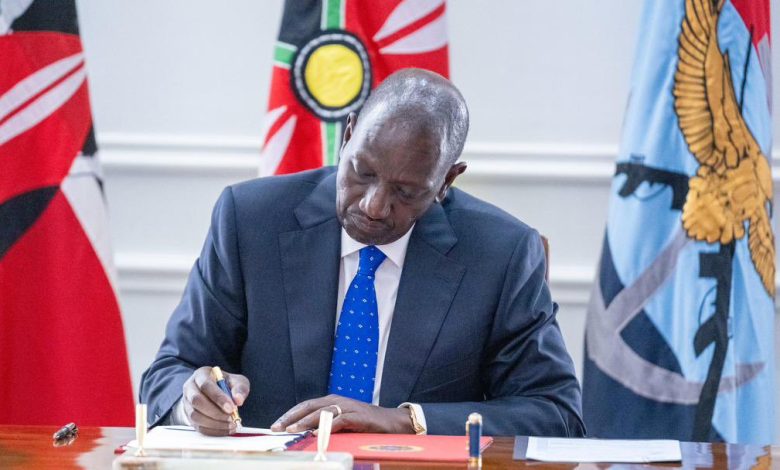
President William Ruto today morning signed into law the National Infrastructure Fund (NIF) Bill, creating a new financing framework designed to mobilise more than Sh5 trillion for major development projects across the country.
The law was assented to this morning at a ceremony held at State House attended by senior government officials, investors and business leaders from Kenya, Africa and other parts of the world despite oversight and transparency concerns raised by the opposition leaders opposing the move as budgeted corruption.
President William Ruto signed the NIF Bill into law shortly after the National Assembly passed it and after the Kenya High Court has lifted conservatory orders that temporarily halted the Sh5 trillion National Infrastructure Fund (NIF) earlier this month paving way for the government to proceed with its operationalisation.
The petition, initially filed by th Consumers Federation of Kenya (COFEK) and other petitioners, challenged the constitutionality, public participation, and management of the proposed Sh5 trillion fund.
The move marks a significant step in the government’s plan to close the country’s infrastructure financing gap and accelerate economic growth.
President Ruto described the National Infrastructure Fund as one of the most consequential initiatives in Kenya’s development agenda, saying it will provide a structured platform for financing critical national projects.
He noted that the fund is intended to reduce reliance on traditional borrowing while attracting private capital into large-scale infrastructure investments.
Under the new framework, the government plans to channel funds into a wide range of strategic projects aimed at transforming the country’s energy, water, transport and logistics sectors. Among the key priorities is the generation of 10,000 megawatts of clean energy, which the administration views as essential for supporting industrial expansion and meeting the country’s growing electricity demand.
The infrastructure programme will also focus on strengthening water security through the construction of 50 mega dams, 200 micro-dams and more than 1,000 small dams across different regions. These projects are expected to support irrigation, improve water supply and enhance climate resilience.
In the transport sector, the fund will support the development of 2,500 kilometres of dual carriageways and the upgrading of approximately 28,000 kilometres of roads.
The government believes these investments will ease congestion, enhance regional connectivity and lower the cost of transporting goods and services.
The new financing mechanism will also back major rail and aviation projects. This includes extending the Standard Gauge Railway from Naivasha to Malaba and Kisumu, a project aimed at improving cargo movement between Kenya and neighbouring countries. In addition, the fund will help finance the expansion of Jomo Kenyatta International Airport to increase passenger and cargo handling capacity.
President Ruto said the fund will allow the government to package infrastructure priorities into investable financial instruments, making them attractive to both local and international investors. The structure is also designed to de-risk large infrastructure projects, providing confidence to investors seeking long-term opportunities.
“The Kenyan National Infrastructure Fund is not an experiment; it is a model that has succeeded in other jurisdictions,” the President said during the signing ceremony.
According to the government, the establishment of the fund fulfils a key pledge in its development agenda and is expected to play a major role in supporting Kenya’s long-term ambition of achieving advanced economic growth and global competitiveness.