Ruto enters US-Israel firestorm against Iran as Tehran spares Kenya

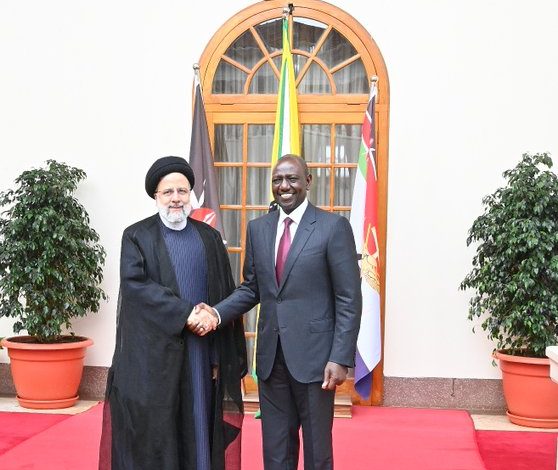
President William Ruto yesterday waded into the escalating confrontation between the United States, Israel and Iran, condemning missile strikes in the Gulf region even as Tehran reassured Nairobi that Kenya is not a target.
The diplomatic exchange unfolded as tensions in the Middle East surged following joint US-Israeli strikes on Iran that reportedly killed senior officials, including Supreme Leader Ayatollah Ali Khamenei.
In retaliation, Iran launched missile and drone attacks across several Gulf states, dramatically widening the scope of the conflict.
Speaking at a press briefing in Nairobi yesterday, Iran’s Ambassador to Kenya, Dr Ali Gholampour, sought to calm fears that Kenya could be drawn into the crisis.
He stated that Kenya does not host a US military facility of sufficient strategic importance to justify Iranian retaliation.
“This country does not provide a US military facility with a magnitude to attack Iran,” Gholampour said, dismissing speculation that Nairobi could be caught in the crossfire as Tehran responds to strikes by Washington and Tel Aviv. While condemning the US and Israeli attacks as a “flagrant violation of international peace and stability,” the envoy insisted Kenya remains outside Iran’s crosshairs.
Iran’s retaliatory strikes have targeted or hit the United Arab Emirates, Qatar, Saudi Arabia, Iraq, Oman, Kuwait, Jordan and Bahrain, in what Tehran describes as acts of self-defence.
The UAE reported that two people were killed in Abu Dhabi, including a Pakistani civilian, after 137 missiles and 209 drones were launched toward its territory.
Witnesses in Dubai described explosions and smoke rising near the Palm island. Qatar said it intercepted several incoming missiles, while in Iraq, air strikes on a military base housing the pro-Iran group Kataeb Hezbollah left two people dead, heightening fears of further escalation.
Iran’s Revolutionary Guards also moved to close the Strait of Hormuz, a vital maritime chokepoint through which much of the world’s oil and gas supplies transit, sparking concerns over potential global economic disruption.
In Nairobi, President Ruto strongly condemned the missile attacks targeting American bases in the Gulf and warned that the regionalisation of the conflict poses a grave threat to international peace and security.
President Ruto called for urgent diplomatic engagement and emphasised the importance of multilateral institutions in managing the crisis.
“At this defining and perilous moment in global history, longstanding multilateral institutions remain indispensable frameworks for the resolution of the current crisis in the Middle East,” Ruto said.
Prime Cabinet Secretary Musalia Mudavadi issued a travel advisory urging Kenyans living in or transiting through the Middle East to exercise extreme caution, avoid non-essential movement, and adhere to local security guidance.
The fallout has also disrupted air travel.
Kenya Airways suspended flights to Dubai and Sharjah as multiple countries closed their airspace. Aviation experts describe the turmoil as the most significant disruption to global air transport since the Covid-19 pandemic.
Meanwhile, the United Nations Security Council convened an emergency session, with UN Secretary-General Antonio Guterres warning that continued military action risks triggering uncontrollable consequences.
As diplomatic tensions mount, Kenya finds itself balancing condemnation of regional violence with reassurances from Tehran that it is not in the line of fire.