Ruku’s Mt Kenya split push exposes Ruto’s new political battle plan
DCP’s landslide victory in Ol Kalou has intensified debate over President Ruto's rapidly declining influence in Mt Kenya, where former Deputy President Rigathi Gachagua continues to command significant political support coupled by the commanding influence retired President Uhuru Kenyatta wields in his backyard.

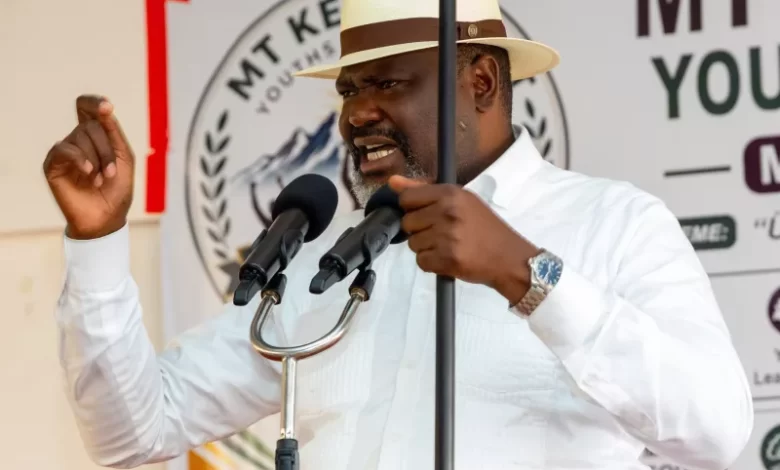
Public Service Cabinet Secretary Geoffrey Ruku has emerged as the face of an increasingly aggressive political strategy by President William Ruto’s camp for increasingly contentious battle for control of the vote-rich Mount Kenya region, with his push to politically separate Mount Kenya East from Mount Kenya West igniting fierce debate following the ruling coalition’s crushing defeat in the Ol Kalou parliamentary by-election.
Ruku’s latest push came in the aftermath of the crushing defeat suffered by President Ruto’s United Democratic Alliance (UDA) in Thursday’s Ol Kalou parliamentary by-election, a contest widely viewed as a referendum on the President’s standing in the region.
Ruku’s latest remarks have reinforced perceptions that he is spearheading a strategy by the Kenya Kwanza administration to weaken the traditional political unity of the Mount Kenya region as President Ruto seeks to recover waning support ahead of the 2027 General Election.
The by-election delivered a major political blow to the Kenya Kwanza administration after Democracy for the Citizens Party (DCP) candidate Sammy Douglas Waweru Kamau won by an overwhelming margin, marking one of UDA’s most humiliating electoral defeats since coming to power and just slightly one year to 2027 General Elections.
Official results released by the Independent Electoral and Boundaries Commission (IEBC) showed Waweru of DCP won the seat with more than 35,440 votes, while UDA candidate Samuel Muchina Nyagah managed only about 5,450 votes.
The remaining candidates trailed far behind: Abdifatah Hussein Abdallah (FPK) 19 votes, Timothy Kariuki (PPM) 51 votes, Wilson Mwaniki (Jubilee) 198 votes, Edwin Kareri (PNU) 28 votes, Edward Mathenge (KKM) 16 votes, Rachel Wangui (PDP) 11 votes and Stephen Waithaka (NLP) 103 votes.
DCP’s landslide victory in Ol Kalou has intensified debate over President Ruto’s rapidly declining influence in Mt Kenya, where former Deputy President Rigathi Gachagua continues to command significant political support coupled by the commanding influence retired President Uhuru Kenyatta wields in his backyard.
It is against this backdrop that Ruku has intensified his campaign to politically distinguish Meru, Embu and Tharaka Nithi—collectively referred to as Mt Kenya East—from Nyeri, Murang’a, Kiambu, Kirinyaga and Nyandarua, commonly associated with Mt Kenya West.
In a series of posts, the Cabinet Secretary appeared to distance the counties from the politics of Nyeri, Murang’a, Laikipia, Kiambu, Kirinyaga and Nyandarua, arguing that the interests of the eastern counties had for years been overshadowed.
Ruku openly celebrated what he described as the political liberation of Mt Kenya East.
“We as Mt. Kenya East do not care what happens in Mt. Kenya West… We don’t care! We’re Mt. Kenya East!… Mambo ya West kutukulia kwa mfuko kama njugu karanga imekwisha! Liberation has come early,” Ruku posted.
The remarks immediately ignited debate across the region, where political and economic unity has historically formed the basis of Mount Kenya’s bargaining power in national politics.
In a trail of responses to his posts, CS Ruku was vehemently accused of advancing an agenda designed to fracture one of Kenya’s most influential voting blocs.
For decades, the wider Mount Kenya region has largely presented itself as a united political and economic bloc despite ethnic and county differences.
During numerous public functions, the Cabinet Secretary has openly campaigned for both President Ruto and Kindiki while using development projects in Meru, Embu and Tharaka Nithi as justification for political realignment.
His critics, however, interpret the campaign as a calculated counter-offensive against Gachagua, who remains widely regarded as the dominant political figure in the wider Mt Kenya region.
Ruku has repeatedly denied accusations that he is promoting ethnic or tribal politics.
Speaking during an interview on a local television station, the Cabinet Secretary insisted that his campaign was driven solely by demands for equitable development.
“The people of Mt Kenya East have every right to demand equitable development. We want our region to receive a fair share of national projects, employment opportunities and investment comparable to other parts of Mt Kenya,” he said.
The Cabinet Secretary also denied acting on behalf of President Ruto or Deputy President Kindiki.
“I’m expressing my views as a Kenyan and as a leader. I should be held accountable as Geoffrey Ruku, not as a spokesperson for anyone else.”
Despite those assurances, Ruku has repeatedly linked the political future of Mount Kenya East to Kindiki’s leadership, arguing that the region deserves recognition for supporting leaders from other parts of the mountain over the years.
“Time has come to divorce”
His strongest remarks came during a church service at AIPCA St Dominic KK Mau in Igembe Central, Meru County, where he openly questioned the continued political association between Mount Kenya East and the larger Mount Kenya bloc.
“I want to categorically state that Merus are not Kikuyus. When professionals from Kiambu or Murang’a get jobs, it is said the Mountain has gotten its share. How is that possible?” Ruku said.
He went further.
“The time has come, we divorce as a mountain because if you do not support our son Kithure Kindiki and we have supported you all along, then clearly let’s split the mountain.”
The remarks reinforced accusations from critics that the Cabinet Secretary is actively promoting regional political realignment in favour of the Kenya Kwanza administration.
Government split over Mount Kenya narrative
Ruku’s campaign has not gone unchallenged even within government.
Energy Principal Secretary Wachira publicly rebuked the Cabinet Secretary, warning that such rhetoric threatens to destroy decades of political cohesion within the region.
Referring to former President Mwai Kibaki’s administration, Wachira argued that Mount Kenya East had historically benefited significantly from national appointments.
“Mheshimiwa Ruku, I listened to you keenly yesterday. I want to remind you that Mwai Kibaki was in power since you mentioned him, and he hails from here in Nyeri. The person he appointed as Head of Public Service, Francis Muthaura, was from Meru,” Wachira said.
He continued:
“Finance Minister was Daudi Mwiraria and Energy Minister was Kiraitu Murungi, both from Meru, with the region getting six PS slots. The Minister for Cooperatives was Njeru Ndwiga from Embu.”
Wachira warned against repeated calls to divide the region.
“Therefore, speaking in public and calling for the region to be split twice; that one we reject, reject and reject in broad daylight.”
Mobilising youth and expanding influence
Beyond public rallies, Ruku has intensified grassroots mobilisation across Mount Kenya East.
During meetings with young people in Meru, he urged them to reject opposition politics and instead embrace entrepreneurship, economic empowerment and government development programmes.
He cautioned unemployed youth against allowing themselves to be exploited by politicians.
According to Ruku, some leaders were taking advantage of frustration among young people to advance divisive political agendas instead of providing practical solutions to unemployment and economic hardship.
His political activities have extended beyond Mount Kenya.
Following his installation as a Kamba elder, Ruku dismissed the emerging political cooperation between Wiper leader Kalonzo Musyoka and DCP leader Rigathi Gachagua, describing the alliance as self-serving and incapable of advancing the interests of the Akamba community.
Wider political strategy
Ruku’s remarks come amid growing suggestions from some Kenya Kwanza leaders that the traditional Mount Kenya voting bloc should be politically reconfigured.
Some allies of President Ruto have even proposed separating populous Kiambu County from the wider Mount Kenya political formation, arguing that different counties have distinct development priorities.
Critics, however, view the strategy as an attempt to weaken Gachagua’s growing influence after his fallout with President Ruto and subsequent impeachment.
The exchange between Ruku and Wachira has exposed widening cracks within government over how best to approach the increasingly restless region, whose overwhelming support helped propel President Ruto to power in 2022 but which has shown growing signs of political realignment ahead of the next General Election.
Gachagua dismisses split agenda
Former Deputy President Rigathi Gachagua has since dismissed Ruku’s campaign as politically unrealistic, insisting that Mount Kenya’s unity cannot be dismantled through political rhetoric.
Gachagua described attempts to divide the region into eastern and western blocs as “an exercise in futility,” likening the effort to attempting to cut down a sacred Mugumo tree using a razor blade.
With the humiliating Ol Kalou defeat exposing President Ruto’s declining influence in the mountain, Ruku’s aggressive campaign to redefine Mount Kenya politics has now placed him at the centre of one of the country’s most consequential political contests—whether the region remains a united voting bloc or fractures into competing regional identities.