Mudavadi denies claims of Ruto’s family profiteering from Saudi labour exports

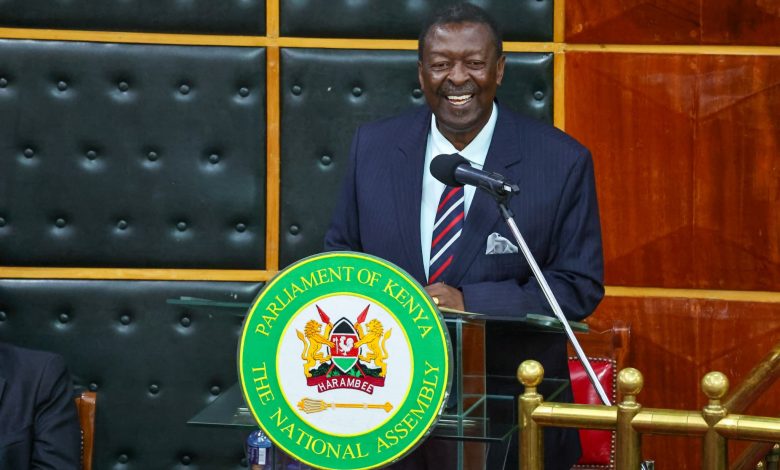
Claims of alleged involvement of senior government officials in the shady labour transfer of semi-skilled Kenyans vulnerable Kenyans to the Gulf states in the Middle East in covert-like human trafficking scenarios came to the floor of the National Assembly when Foreign and Diaspora Affairs Cabinet Secretary Musalia Mudavadi appeared before the House today.
Mudavadi has defended the first family against accusations of profiting from the government’s programme of exporting domestic workers seeking employment to Saudi Arabia.
Appearing before the National Assembly, Mudavadi was questioned on a New York Times report that fingered senior government officials and even the first family for profiting from the mass export of domestic workers to Saudi Arabia where they are subjected to inhumane conditions.
The report alleged that President William Ruto’s family is among the largest shareholders of the staffing industry’s major insurance company that sends cheap labour abroad.
“Clarify whether any senior government official directly or indirectly own, control or benefit from recruitment, training or insurance companies involved in deploying Kenyan workers to the gulf,” Naisula Lesuuda, Samburu West MP, challenged.
In his response, Mudavadi denied the claims, stating that no single insurance company can be granted the monopoly to handle Kenyans seeking jobs abroad.
“We do not engage in any human trafficking neither does the President of this country or his government engage in any slave trading,” he remarked.
“No single insurance company has a monopoly covering Kenyans seeking jobs in the Gulf or any other foreign country. As to whether there’s details of family members owned or controlled…we have a list of 594 recruitment agencies and it would take time to go through that detail. But as we speak this Parliament passed the Conflict-of-Interest bill and if anybody is found to be in conflict, appropriate action will be taken.”
The New York Times report delved deeper into the plight of stranded Kenyan mothers and their children in the Gulf nation.
Kenyan mothers often encounter legal issues as giving birth outside marriage is illegal, hence their children are deprived of birth certificates and essential services such as medical care, education among others.
Responding to the report, State Department for Diaspora Affairs Principal Secretary Roseline Njogu highlighted that the government had created several pathways for the mothers to collect their birth certificates from the Riyadh Embassy.
Some of these pathways include the Mwanamberi Project which uses DNA sampling to establish parentage and secure Kenyan birth certificates; a Joint Interdepartmental Working Group with Saudi authorities to facilitate repatriation; and an amnesty for undocumented mothers and children, allowing them to regularise their status or return home without penalty.
She, however, noted that few Kenyan mothers have utilised the options.
“We urge the single mothers in Saudi Arabia with undocumented children to utilise the pathways already created by the government to regularise their status and procure documentation for their children,” she said in a statement dated November 15, 2025.