Media freedom must be defended, but journalism must also remain accountable
Kenya's constitution envisioned a media sector that is free, independent and responsible. That vision requires restraint from political leaders, professionalism from journalists, integrity from media proprietors and fairness from state institutions.

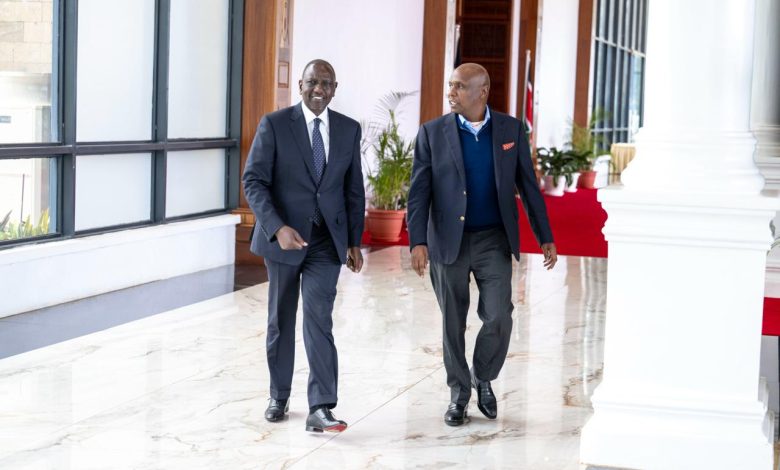
The shocking public spat between President William Ruto and Standard Media Group may appear at first glance to be yet another episode in Kenya’s long history of uneasy relations between those who wield political power and those tasked with scrutinising it.
Yet beneath the heated exchanges, social media barbs and political theatrics lies a much deeper and more consequential question: what kind of democracy do Kenyans want to build and protect?
Needless to say, at the heart of every democratic society is an independent media capable of asking uncomfortable questions, exposing waste, highlighting broken promises and holding those in authority accountable.
Governments come and go, political alliances shift, and leaders rise and fall, but the role of the press remains constant.
Its loyalty is not to presidents, opposition leaders, shareholders or advertisers, but to citizens and the public interest.
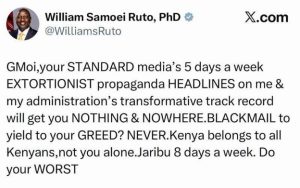
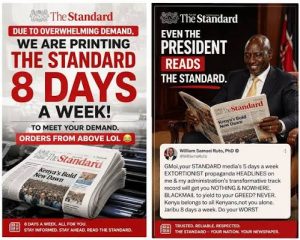
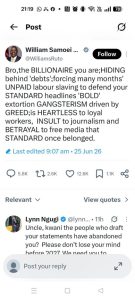
President Ruto’s recent attacks on Standard Media Group, accusing it of running “extortionist propaganda” and linking its editorial stance to the wealth of its principal shareholders, have sparked legitimate concern among defenders of press freedom.
While public officials have every right to disagree with media coverage, criticise reporting they consider unfair or even seek redress through established legal mechanisms, the use of language that portrays a media house as an enemy risks creating an environment where journalists become targets of intimidation and hostility.
A president occupies the highest office in the land. Words uttered from such a position carry immense weight.
They shape public perceptions, influence state institutions and can embolden supporters to view journalists not as professionals carrying out a constitutional mandate but as adversaries deserving punishment.
Democracies thrive when leaders tolerate criticism, however uncomfortable or repetitive it may seem.
History teaches us that governments rarely enjoy being scrutinised.
Investigative journalism often irritates those in power precisely because it exposes inconsistencies between promises and performance.
Stories examining public spending, taxation, governance failures and unfulfilled pledges are not acts of sabotage.
Instead. they are part of journalism’s fundamental duty to speak truth to power. Citizens cannot make informed decisions without access to information that is independent, critical and sometimes inconvenient to governments.
At the same time, defending media freedom cannot mean shielding journalism from legitimate scrutiny.
The press itself bears a profound responsibility to uphold professional standards, fairness and ethical conduct.
Journalism loses credibility when it becomes sensationalist, partisan, inaccurate or driven by commercial interests disguised as public interest reporting.
Media houses must constantly ask themselves whether they are pursuing stories because they genuinely serve citizens or because they advance political, business or personal agendas.
Ethical journalism requires rigorous verification, balance, accountability and a willingness to correct mistakes.
It also demands a clear separation between editorial decisions and commercial pressures. The public’s trust in the media depends not merely on constitutional protections but on consistent adherence to professional values.
The tensions surrounding Standard Media Group also expose another uncomfortable reality: the economic vulnerability of Kenya’s media industry.
Across the country, journalists and other media workers have increasingly faced salary delays, layoffs and shrinking newsroom resources. Independent journalism cannot flourish when reporters work under constant financial uncertainty.
Equally troubling is that government institutions owe media houses billions of shillings in unpaid advertising and service-related debts.
Since the state owes media organisations substantial amounts for services already rendered, those obligations should be settled promptly and transparently.
Financial strangulation can become a subtle but effective mechanism for undermining press freedom. A media house struggling to meet payroll obligations, retain talent or sustain operations because payments are withheld may eventually find itself less capable of undertaking expensive investigative reporting or resisting political and commercial influence.
Delayed payments may not amount to outright censorship, but they can contribute to an environment where editorial independence is weakened through economic pressure.
Governments should not selectively reward favourable coverage nor punish critical reporting through advertising boycotts, delayed payments or discriminatory allocation of public communication budgets.
State advertising and contractual obligations belong to taxpayers, not political office holders. Their management should be guided by transparent rules and respect for constitutional principles rather than political convenience.
Similarly, media owners must recognise that journalists are not collateral damage in corporate or political battles.
Workers deserve timely salaries, decent working conditions and respect for their labour. No noble defence of press freedom can be complete if journalists themselves endure months of unpaid wages while being expected to continue informing the public.
Kenya’s constitution envisioned a media sector that is free, independent and responsible. That vision requires restraint from political leaders, professionalism from journalists, integrity from media proprietors and fairness from state institutions.
President Ruto has every right to challenge narratives he considers inaccurate and to showcase what he believes are his administration’s achievements.
Media houses have an equally protected right to investigate, question and critique those claims. The appropriate response to journalism that leaders dislike is not intimidation, name-calling or public vilification, but facts, transparency and engagement.
A democracy confident in itself does not fear critical headlines. It answers them. Equally, a responsible media does not seek conflict for its own sake; it seeks truth, fairness and accountability.
Kenya must therefore guard against any actions that shrink civic space, whether through hostile rhetoric, economic pressure or editorial excesses.
The defence of media freedom and the pursuit of ethical journalism are not competing objectives. They are complementary pillars of a mature democracy where power is questioned, citizens are informed and no institution, however influential, is beyond accountability.
By The Informer Media Group