Kericho governor on the spot over alleged extortion of staff for fundraisers
Former CEC tells lawmakers that until her dismissal, she had sent to the governor more than Sh1.5 million from her own personal savings

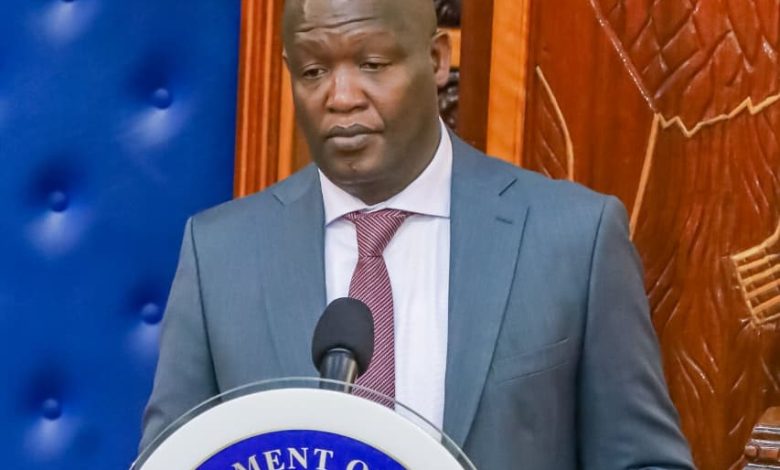
Kericho Governor Eric Mutai has been accused of abuse of office by harassing and humiliating employees by demanding financial favours if they wanted keep their jobs.
In its case against the Governor, two former employees of the devolved unit said the County Chief had frequently forced them to contribute money for his fundraisers and other unexplained emergencies in the course of his duties as the Governor.
In her case, Edna Tanui, who was appointed but later dismissed as a member of the County Executive Committee (CEC), told the Senate that she had, in the course of two years, cumulatively contributed a total of Sh1.5 million to the Governor’s insatiable demand for money for the duration she served as a CEC.
Tanui and other CECs were dismissed by the governor in December last year, through a post on his official Facebook page.
While she did not give reasons for the sackings, merely stating that it was a reorganisation of his administration, Tanui told the House that she suspects that she was fired because she failed to contribute to the Governor’s constant demand for money from her.
“I have never known why the governor sacked me. I suspect I had to go because I refused to support him in his fundraisers,” she added.
She told lawmakers that until her dismissal, she had sent to the governor more than Sh1.5 million from her own personal savings.
However, evidence submitted to the House by the County Assembly shows that only Sh300,000 was deposited directly to the governor’s M-Pesa account on his mobile number.
Pressed by senators and the governor’s lawyers, the witness was at pains to explain how the difference of Sh1.2 million was given to the Governor, as there was no evidence in the bundles of evidence submitted to support the claim.
But she stuck to her gains, insisting that she had dispatched the money in cash through the personal aides of the governor, who she identified as Robinson Kiplagat and Renny Kipsang Ng’etich.
“If given a chance, I can produce conversations with the Governor leading to the Sh1.2 million,” she said, even though she admitted that the process will include a court process to compel Safaricom to provide the call logs of the phone conversations. He would call and demand that he wanted money and go ahead to quote the figure,” she said, adding that most of the time, she rebuffed the requests.
Documents presented to the House by the Assembly indicate that Paul Misik deposited Sh50,000 to the witness’ M-Pesa account, Janet Koech deposited Sh10,000 while Beatrice Kiptanui deposited Sh10,000, among other transactions.
Tana River Senator Danson Mungatana challenged the witness to explain the disparity between the Sh300,000 and the Sh1.2 million, arguing that her testimony did not sufficiently justify the claim of the Sh1.5 million she claims she sent to the Governor.
“How was the money given?” he asked, adding that the witness should have planned to explain the difference in a manner that would convince the House.
Nyamira Senator Okongo Omogeni wanted to know the identity of the individuals who deposited money in Tanui’s M-Pesa account and which was forwarded to the governor. He also wanted to know whether they deposited the money into her account so that she could forward it to the governor.
Busia Senator Okiya Omtatah wondered why the witness did not report the governor investigative agencies.
Vihiga Senator Godfrey Osotsi suggested that the Money could be proceeds of corruption and challenged the witness to explain its source.
Responding to the concerns from the lawmakers, Tanui insisted that she contributed the money and could prove the claims, given time to get her statements from Safaricom.
On the huge transactions through her M-Pesa account, she argued she runs a string of businesses, including farming, whose proceeds are transacted through her M-Pesa account.
“I have only one number and all my personal and business transactions go through my Safaricom line,” she said, adding that one of the transactions flagged by Omogeni was her uncle.
“I had lent him money, and in the transaction you are citing, he was repaying the loan.”
Kipngeno Bett, who was the first County Assembly witness to take the stand, told the House that the Governor had the habit of calling him and demanding the money.
“I sent him money many times after he called, demanding the money. I don’t know where he expected me to get the money from,” Bett, who had served as a chief officer in the county Executive before he was dismissed said.
He said that the governor had once humiliated him right in front of his family.
“He called and said I am an ungrateful person because I could not send him the little money he was asking for.”
The two witnesses told the House that the money they sent to the governor was raised from their personal savings and businesses.
Asked by lawyer Elias Mutuma, for the County Assembly, whether he was under an obligation to send the money, Bett said there was none, but he had to send the money to save himself from the Governor’s oftentimes disparaging remarks on him.
The third witness, Alfred Mutai Korir, defended the integrity of the digital system used for voting at the County Assembly.
He said it was tamperproof and no unauthorised person could access it.