Irony of costly beef despite livestock flooded market

By Larry Lesian
The recent weather predictions by Kenya Metrology Department (KMD) that rains will be minimal in most parts of Kajiado County, has witnessed high cattle supply in the market as farmers race against time to avert losses occasioned by prolonged dry spell.
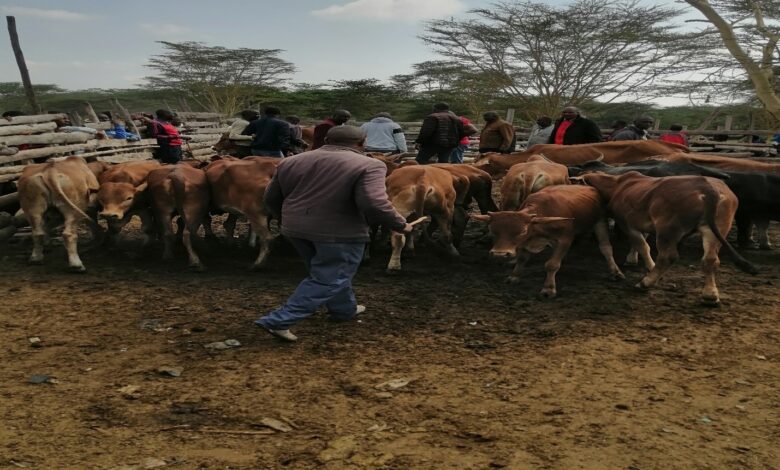
A spot check by The Informer Media Group at Ilbisil, Isinya, Kitengela, Kiserian and Sultan markets indicate a surge of cattle supply in the market up to three-fold compared to two months ago.
Ordinarily, when there is enough pasture and water, farmers withhold cattle from the market to fatten them so that they fetch good prices.
The acute supply shortage also ensures the prices are stable because demand remains high compared to supply.
Meat dealers and cattle brokers take advantage of surplus supply to buy the animals at cheaper prices.
However, despite the high supply in the markets, farmers have unanimously embraced a new tactic to bargain prices.
“This time we are not just selling our animals at throw away prices because of the high numbers. We are negotiating on the basis of quality. We are coming from a season that had enough pasture and our cattle are very healthy and the quality of meat is good. In the recent past, we have also not had any meat quality threatening diseases. We are not going to lower prices of cattle that are not emaciated, “explained Joel Supeet, a farmer from Isinya.
A kilogram of beef is now seeking at Sh530 wholesale price and up to Sh700 on retail price in most butcheries.
According to John Mwangi, a meat dealer who supplies beef to entertainment joints within Kitengela, he is witnessing surplus supply and constant prices for the first time.
“Farmers are patient and are withholding a cow for up to one week waiting for a buyer willing to pay the price. In the past, the farmers used to sell the animals at throw away prices once they found a flooded market. It is not the case now,” says Mwangi.
During dry spell seasons when cattle are emaciated the prices per kg drastically reduce up to Sh300 per kg.
According to local farmers, revamping of Kenya Meat Commission (KMC) has not had any significant impact in the meat industry to the local farmers.
“In ordinary markets, we sell our animals on a cash basis, at KMC you supply and wait. You have to supply at least 10 animals at once making it business for brokers and those who have financial muscles. When I compare the price, my animal fetches from the ordinary local market, KMC offers relatively low prices,” said Paul Ole Kopit, a farmer from Korompoi.
Kiambu, Nairobi and Machakos Counties remain the major markets for cattle slaughtered in Kajiado.