IEBC admits tender error as Gachagua 2027 polls rigging plot claims draw COTU rebuke
The commission's admission that the performance-security requirement was erroneously set at 20 per cent is likely to form part of the scrutiny before the procurement review board, even as IEBC insists that the mistake can be rectified through an addendum without invalidating the entire tender.

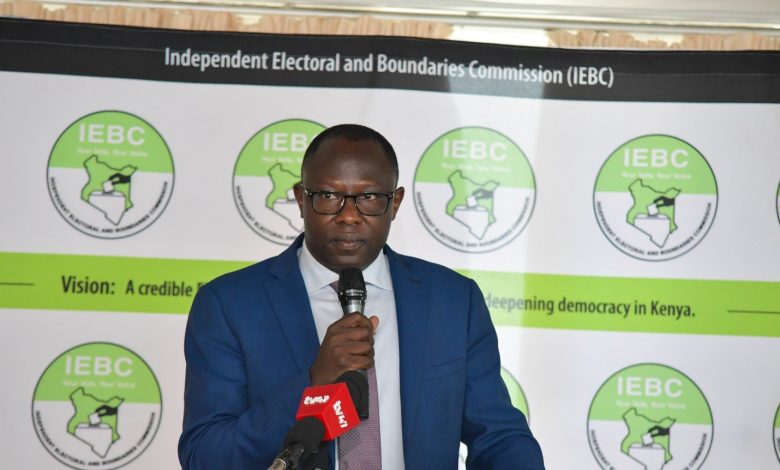
The Independent Electoral and Boundaries Commission (IEBC) has admitted that its tender for a new Integrated Elections Management System (IEMS) contains an error, after mistakenly requiring bidders to provide performance security equivalent to 20 per cent of the contract price.
The electoral commission said it has identified the mistake and is preparing an addendum to correct the requirement, noting that the law caps performance security at 20 per cent of the contract price.
The admission comes as the IEBC defends the controversial tender advertised on August 11, 2026, following a challenge by Galadirel Investments Limited before the Public Procurement Administrative Review Board (PPARB).
Despite acknowledging the error, the commission maintains that the rest of the tender is lawful and has rejected claims that the procurement is flawed, discriminatory or structured to favour a particular bidder.
IEBC has also defended the Sh30 million tender security requirement, arguing that the procurement is a framework contract and that the law permits it to prescribe tender security as an absolute amount rather than as a percentage of the contract value.
The commission has further dismissed allegations that the specifications were tailored to favour South Korean technology company Miru Systems Limited.
The claims have emerged amid heightened political scrutiny of the electoral technology procurement, with former Deputy President Rigathi Gachagua alleging that the Miru Systems tender could be linked to plans to manipulate the 2027 General Election.
IEBC has described such allegations as speculative, arguing that those challenging the procurement have failed to identify any specific requirement that gives Miru Systems an unfair advantage.
“The tender is strict, it’s either you are compliant or not; for the bidder to succeed, it should be hundred percent. With respect to tax, the requirements is that they are tax compliant by whatever instruments they have in their country,” IEBC argued.
The commission also says it has incorporated a 40 per cent local content requirement into the tender to enhance local participation, skills transfer and involvement of Kenyan firms in the implementation of the election management system.
However, Galadirel Investments Limited maintains that the tender contains material omissions, contradictions and ambiguities that undermine competition and violate constitutional procurement principles.
Through lawyer Julius Miiri, the applicant argues that the tender document does not provide a clear, transparent, objective and uniform basis upon which prospective bidders can prepare responsive and comparable bids.
“The Applicant has perused the said tender document and has found the following breaches; There is no value of the tender provided despite the Respondent issuing a tender security value of Sh30,000,000 contrary to Section 61 of the PPADA,” the applicant says in court documents.
The company further argues that the document contains “material omissions, contradictions, undefined requirements and incomplete provisions” that could affect competition, responsiveness, evaluation, comparability of tenders and equal treatment of bidders.
“The aforesaid omissions, contradictions and ambiguities are material and have the potential to affect competition, responsiveness, evaluation, comparability of tenders and equal treatment of tenderers, thereby rendering the procurement process procedurally defective,” the applicant argues.
The dispute has now placed the procurement process under the scrutiny of the PPARB, which is expected to issue its decision on Friday next week.
IEBC is asking the Board to dismiss the challenge and lift the suspension imposed on the procurement process, allowing the commission to proceed with the next stages of acquiring the election management system ahead of the 2027 polls.
As the procurement dispute unfolds, Central Organisation of Trade Unions (COTU) Secretary General Francis Atwoli has entered the debate, cautioning Gachagua against what the labour movement described as a “proof by assertion fallacy” over his allegations concerning the IEMS tender.
In a statement issued today, Thursday, August 27, 2026, COTU said it had taken serious note of Gachagua’s accusations and warned that unsubstantiated attacks on the credibility of the electoral commission could destabilise the country ahead of the 2027 General Election.
“We wish to caution Rigathi Gachagua against his proof by assertion fallacy that might ultimately plunge this country into violence and thus affect the livelihoods of workers, women and children,” COTU said.
The union expressed concern that repeated allegations against the electoral body could amount to laying the political groundwork for rejecting the outcome of next year’s election before Kenyans have even gone to the ballot.
COTU invoked Article 249(2) of the Constitution, which guarantees the independence of constitutional commissions, arguing that IEBC must be allowed to discharge its mandate without political interference.
The union said legitimate concerns over the procurement should instead be pursued through established institutions, procurement procedures and available legal remedies.
COTU also questioned Gachagua’s apparent support for Smartmatic as an alternative election technology provider.
The union argued that while Gachagua accuses IEBC of designing the procurement process around a preferred company, his endorsement of another private technology provider could raise similar questions.
“Gachagua must explain to Kenyans why he himself appears to be prescribing another private company as his preferred election technology provider,” COTU said, demanding that he disclose the basis for concluding that Smartmatic is the technology provider IEBC should retain.
The labour union warned that electoral disputes and ethnic tensions could have devastating consequences for ordinary Kenyans, particularly workers, women and children, and urged political leaders to exercise restraint as the country approaches the 2027 elections.
PPARB will make a decision next week and the outcome will determine whether IEBC can resume the procurement process or whether further changes will be required before the acquisition of the new IEMS can proceed.