Gachagua: Opposition candidate talks can wait until after Christmas
Gachagua’s position comes amid competing views within the United Opposition on the timing and method of selecting a joint presidential candidate.

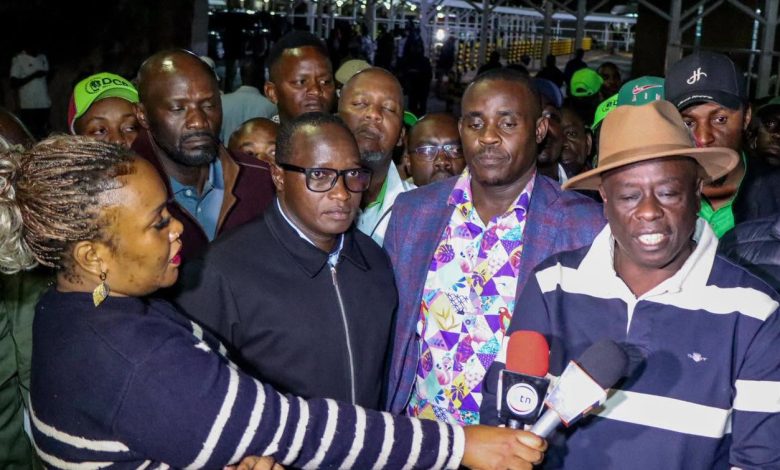
Democracy for Citizens Party (DCP) leader Rigathi Gachagua has said the United Opposition should prioritise political mobilisation rather than rush to settle on a joint presidential candidate, suggesting that negotiations on the coalition’s flag bearer could gain momentum after Christmas.
Gachagua, who spoke to journalists at Jomo Kenyatta International Airport (JKIA) on Wednesday night before departing for the United States, said choosing a single presidential candidate would be the easiest task facing the opposition as it prepares to challenge President William Ruto in the 2027 General Election.
“Choosing a single presidential candidate is the easiest of all the challenges that we have ahead of us. We can meet one day for lunch and before dinner we have a candidate,” Gachagua said.
He argued that the more urgent task was to build a nationwide political machine capable of mobilising voters, persuading eligible Kenyans to register and turning out supporters on election day.
“The real job, and that’s what I expect of my colleagues in the United Opposition to do, is political mobilisation against Ruto, it’s to persuade Kenyans to register as voters, come out and vote him out and vote in a responsible government,” he said.
Gachagua is expected to use his US trip to engage Kenyans in the diaspora as he steps up efforts to build support for the opposition ahead of the 2027 elections.
March or April for flag-bearer talks
The former Deputy President urged Kenyans to be patient over the question of who will lead the opposition into the presidential race, pointing to the 2002 election as evidence that a joint candidate does not necessarily have to be identified early.
He recalled that Mwai Kibaki was selected as the opposition’s presidential candidate on October 14, 2002, barely two months before the December 27 election.
“I want to ask Kenyans to be patient. Mwai Kibaki was chosen as the single presidential candidate for the opposition on October 14, 2002, when elections were to be held on December 27 the same year. We have a whole year, what is the hurry?” Gachagua posed.
He suggested that serious discussions on the opposition’s presidential ticket could take place around March or April 2027.
“In my view, hii ni maneno ya March, April huko,” he said.
At the same time, Gachagua indicated that political leaders could reach an agreement much earlier, saying the coalition should be in a position to agree on a candidate after the Christmas period.
“After Christmas, we should be able to agree and come up with a single presidential candidate,” he said.
His remarks therefore appear to leave room for two stages in the process — continued mobilisation and coalition-building in the coming months, followed by more definitive negotiations over the presidential ticket after Christmas and potentially a final decision around March or April.
Contrasting voices over when to choose candidate
Gachagua’s position comes amid competing views within the United Opposition on the timing and method of selecting a joint presidential candidate.
While he has argued that there is no need for an early decision and that the opposition should concentrate on mobilisation, other voices within the broader opposition movement have pushed for an earlier and more structured process to prevent competing presidential ambitions from undermining unity.
The question has become increasingly sensitive as several prominent leaders position themselves for the 2027 race.
Gachagua himself has declared that he considers himself the most suitable candidate, but has also pledged to back whoever the opposition ultimately settles on.
“I have said I am the most suitable, but in case my colleagues see otherwise, whoever is agreed on has my support,” he said.
Other figures associated with the opposition presidential contest include Jubilee deputy party leader Fred Matiang’i, Wiper leader Kalonzo Musyoka, People’s Liberation Party (PLP) leader Martha Karua and former Chief Justice David Maraga.
Nairobi Senator Edwin Sifuna has also increasingly attracted attention through the Linda Mwananchi Movement, with members of the movement fronting him as a potential presidential contender capable of mounting a strong challenge against Ruto.
The growing list of potential candidates has intensified questions about whether the opposition can agree on a formula that will balance individual ambitions with the broader objective of presenting a single candidate against the incumbent.
Gachagua’s legal battle adds uncertainty
Gachagua’s own path to the presidency could also be influenced by his ongoing legal battle over his impeachment.
The former Deputy President has appealed a High Court decision that upheld his impeachment, arguing that the court erred in law. The eventual outcome of the case could have implications for his eligibility to contest the presidency.
Despite the uncertainty, Gachagua has continued to position himself as a leading figure in the opposition effort to remove Ruto from power.
He has also repeatedly stressed that the opposition’s ultimate objective should extend beyond simply defeating the president to building what he described as a responsible government.
The United Opposition is now faced with the delicate task of maintaining unity while allowing its various leaders to mobilise their respective political bases.
With Gachagua calling for patience, while other opposition voices advocate an earlier resolution of the presidential question, the timing and formula for selecting a joint candidate are likely to remain a major point of debate in the months ahead.