Gathungu flags Kenya Railways as delays in repaying SGR loan costs country dearly
She says expenditure of Sh34.17 billion in interests and penalties is not proper charge to public funds

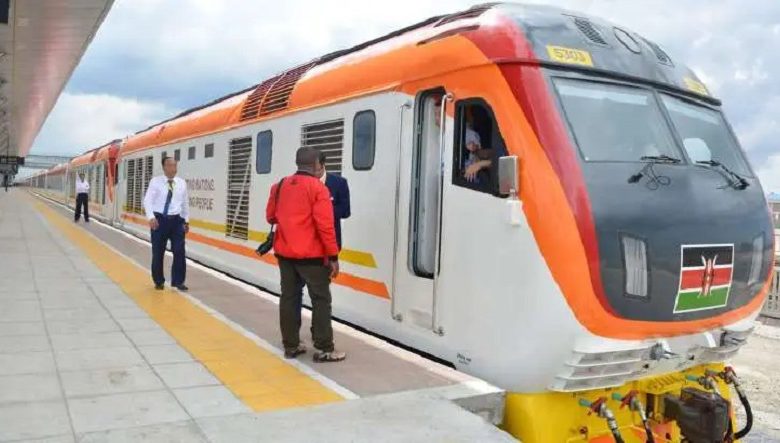
Delays by the government to repay the loans taken from China’s Exim Bank for the construction of the Standard Gauge Railway (SGR) with the latest report by Auditor General Nancy Gathungu revealing that it will cost taxpayers a further Sh5.3 billion in penalties.
According to Gathungu’s report on Kenya Railways Corporation for the year ended 30 June, 2024, Kenya incurred Sh34,166,273,919 comprising of Sh5,309,944,132 and interests amounting to Sh28,856,329,787 which could have otherwise been avoided.
According to the audit report, Kenya Railways’ financial statement reflected a balance of Sh646,072,165,699 in respect of Exim Bank Ioan (on lent) as at 30 June, 2024.
On payables and accrued charges, Sh51,123,139,882 out of which Sh12,688,850,568 was due to creditors, including Exim Bank, Kenya Power and Lighting Company, Nairobi County Government, National Youth Service, Kenya Railways Staff Retirement Scheme and other State agencies, who are owed Sh1,005,558,410 that has been outstanding for more than one year.
“This expenditure is not proper charge to public funds. In the circumstances, the accuracy and completeness of payable and accrual charges balance of Kshs.51,123,139,832 could not be confirmed,” Gathungu says in her report.
This is not the first time Kenya is being fined for delaying to repay the loan after it was fined Sh1.312 billion in the year ended June 30, 2022 and Sh3.5 billion in 2024.
The expenditure is one of the reasons Gathungu gave Kenya Railways a qualified opinion in accordance with ISSAl 3000 and ISSAI 4000, which require that she complies with ethical requirements and plan and perform the audit to obtain assurance about whether the activities, financial transactions and information reflected in
the financial statements are in compliance, in all material material respects, with the autthorities
that govern them.
“I believe that the audit evidence I have obtained is sufficient and appropriate to provide a basis for my conclusion.”
Kenya borrowed approximately US$5.8 billion (Sh659 billion at today’s exchange rate) from Exim Bank to construct the SGR, including the extension to Naivasha.
The audit report also says a review of creditors records reflects payables and revealed other anomalies, including long outstanding prepayments, long outstanding land compensation balance and long outstanding customer deposits.
For instance, the balance includes an amount of Sh8,307,857,507 in respect of land compensation and which has remained the same from the previous year’s with the management unable to explain why it has remained outstanding for a long period without being settled.
The balance also includes an amount of Sh5,521,7124,335 in respect of customer deposits out of which an amount of Kshs.675,561,490 remained unsettled for long and which have been outstanding between January, 2012 and June, 2023.
No plausible explanation given why the deposits have not been refunded to customers or remitted to consolidated fund.
The audit also unearthed weaknesses in the Metre Gauge Railway (MGR) revenue collection, noting that although the corporation earned Sh2,218,418,736 out of its Sh21,216,776,168 from the Nairobi Commuter Railway anomalies were noted including congested trains that make it difficult for its revenue inspectors to confirm that all the passengers were receipted, adding that this may result in passengers not paying hence potential loss of revenue.
At the same time, payment through MPESA was not well managed and coordinated. It was noted
that cashiers prioritise receipting cash customers and then MPESA customers.
“Considering that the train has different boarding and alighting stations along the route, it was likely that MPESA customers may alight before they were receipted,” the audit report says.
It was also noted that internal controls on handling of the issued receipts at the main railway station exit
was weak with the receipts were being dropped in an open tray.
“It was likely that the same used receipts can be used later either in the evening or the next day since the can be used later either in the evening or next used receipts are not being safe guarded or destroyed.
According to the report, in some instances, MPESA customers only displayed the message to the cashier and the cashier requests the customer to read for him/her the MPESA referencе number. Considering that there are instances where dishonest people tamper with MPESA messages, chances of the cashier recording doctored messages could not be ruled out.
At the same time, the cashiers who gave out tickets were the very same people who walks around to check the tickets. Lack of segregation of duties can easily lead to collusion and loss of cash. Mostly, the inspectors/ supervisors are not on the train to check the tickets.
“In the circumstances, the effectiveness of internal controls on revenue collections in the commuter service trains could not be confirmed,” the report adds.
The audit also reveals that out of income balance of Sh256,405,942, the balance for Nakuru Parking Revenue Sh6,090,940.
“However, review of the records provided during the audit revealed that the balances were not supported by
receipts and bank statements. in In the circumstances, the accuracy and completeness of the Nakuru parking revenue of Kshs.6,090,940 could not be confirmed.”
According to the audit report, the statement of comparison of budget and actual amounts reflects total revenue budget actual on comparable basis of Sh29,012,376,299 and Sh23,921,304,31 respectively, resulting in under-funding of Sh5,091,071,985 or 18 per cent of the budget.
However, the Corporation spent Sh26,759,007,311 against actual receipts of Sh23,921,3 ,304,314 resulting in an over utilisation of Sh2,837,702,997 or 12 per cent of the total receipts.
The audit also established contingent liabilities balance Sh28,145,099,199 being law suits against Kenya Railways yet to be determined estimated at Sh27,978,266,389 and guarantees given on behalf of the Corporation amounting to Sh166,832,810.
“I draw your attention to the fact that the Corporation is at risk of operations interruption should the contingent liabilities crystalise My opinion is not modified in respect of these matters,” says Gathungu.
Review of land records by auditors also revealed that 529 parcels of land have been illegally allocated across the country.
In Mombasa, various parcels of land were allocated to private persons without without the consent of the Corporation, by either the Commissioner of Lands or Local Authorities. For instance, parcels of land adjacent to Mombasa Railway Station measuring approximately 0.75 to one acre was irregularly to private persons who have since made developments on the land.
Although Kenya Railways management indicated that the leases were procedural, board approvals authorsing the leases were not provided for audit. However, Management has sought Ethics and Anti-Corruption Commission (EACC) intervention to repossess the parcels of land and this process is ongoing and had not been concluded
as at 30 June, 2024.
The audit also found out that various parcels of land in Limuru were allocated to third parties without the consent of the Corporation by either the Commissioner of Lands or the defunct local Authorities. It cites land within Limuru railway station constituting nine industrial plots measuring approximately three acres and a piece of land within Kikuyu railway station measuring approximately two acres;
However Management has sought court intervention to repossess 27 of the illegally allocated parcels. The Corporation has also sought the intervention of various Government agencies such as the Ethics and Anti-Corruption Commission, Commission, Ministry of Lands and Physical Planning, National Land Commission and the Director of Survey to assist in the recovery of irregularly allocated land.
In Nakuru’s Ziwani estate, land measuring approximately seven acres belonging to Kenya Railways has been encroached on by the County Government of Nakuru and currently used as
a bus park.
The land had been allocated to private individuals by the County Government of Nakuru on a long-term lease of of 25 years and an amount of Sh37,500,000 having been paid as premium and attracting an annual rent of Sh13,300,002.
In Kisumu, 247 residential units have been forcefully occupied by organisations with no lease agreements and therefore not paying rent, which is making the corporation to lose rent to the tune of Sh27,435,600 annually
This, it says, shows that the existence of effective asset manager management mechanisms to safeguard public properties is lacking.