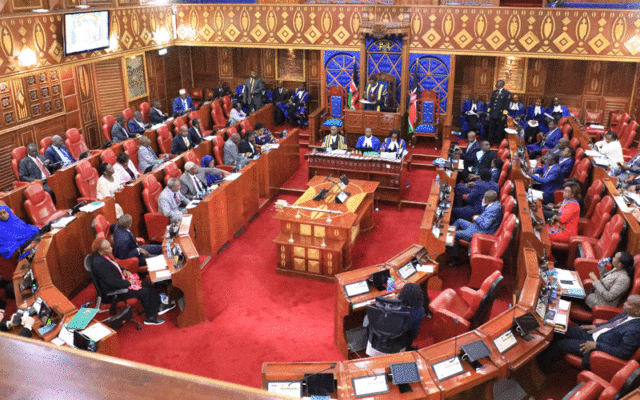
Counties face paralysis over the division of Revenue Bill stalemate after the Senate gave the Treasury notice, saying they will not be arm-twisted to pass the Division of Revenue Bill 2022.
If the Bill is not passed, Kenyans will be staring at frozen county government functions due to lack of money for efficient operations. The national and county governments will not be financing the operations, including medical supply, the general election, and other critical functions.
The Revenue Bill allocates funds between the National and County governments equitably.
A three-judge bench in 2020 ruled that Parliament shall approve the Division of Revenue Bill before tabling the Budget Estimates and reading the budget speech.
As per the High Court petitions number 277 and 232 of 2019, the ruling consequently meant that budget policy statements tabled in Parliament without including the division Revenue Bill would be unconstitutional.
Speaker of the National Assembly, Justin Muturi, said that the Treasury would be forced to ensure that it strikes an agreement with the Senate to ensure the tabling of Budget is not time barred.
“The Treasury CS had not determined the date. He wrote a request to be allowed to come and read the highlights on April 7.”
“At the time he wrote, the date requested appeared reasonable, given that the National Assembly had passed the DORB and referred the same to the Senate,” Muturi said.
“The fears have been raised before the House Business Committee. Before the Bill is passed, anything that happens will violate the courts.
He said that House Business Team resolved that, “Without seeing what would become of the Division of Revenue Bill, we agreed that the CS be notified accordingly.”
Muturi said it was up to the Treasury to see how they could approach the Senate to expedite the Bill, being one with the “vagaries of being subject to mediation”.
“What becomes of the DORB is the most crucial…we don’t want to violate the High Court ruling.
We cannot engage in that process before we process the Division of Revenue Bill, 2022,” he said.
As both houses work on the Bill, any amendments have to be subjected to mediation between the National Assembly and the Senate – due to a previous history of back and forth over several laws that need the approval of both Houses. This process can drag on for days without having an amicable solution.
Traditionally the Budget is tabled in the National Assembly in June; however, since this year is an electioneering year, the Budget has started early.
The Budget for the financial year 2022/2023 is Sh2.14 trillion. Sh1.76 billion has been allocated to the national government, Sh370 billion to the county government, and Sh7.06 billion has been allocated to the equalisation fund.
Traditionally, the Budget is tabled in the national assembly in June; however, since this year is an electioneering year, the budget process has started early.