Bribes, sextortion and abuse: EACC report lays bare Kenya’s rot

A new report by the Ethics and Anti-Corruption Commission has exposed widespread bribery, sextortion, and systemic corruption across key public institutions, with police officers emerging as the leading perpetrators.
The Kenya National Gender and Corruption Survey 2025 reveal that more than one in three Kenyans seeking services from the police are forced to pay bribes — the highest rate among all public agencies. Civil registration officials and transport officers were also flagged as major offenders, pointing to deeply entrenched corruption in essential government services.
The report shows that corruption is not only persistent but increasingly costly. The average bribe has doubled over the past two decades to Sh6,724 in 2025.
In some sectors, the amounts are significantly higher, with Kenyans seeking government jobs paying an average of Sh85,033, while those dealing with courts reported average bribes of over Sh164,000 to magistrates.
In many cases, bribery has become a prerequisite for accessing services. “If you follow the normal process, it can take weeks… but if you pay, you get the service the same day,” one respondent said, highlighting deliberate delays designed to coerce payments.
The findings further reveal a coercive system where 84 per cent of bribes are paid upfront, leaving citizens with no guarantee of service. Cash remains the most common mode of payment, although digital channels are increasingly being used to conceal illicit transactions.
Beyond financial corruption, the report highlights a disturbing rise in sexual extortion.
At least 10 per cent of respondents reported being asked for sexual favours in exchange for services, with women disproportionately affected, particularly in healthcare, education, and employment sectors.
The survey paints a grim picture of public service delivery, where corruption can have life-or-death consequences. Patients reported paying bribes for urgent medical attention, while survivors of abuse struggled to obtain medical reports needed for court cases.
Despite the widespread abuse, reporting remains low. Many victims feel it is futile, with 33.4 per cent saying “nobody would care,” while others noted that bribery has become normalized.
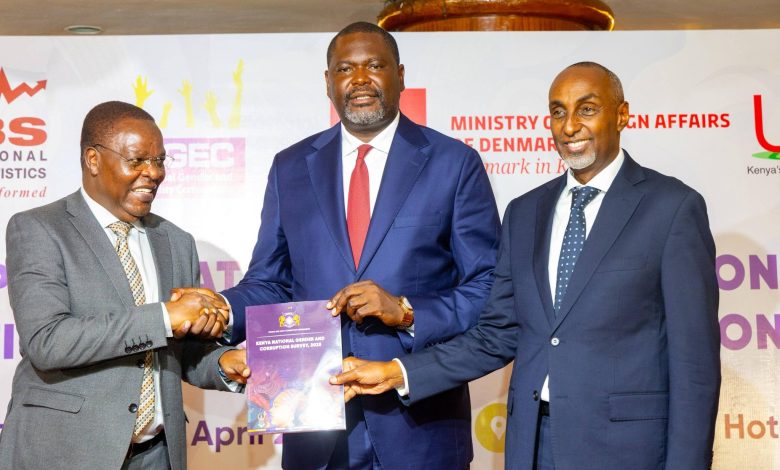
Speaking during the report’s launch, EACC Chief Executive Officer Abdi Mohamud described the findings as a turning point in understanding corruption.
“This report moves us beyond generalities to a precise understanding of how gender mediates exposure to and the impact of unethical practices,” he said.
He warned that corruption in Kenya is worsening, noting that rising bribery costs and growing public perception of corruption underscore the urgency for reforms, including stronger enforcement, digital systems, and better protection for whistleblowers.
The report painted a grim picture of entrenched corruption levels particularly in the public sector where more than one in three Kenyans seeking services from police have been forced to pay bribes, the highest rate among all public institutions.
The Kenya National Gender and Corruption Survey 2025 also reveals that civil registration officials and transport officers followed closely, pointing to a deeply entrenched system of corruption across essential government services.
The report shows corruption is not only persistent but growing more expensive with the average bribe doubling over the past two decades, rising to Sh6,724 in 2025, with some services attracting significantly higher payoffs.
Kenyans seeking government jobs reported paying an average of Sh85,033, while those dealing with courts faced some of the highest extortion, with magistrates receiving average bribes of over Sh164,000.
In many cases, bribes are no longer optional but the price of survival.
“If you follow the normal process, it can take weeks… but if you pay, you get the service the same day,” one respondent said, describing systemic delays deliberately engineered to force payments.
The findings show a coercive system where over 84 per cent of bribes are paid before services are delivered, effectively locking citizens into illegal transactions with no guarantee of results.
Cash remains the dominant mode of bribery, accounting for more than 70 per cent of transactions, though digital payments are increasingly being used to conceal illicit exchanges.
Beyond financial corruption, the report exposes a darker reality sexual extortion (sextortion).
At least 10 per cent of Kenyans reported being asked for sexual favours, either directly or indirectly, in exchange for services. Women were disproportionately targeted, often in critical sectors such as healthcare, employment, and education.
In some cases, victims seeking justice were silenced through intimidation and cover-ups involving powerful individuals.
The survey paints a grim picture of essential services, where corruption can mean the difference between life and death.
Patients reported being forced to pay bribes for urgent medical attention, while survivors of abuse struggled to access medical reports needed for court cases unless they could pay additional fees.
In the justice system, delays and inefficiencies are pushing citizens toward bribery as a faster alternative to due process.
Despite widespread abuse, reporting remains low. Many victims believe reporting corruption is pointless, with 33.4 per cent saying “nobody would care”, while others admitted bribery had become normalized.
Even when reported, most cases are handled by the same institutions accused of corruption, raising questions about accountability.
The report also highlights regional disparities, with Kakamega County recording the highest average bribes at Sh79,305, largely linked to judicial corruption. Other high-ranking counties include West Pokot, Isiolo, and Garissa.
The findings point to a system where corruption is deeply embedded in everyday interactions between citizens and the state.
With corruption now ranked among the country’s top concerns, the report warns that without urgent reforms including stricter enforcement, digital payment systems, and protection for whistleblowers public trust in institutions will continue to erode.