Battle of cherries as Ruto seeks to reignite foothold in Mt Kenya region
Pundits contend that Ruto’s coffee revival push signals new offensive against his former deputy Gachagua and his former boss retired President Uhuru Kenyatta whose influence in the region that propelled him to power in 2022 is largely unchallengeable.

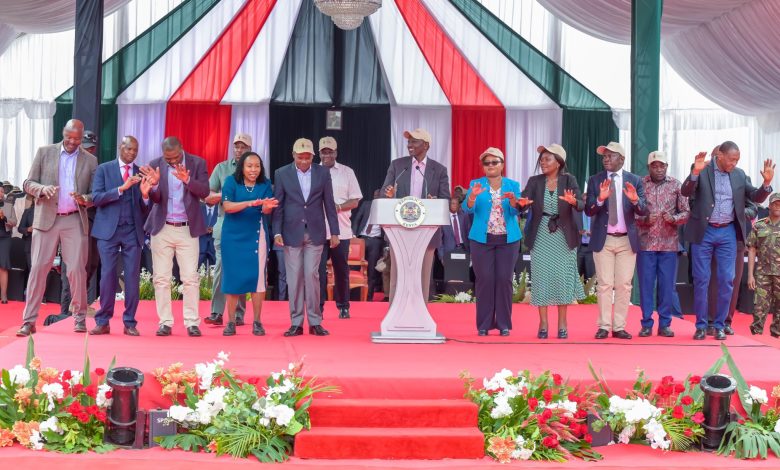
President William Ruto’s fresh push to revive the coffee sector is seen as a political strategy to win over coffee farmers in the vote-rich bloc, which could be the beginning to a charm offensive aimed at countering his former deputy Rigathi Gachagua to block his re-election after their falling out in 2024 when he was impeached and hounded out of office.
On Monday, June 22, 2026, Ruto launched the National Coffee Revival Through Cooperative Societies Programme in Kirinyaga County during which he announced an investment of Sh20 billion to further improve returns to farmers and restore confidence in a sector that had suffered decades of decline.
Together, the Central Kenya region accounts for more than half of the country’s total coffee production with Kiambu historically leading in total volume and acreage though the proliferation of real estate developments has over the years depleted it.
Kirinyaga, Nyeri and Kiambu are the other dominant, premium coffee-growing powerhouses.
Resuscitation of the coffee sector was among reforms that the Ruto administration prioritised in the early years of his tenure as it was a key plank of his 2022 campaign promises with Gachagua being tasked to spearhead them but they largely took a backburner following his exit and failure to comprehensively address farmers’ plight has been one of the grievances raised by Gachagua and his allies.
The choice of Kirinyaga for the launch of the programme is especially seen as politically significant as it sits on the border between Mt Kenya West and Mt Kenya East.
Ruto is keen on gaining a foothold on Mt Kenya East, through Deputy President Kithure Kindiki and Embu Governor Cecily Mbarire, in a move to counter Gachagua, who has a foothold in Mt Kenya West.
During the launch, he defended progress made in the last two years, coffee prices have risen from between Sh30 and Sh70 per kilogramme before his administration took office to between Sh120 and Sh160 thus putting more money in the pockets of farmers.
He announced that his administration will inject Sh2 billion to offset debts owed to farmers.
Political pundits aver that the President is keen on stealing the thunder from Gachagua and his allies in the United Opposition by selling the narrative that his Botton Up Economic Agenda is benefiting ordinary citizens contrary to messaging by his adversaries that life has become more difficult since he took over from retired President Uhuru Kenyatta.
This is especially crucial in Mt Kenya, a region that gave him over three million votes, enabling him to narrowly defeat Azimio’s Raila Odinga (now deceased) by about 200,000 votes by selling the hustlers vs dynasties narrative that saw the region revolt against Uhuru, who was backing the ODM leader.
However, Gachagua has never missed an opportunity to take credit for the improved earnings by farmers in the coffee and tea sectors, linking them to the reforms he spearheaded.
Speaking before he was hounded from office, the told the media that this had seen coffee farmers earn an average of Sh100 per kilogramme.
“I had a very successful coffee reforms conference in Meru, bringing together all stakeholders. Out of that conference, we have worked with all stakeholders and come out with the Coffee Bill 2023 that is now before the National Assembly. In that Bill, we have recommended the reestablishment of the Coffee Board of Kenya to market coffee for farmers instead of private entrepreneurs,” he said on September 21, 2024 weeks before Parliament voted to impeach him.
And speaking after Ruto launched the fresh round of reforms, Gachagua, who said farmers are being paid more because of those reforms, accused the President of allegedly seeking to sabotage them, including by shelving a plan to offset Sh7 billion owed to farmers despite Cabinet approval even as the government settled arrears owed to coffee farmers amounting to Sh120 billion despite voters in Nyanza and Western mostly sided with Raila in the 2022 State House contest.
“William Ruto tried to sabotage those reforms. I wrote him a message and told him, ‘Keep off, don’t interfere with my work… I want reforms to benefit coffee farmers.’”
“In 2023, William Ruto approved 118 billion in debts for sugarcane farmers… but what about coffee farmers who assisted you to be president?” he added while speaking at his Wamunyoro home in Nyeri.
Agriculture Cabinet Secretary Mutahi Kagwe thanked President Ruto for signing the Coffee Bill, describing it as a major milestone that will transform the coffee value chain and address challenges that have affected farmers for years.
He said it strengthens institutions responsible for the coffee sector, including the Coffee Board and the Coffee Research and Training Institute, enabling them to better serve farmers through improved regulation, research, quality assurance, and farmer training.