Kenya’s growing poison: Pesticide contamination triggers public health emergency
Of the 67 hazardous active ingredients identified in Kenya, 67 per cent are toxic to soil life, 46 percent to water organisms, 41 per cent to birds, and 18 per cent to bees

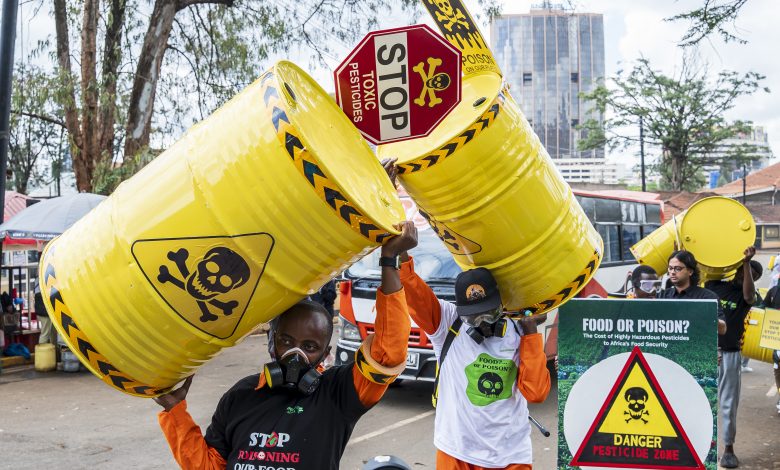
By Suleiman Mbatiah
Nearly half of Kenya’s registered pesticide active ingredients are classified as highly hazardous, with new findings showing contamination across water systems, threatening soil fertility, pollination, and the long-term viability of the agricultural sector.
A report released on Thursday, April 16, 2026 by Greenpeace Africa found that 67 of Kenya’s 141 registered pesticide active ingredients, or 48 per cent, meet international scientific criteria for classification as highly hazardous.
Kenya’s agricultural sector employs roughly 40 per cent of the formal workforce and contributes about 22 per cent of GDP, making the long-term health of its soils and water a national economic priority.
The report, titled Food or Poison? The Cost of Highly Hazardous Pesticides to Africa’s Food Security, documents contamination in rivers, soils, and bee products across Kenya, Ghana, and South Africa.
Toxic chemicals including chlorpyrifos, glyphosate, imidacloprid, and atrazine have been detected across entire river systems, accumulating in soils and decimating the pollinators and soil organisms that productive farming depends on.
Of the 67 hazardous active ingredients identified in Kenya, 67 per cent are toxic to soil life, 46 percent to water organisms, 41 percent to birds, and 18 percent to bees.
In Murang’a County alone, researchers detected 11 different pesticide compounds in bee products, while investigations around Kisumu revealed contamination present in all collected samples from five separately monitored river sites.
Chemicals detected in the Kisumu waterways included diazinon, imidacloprid, acetamiprid, and atrazine, with almost all classified as highly hazardous, present at concentrations found to be harmful to aquatic and riverine ecosystems.
In Narok County, approximately 70 per cent of water samples tested positive for carbendazim, a fungicide the report identifies as rendering affected water sources unsafe for consumption by infants and young children.
Elizabeth Atieno, Food Campaigner at Greenpeace Africa, said the findings point to a systemic failure in how Kenya’s agricultural sector manages chemical inputs and their downstream effects on natural ecosystems.
“We are poisoning the natural systems that our food depends on. The bees, the soil, and the rivers are the foundation of every farm. When we lose them, we lose farming itself,” Atieno said.
Kenya banned 77 highly hazardous pesticides in a move Greenpeace Africa acknowledges as progress, but the report warns that significant regulatory loopholes continue to undermine the full effectiveness of that policy measure.
Chlorpyrifos, a nerve-damaging organophosphate insecticide, remains permitted for termite control, while imidacloprid, which poses lethal risks to bees, is still allowed in greenhouse settings under the current Kenyan regulatory framework.
Without strict enforcement mechanisms, clear phase-out timelines, and government investment in safer farming inputs, the report warns the ban risks remaining largely symbolic without reversing measurable ecological damage already underway.
The contamination is compounded by a near-total absence of national monitoring. Kenya and most African nations operate with no systematic programmes to track pesticide residues in soil, water, or food supply chains.
Silke Bollmohr, the report’s lead researcher, said the absence of monitoring meant that policymakers across the continent were making consequential decisions about Africa’s food future with almost no reliable baseline data.
“The data is unambiguous. These pesticides are not staying on farms. They are spreading into waterways, accumulating in bee products, and contaminating household dust that children breathe every day,” Bollmohr said.
Smallholder farmers bear a disproportionate share of the risk, relying on chemical inputs without access to independent advice, agronomic training, or affordable alternatives, leaving them economically and environmentally exposed to long-term harm.
Jeff Kahuho, Senior Program Officer at PELUM Kenya, said farmers are caught between commercial pressure to use chemicals and the long-term degradation those chemicals inflict on their soils and water.
“Smallholder farmers are caught in a trap. They are sold the idea that chemicals are the only solution, yet those same chemicals are degrading the very soil and water that farming depends on,” Kahuho said.
The report argues that agroecology, a farming approach that works with natural ecosystems rather than against them, offers a practical and proven pathway out of the cycle of chemical dependency.
Farmers who have made the transition report healthier soils, reduced input costs, and recovering pollinator populations. The challenge, advocates say, lies in scaling those outcomes across the millions of smallholder households.
Greenpeace Africa is calling for continental phase-out timelines for all highly hazardous pesticides and a prohibition on the export to Africa of pesticides that are already banned within the European Union.
The organisation also recommends sustained regional investment in agroecological training and rural infrastructure, arguing that banning harmful chemicals without equipping farmers with workable alternatives will entrench and deepen existing rural community vulnerabilities.