Africa’s democracy warning: Shrinking civic space tests Kenya ahead of 2027 polls
While 64 per cent of Africans still say they prefer democracy, only 36 per cent meet the survey’s definition of a “committed democrat”—someone who prefers democracy and rejects one-person, one-party and military rule. At the same time, only 47 per cent describe their country as a democracy and just 38 per cent say they are satisfied with the way democracy works.

Africa’s democratic promise is facing a serious test—not because Africans have suddenly abandoned the idea of democracy, but because growing frustration with governments is eroding citizens’ willingness to defend it.
A new Afrobarometer report released to mark the 2026 International Day of Democracy presents a sobering picture.
While 64 per cent of Africans still say they prefer democracy, only 36 per cent meet the survey’s definition of a “committed democrat”—someone who prefers democracy and rejects one-person, one-party and military rule.
At the same time, only 47 per cent describe their country as a democracy and just 38 per cent say they are satisfied with the way democracy works.
The findings are based on 50,961 face-to-face interviews conducted in 38 African countries during 2024/2025.
They show that over the past decade, demand for democracy has fallen by an average of 10 percentage points across 29 countries surveyed consistently. Opposition to military rule alone has fallen by 11 percentage points.
That should concern governments, political parties, civil society and the international community.
The narrowing gap between what Africans want from democracy and what they believe their governments provide is particularly revealing.
The gap has shrunk from 11 percentage points in 2014/2015 to just four points today—not primarily because citizens believe democratic governance has improved, but because their demand for democracy itself has weakened. Afrobarometer associates that decline with increasingly negative assessments of government performance.
This is where the warning becomes particularly relevant to East Africa and, more specifically, Kenya as the country moves towards the 2027 General Election.
Kenya remains a multiparty democracy with regular competitive elections and an active media and civil society sector.
But the democratic space has come under increasing pressure. Freedom House’s 2026 assessment rates Kenya “Partly Free” and records a decline in its overall score from 51 to 49, citing concerns over political competition, freedom of expression and the treatment of government critics.
Human Rights Watch has similarly documented restrictions on peaceful protests, alleged abductions and arbitrary arrests, attacks on journalists and pressure on activists and government critics during 2025.
It also reported that media houses faced interruptions while covering protests and that security forces were accused of abuses against demonstrators.
These developments matter because democracy does not begin and end at the ballot box.
The test of a democratic society is also what happens between elections and whether citizens can criticise those in power without fear, whether journalists can investigate government without intimidation, whether civil society can organise freely, whether protesters can assemble peacefully, whether courts can operate independently and whether political opponents can compete on a reasonably open field.
The experience of Kenya’s recent protests illustrates the danger.
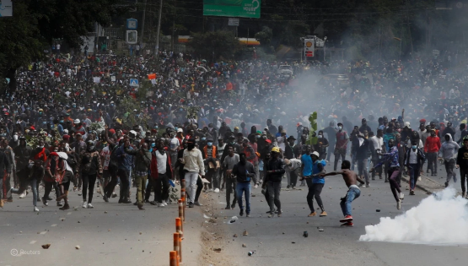
The 2024 youth-led demonstrations over the Finance Bill grew into a broader expression of public anger over taxation, governance, corruption and the cost of living.
Human Rights Watch documented killings, arrests, abductions and restrictions on protesters and activists during the unrest.
The events of 2025 added another layer to the concern, following the death in police custody of blogger Albert Ojwang and subsequent protests.
Human Rights Watch reported allegations of killings, disappearances, arbitrary arrests and attacks on journalists and social-media activists.
Yet Kenya’s democratic challenge should not be reduced to criticism of the government alone.
Opposition parties, political movements, Parliament, media organisations, civil society and citizens all have responsibilities in protecting democratic institutions. Democracy becomes vulnerable when political competition is reduced to personalities, elections become purely transactional and public institutions are viewed primarily as instruments of whoever controls state power.
The wider African picture makes that danger more urgent.
Afrobarometer found that 65 per cent of respondents still reject military rule, while 79 per cent reject one-person rule and 76 per cent reject one-party rule.
The figures show that authoritarian alternatives remain unpopular among majorities. But the weakening of those protections over time demonstrates that democratic support cannot simply be assumed.
The international community therefore has a role beyond issuing statements on election day.
Global partners should support independent institutions, credible electoral processes, civic education, free media, human-rights defenders and organisations working to protect democratic participation.
They should also consistently press governments to investigate abuses and uphold constitutional rights rather than treating restrictions on civic space as an internal matter until violence or electoral instability becomes unavoidable.
The United Nations Secretary-General António Guterres captured the broader challenge in his 2026 International Day of Democracy message, warning that conflicts, declining trust and a weakening social contract are putting democracy under strain. He stressed that democracy is more than elections and depends on human rights, the rule of law and meaningful participation in civic and political life.
His call for stronger deliberative democratic processes is especially relevant to Kenya. Citizens need meaningful avenues to influence decisions before grievances become street confrontations.
Governments need to listen before citizens feel compelled to protest. Political parties need to offer more than election-season mobilisation. And institutions need to demonstrate that constitutional rights apply even when citizens are challenging those in power.
Kenya’s 2027 election should therefore be viewed not simply as a contest for political office, but as another test of the country’s democratic institutions.
The Afrobarometer findings offer a clear warning that when citizens lose faith in governments, they can also begin losing faith in democracy itself.
The answer is not to demand greater loyalty from citizens. It is to make democracy work well enough that citizens have reasons to defend it.
That requires protecting civic space, respecting dissent, safeguarding independent institutions and ensuring that every election is preceded by years—not merely weeks—of genuine political participation.
If Africa is to reverse the decline in democratic commitment, the world cannot wait for citizens to abandon democracy before acting. The protection of democratic space must begin while people are still demanding it.
By Williams Peterson, Human Rights and Advocacy commentator.