Raila Amolo Odinga, Kenya’s political enigma is dead
Following Odinga’s death, President William Ruto has convened an ongoing an extraordinary meeting of the National Security Council. State House says the president will also chair a special cabinet meeting at 2:30 pm

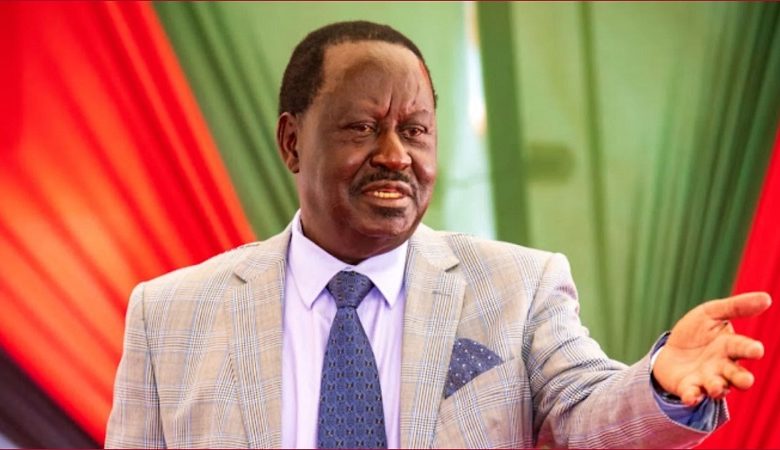
Former Prime Minister Raila Amolo Odinga, one of Kenya’s most influential and polarising political figures whose career spanned over four decades of democratic struggle, has died at the age of 80.
Odinga passed away today while receiving treatment at a hospital in Kochi, India, where he had been flown for specialised medical care. Media reports indicate that his doctors said he succumbed to cardiac complications.
Reports indicate that Odinga died at Koothattukulam in Ernakulam Hospital in India following a heart attack.
Following Odinga’s death, President William Ruto has convened an ongoing an extraordinary meeting of the National Security Council. State House says the president will also chair a special cabinet meeting at 2:30 pm.
Odinga’s family is expected to address the media. Also, leaders and Kenyans have started streaming in at Odinga’s Karen residence to pay homage and condole with the family.
Born on January 7, 1945, in Maseno, Kisumu County, Raila was the son of Kenya’s first Vice President, Jaramogi Oginga Odinga, a towering figure in the country’s independence history.
From an early age, he was immersed in politics, inheriting both the charisma and defiance that would define his life’s journey.
Educated in East Germany, Odinga trained as a mechanical engineer before joining the Kenya Bureau of Standards.
But politics beckoned early. In the 1980s, his name became synonymous with the struggle against the repressive one-party regime of Kenya’s second president, the late Daniel arap Moi.
He was detained without trial for nearly a decade, accused of involvement in the failed 1982 coup attempt. His imprisonment turned him into a symbol of resistance, a freedom fighter to his supporters, a subversive agitator to his critics.
When Kenya embraced multiparty democracy in the 1990s, Odinga emerged as a formidable force.
He served as Member of Parliament for Lang’ata, cabinet minister, and later Prime Minister in the 2008–2013 Grand Coalition Government formed to end the post-election violence that followed the disputed 2007 polls in which Kenya’s third president the late President Mwai Kibaki trounced his rivals for his second and final term.
Throughout his political life, Odinga ran for president five times, 1997, 2007, 2013, 2017, and 2022, coming agonisingly close but never winning the top seat and has been the constant face of opposition who later managed to brokered coalitions with serving administrations preceded with sporadic civil anarchy, rebellion against government and mass street protests.
Odinga formed alliance with Moi, Kibaki, the fourth Kenya’s president Uhuru Kenyatta and lately with President William Ruto under the Broad-Based-Government (BBG) following the June 2024 youth-led insurrection that culminated in Parliament invasion resulting to mass killings by police.
Almost half of Kenyans at 48 per cent have expressed lack of confidence on the newly reconstituted Independent Electoral and Boundaries Commission (IEBC) in delivering a free and fair elections in 2027, a new survey by
A survey released last month by the Trends and Insights for Africa (TIFA) Research showed that majority of Kenyans oppose the president Ruto and ODM party leader Odinga’s broad-based government saying it prioritises personal interests over the public good.
The poll shows that despite efforts to present the coalition as a unifying force, skepticism remains high among citizens across the country.
According to the findings, 37 per cent of respondents believe the BBG puts leaders’ personal gain ahead of public interest.
Another 27 per cent said they reject the arrangement because it undermines democracy and weakens the role of the opposition.
A further 17 per cent argued that the government is irrelevant to people’s daily needs and development priorities.
The survey, conducted between August 23 and September 3, 2025, interviewed 2,024 Kenyans by telephone in both Kiswahili and English. Respondents’ contacts had been collected earlier through face-to-face household interviews.
The report notes that these two concerns, political interference and mistrust in the electoral body, account for the largest share of skepticism, together representing nearly four out of every five Kenyans who doubt the integrity of the 2027 elections.
Back to Odinga. On each election he lost stirred controversy, protest, and deep national reflection about Kenya’s democracy. His relentless pursuit of electoral justice earned him both admiration and fatigue from a country he helped shape and shake in equal measure.
Beyond his electoral battles, Odinga was a key architect of Kenya’s 2010 Constitution, which entrenched devolution and expanded civil liberties. His 2018 “handshake” with then-President Uhuru Kenyatta marked a rare moment of political reconciliation, though it divided his supporters and realigned Kenya’s political landscape ahead of the 2022 elections.
To millions, “Baba,” as he was fondly called, was the conscience of the opposition a fearless voice against corruption, impunity, and tribal politics. To others, he was a political enigma — unpredictable, ambitious, and at times too pragmatic for his revolutionary ideals.
Despite never attaining the presidency, Raila Odinga’s imprint on Kenya’s political evolution is indelible. He helped nurture a culture of dissent, defended constitutionalism, and kept alive the dream of a just and equitable society.
Raila Odinga is survived by his wife Ida Odinga, four children, and grandchildren. Funeral arrangements are expected to be announced after consultations between the family and the State.